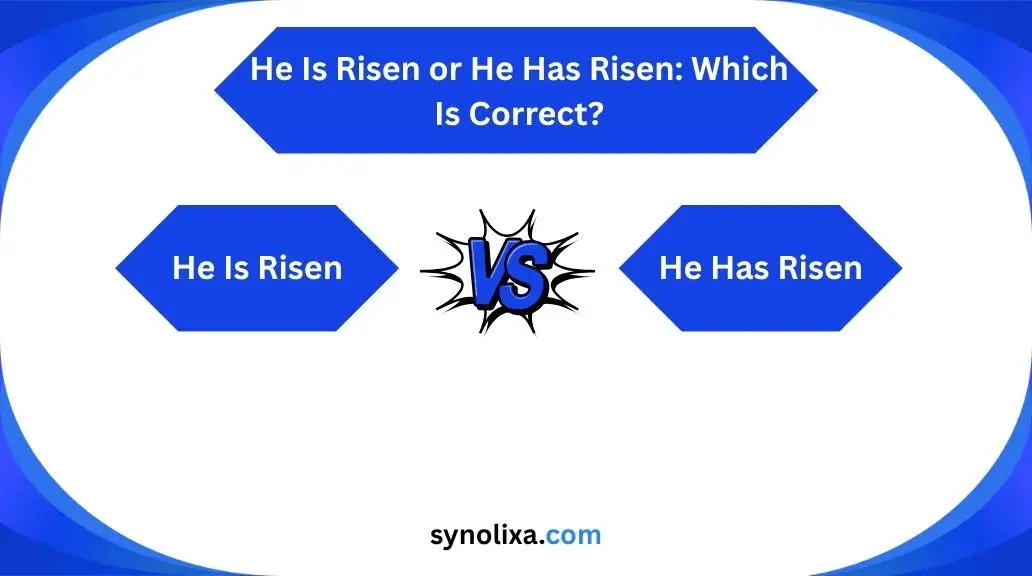
Have you ever wondered whether the correct phrase is “he is risen” or “he has risen”? 🤔 These two expressions look almost identical, but they come from different grammatical patterns and can carry slightly different tones. The confusion becomes even stronger because both phrases can be found in real English, especially when discussing religious or biblical language.
The good news is that you do not have to guess. “He has risen” is the standard modern present-perfect construction, while “he is risen” is also a legitimate expression, particularly in traditional, literary, and Christian contexts. The difference is not simply that one is “right” and the other is “wrong.”
The verb rise is irregular. Its principal forms are rise, rose, risen. Merriam-Webster identifies risen as the past participle of rise and defines rise as including the meaning “to return from death.”
So, which one should you use? The answer depends on the context, the style of English you want, and the meaning you want to emphasize. Let’s break it down clearly. Emasculate or Demasculate | Impatient vs Inpatient | Reevaluation or Re-Evaluation
Quick Answer: He Is Risen or He Has Risen?
“He has risen” is the usual modern English form when you want to say that someone rose and that the result is relevant now.
“He is risen” is also grammatically acceptable, but it is more traditional, formal, literary, and strongly associated with Christian religious language. It presents the person as being in a risen state.
For example:
- He has risen from the dead. ✅ Standard modern English.
- He is risen. ✅ Traditional and grammatically valid, especially in Christian usage.
- He rose from the dead. ✅ Simple past and completely correct.
The key point is that “he is risen” should not automatically be labeled incorrect. It has a long-established grammatical and religious use.
Understanding the Basics: He Is Risen or He Has Risen
To understand the difference, first look at the forms of the irregular verb rise.
| Form | Type | Meaning | Example | Correct/Incorrect |
|---|---|---|---|---|
| rise | Base form | Move upward or get up | I rise early. | ✅ Correct |
| rose | Simple past | Moved upward or got up in the past | He rose early. | ✅ Correct |
| risen | Past participle | Used with auxiliary verbs | He has risen. | ✅ Correct |
| rising | Present participle | Continuing upward movement | He is rising. | ✅ Correct |
| is risen | Be + past participle/state expression | Is in a risen state; traditional usage | He is risen. | ✅ Correct |
| has risen | Have + past participle/present perfect | Rose, with present relevance | He has risen. | ✅ Correct |
The Basic Verb Pattern
The verb rise follows this pattern:
rise → rose → risen
For example:
- Present: He rises early.
- Past: He rose early.
- Present perfect: He has risen early.
- Present participle: He is rising.
Merriam-Webster gives rise as an irregular verb with the forms rise, rose, risen, rising.
This is important because risen cannot normally stand alone as a simple past verb.
You should not write:
He risen yesterday. ❌
Instead, write:
He rose yesterday. ✅
Or:
He has risen. ✅
The auxiliary verb changes the grammatical structure.
What Does “He Has Risen” Mean?
“He has risen” uses the present perfect tense.
The structure is:
Subject + has + past participle
So:
- He = subject
- has = auxiliary verb
- risen = past participle of rise
Therefore:
He has risen.
means that he rose at some point before now, with the result or significance connected to the present.
Merriam-Webster’s examples include constructions such as “The book has risen to the top of best-seller lists,” demonstrating the normal modern pattern of has + risen.
Example 1: Physical Movement
The sun has risen.
This means the sun has come above the horizon, and it is now up.
Example 2: A Person Getting Up
He has risen from his chair.
This means he got up from the chair, and the action has relevance to the current situation.
Example 3: Religious Context
He has risen from the dead.
Here, the present-perfect construction communicates that the rising occurred and its result continues to matter now.
Why “Has” Matters
The word has helps create the present perfect.
Compare:
He rose.
He has risen.
He rose simply reports a completed past event.
He has risen connects that past event to the present.
That distinction is one reason “He has risen” is the natural choice in ordinary modern English when you want a present-perfect construction.
What Does “He Is Risen” Mean?
“He is risen” is a more unusual construction in modern everyday English, but it is not simply a grammatical mistake.
It is especially familiar in Christian language.
The expression can be understood as describing someone as being in a risen state. In this interpretation, risen functions similarly to a participial adjective or resultative description.
For example:
The door is closed.
Here, closed describes the state of the door.
Similarly:
The man is seated.
Seated describes his current state.
In:
He is risen.
risen can describe the state of the person after rising.
This helps explain why the expression can sound natural in traditional religious language even though modern speakers more commonly say:
He has risen.
Traditional Religious Usage
“He is risen” has a strong association with Christian Easter language and traditional translations or liturgical expressions.
That association gives the phrase a special stylistic character. It often sounds solemn, ceremonial, biblical, or poetic.
So if you encounter:
He is risen!
you should not assume that the writer has made a grammatical error.
The expression has an established history and meaning.
Is “He Is Risen” Grammatically Correct?
Yes. “He is risen” can be grammatically correct.
However, its grammatical structure is different from the standard modern present-perfect construction “He has risen.”
The easiest way to understand the difference is this:
“He has risen”
This emphasizes the action or event.
He has risen.
The person has undergone the action of rising.
“He is risen”
This can emphasize the resulting state.
He is risen.
The person is now in a risen state.
This distinction is subtle, and in many religious contexts the two expressions communicate essentially the same central idea.
The major difference is style and grammatical construction, not simply correctness.
Why Does “He Is Risen” Sound So Old-Fashioned?
If you are accustomed to contemporary American English, “He is risen” may sound unusual.
That is because modern English usually uses have to form the present perfect with rise:
He has risen.
The construction “is + past participle” is much less common with this verb in contemporary English.
However, older varieties of English used be as an auxiliary with certain verbs of movement and change of state. Older English could therefore produce constructions that sound unusual to modern speakers.
Over time, English grammar shifted toward more widespread use of have in perfect constructions.
As a result, modern speakers generally expect:
He has risen.
rather than:
He is risen.
But older expressions can survive in religious, literary, and ceremonial language.
That is exactly why “He is risen” remains recognizable and meaningful today.
Correct Meanings and Uses
1. Use “He Has Risen” for Standard Modern English
If you are writing ordinary modern American English, “he has risen” is usually the safest choice when you mean that he rose and the result matters now.
Examples:
He has risen from his seat.
He has risen above the difficulties he faced.
The leader has risen to a position of influence.
The sun has risen over the mountains.
These examples follow the modern present-perfect structure.
Merriam-Webster provides examples such as “The book has risen to the top of best-seller lists,” showing that has risen is a normal contemporary construction.
2. Use “He Is Risen” for Traditional Religious Language
If you are writing an Easter greeting, religious message, sermon title, church announcement, or traditional Christian statement, “He is risen” can be completely appropriate.
Examples:
He is risen!
Rejoice, for He is risen.
We celebrate because He is risen.
This form has a distinctive religious tone.
It can sound more ceremonial and traditional than:
He has risen.
Neither expression needs to be treated as a simple grammatical error.
3. Use “He Rose” for a Simple Past Event
Sometimes neither expression is necessary.
If you are simply describing an event that happened in the past, use:
He rose.
For example:
He rose from his chair at noon.
He rose early yesterday.
He rose to speak before the audience.
The simple past form is rose, not risen.
This is one of the most important rules to remember:
rise → rose → risen
Sentence Breakdown: He Has Risen
Consider:
He has risen from the dead.
Break it into parts:
- He = subject
- has = auxiliary verb
- risen = past participle
- from the dead = prepositional phrase
The grammatical pattern is:
Subject + has + past participle
This is the present perfect.
The sentence communicates a completed event with significance connected to the present.
Sentence Breakdown: He Is Risen
Now consider:
He is risen.
Break it into parts:
- He = subject
- is = linking verb
- risen = participial adjective/state description
The sentence presents the subject as being in a risen condition.
This is why the sentence can function differently from a normal present-perfect construction.
Compare:
He has risen.
with:
He is risen.
The first focuses more directly on the completed action.
The second can focus on the resulting condition.
In ordinary conversation, this distinction may not matter much. In religious or literary writing, however, the stylistic difference can be important.
Test Tip: How Can You Choose the Right Form?
Try replacing the phrase with a simpler verb.
If you mean:
He has completed the action.
then “He has risen” is likely appropriate.
If you mean:
He is now in the resulting condition.
then “He is risen” may work, particularly in traditional or religious language.
Another useful test is to ask:
Am I writing modern everyday English or traditional religious English?
Modern everyday English
Choose:
He has risen.
Traditional Christian expression
Choose:
He is risen.
Simple past event
Choose:
He rose.
This three-way distinction makes the choice much easier.
Case Study: A Real-Life Conversation
Imagine a family discussing Easter.
One person says:
“What should we write on the church bulletin?”
Another replies:
“How about ‘He is risen’?”
That wording works well because the goal is not merely to report an event. The phrase is a traditional religious declaration.
Now imagine a student writing a general English essay:
“The character has risen from poverty and become a successful leader.”
Here, “has risen” is clearly the natural modern choice.
The student would probably not write:
“The character is risen from poverty.”
That would sound unnatural because the context is not traditional or religious.
This shows that context matters.
The two expressions are not interchangeable in every sentence.
Grammar Rules: Why “Has Risen” Is Usually Preferred
Modern English generally uses have/has + past participle for the present perfect.
Examples include:
- He has gone.
- She has arrived.
- He has written.
- She has spoken.
- He has risen.
The verb rise has risen as its past participle. Merriam-Webster explicitly lists the forms rise, rose, risen, rising.
Therefore:
He has risen. ✅
is a straightforward present-perfect construction.
The pattern is:
has + risen
not:
has + rose
So:
He has rose. ❌
is incorrect.
The correct sentence is:
He has risen. ✅
Why “He Has Rose” Is Wrong
This mistake happens because people remember that rose is the past form.
But the present perfect requires the past participle, not the simple past.
Compare:
| Tense | Correct Form |
|---|---|
| Simple present | He rises. |
| Simple past | He rose. |
| Present perfect | He has risen. |
| Past perfect | He had risen. |
| Future perfect | He will have risen. |
Collins’ conjugation table likewise gives rose as the past form and risen as the past participle, with he has risen as the present perfect.
Common Mistakes
Several mistakes commonly appear when people use rise.
Mistake 1: He Has Rose
He has rose. ❌
Correct:
He has risen. ✅
Why?
Because has requires the past participle in the present perfect.
Mistake 2: He Risen
He risen. ❌
Correct:
He rose. ✅
or:
He has risen. ✅
The word risen normally needs an appropriate auxiliary verb.
Mistake 3: He Is Risen Is Always Wrong
He is risen. ❌
This blanket correction is inaccurate.
“He is risen” can be grammatically valid, especially as a traditional Christian expression.
It simply does not function like the ordinary modern present perfect.
Mistake 4: He Is Rose
He is rose. ❌
Correct:
He is rising. ✅
or:
He has risen. ✅
or, in traditional religious usage:
He is risen. ✅
Why Do These Mistakes Happen?
Grammar mistakes involving rise are common because it is an irregular verb.
Fast Typing
When people type quickly, they may choose the first form that comes to mind.
For example:
He has rose…
instead of:
He has risen…
Autocorrect
Autocorrect can sometimes encourage an incorrect form because it may not understand the intended grammatical structure.
Lack of Knowledge
Some writers simply memorize rise and rose but forget the third form:
risen
Learning all three forms together solves much of the problem.
Religious Familiarity
People who frequently hear “He is risen” may naturally use it in other situations where “has risen” would sound more appropriate.
That is not surprising. Familiar phrases strongly influence how we write and speak.
Similar Grammar Confusions
The confusion between “he is risen” and “he has risen” is part of a larger pattern in English: two forms can look or sound similar but perform different grammatical jobs.
| Confusion | Correct Choice | Basic Rule |
|---|---|---|
| its / it’s | Depends on meaning | It’s = it is; its = possession |
| your / you’re | Depends on meaning | You’re = you are; your = possession |
| their / they’re | Depends on meaning | They’re = they are; their = possession |
| then / than | Depends on meaning | Then = time; than = comparison |
| rise / raise | Depends on meaning | Rise usually has no direct object; raise takes one |
| rose / risen | Depends on tense | Rose = simple past; risen = past participle |
| lay / lie | Depends on usage | Different verb forms and meanings |
| affect / effect | Depends on function | Usually verb vs. noun, with exceptions |
Learning these distinctions improves both everyday writing and formal communication.
Rise vs. Raise: Another Important Difference
People sometimes confuse rise with raise.
The difference is useful here because raise has its own verb pattern.
Rise
Rise is generally intransitive. It does not normally take a direct object.
The sun rises.
Prices rise.
He rose from his chair.
Raise
Raise is transitive. It normally takes a direct object.
She raised her hand.
They raised the flag.
He raised the question.
Merriam-Webster defines raise as a transitive verb and includes meanings such as causing something to rise or lifting something higher.
So:
He raised from his chair. ❌
should be:
He rose from his chair. ✅
Usage in Different Contexts
Everyday Conversation
In everyday American English, “he has risen” is usually more natural when you are using the present perfect.
For example:
He has risen from his seat.
However, if you simply mean that someone got up, Americans might often say:
He got up.
This is another reason “he is risen” can sound unusual in casual speech.
Professional Writing
In professional writing, use “he has risen” when the present perfect is appropriate.
For example:
The candidate has risen rapidly through the organization.
The company’s profile has risen significantly in recent years.
These sentences sound natural and professional.
“He is risen” would generally be unsuitable unless the professional document specifically discusses religious, historical, literary, or ceremonial language.
Creative Writing
Creative writing gives you more freedom.
An author might deliberately write:
He is risen.
to create an old-fashioned, solemn, poetic, or religious mood.
Alternatively:
He has risen.
may sound more contemporary.
In creative writing, the choice can therefore become a matter of voice and atmosphere.
Social Media and Texting
Social media depends heavily on context.
For an Easter post, someone might write:
He is risen! ✨
That sounds traditional and recognizable.
For a general statement about personal growth, someone might write:
He has risen above every challenge.
That sounds modern and natural.
The context determines which expression feels appropriate.
Why “He Is Risen” Matters in Religious Writing
The phrase “He is risen” carries more than ordinary grammatical meaning.
Because of its long association with Christian Easter traditions, it has become a recognizable expression of faith and celebration.
This means changing it to “He has risen” may preserve the basic idea but change the tone.
For example:
He is risen!
sounds like a traditional proclamation.
Meanwhile:
He has risen.
sounds more like a modern statement describing what happened.
Both can communicate the resurrection, but their rhetorical effects differ.
That distinction matters when writing:
- Easter cards
- church announcements
- religious social media posts
- sermons
- devotional material
- Christian artwork
- ceremonial messages
- theological discussions
Why It Matters: Clarity and Professionalism
Grammar matters because small changes can affect meaning, tone, and style.
Using the appropriate form helps readers understand exactly what you intend.
1. Clarity
Readers can quickly recognize whether you are describing an action, a state, or a traditional expression.
2. Professionalism
Correct grammar makes formal writing easier to trust.
3. Digital Communication
In emails, captions, websites, and social media posts, wording matters because readers often have little context.
4. Tone
“He is risen” has a traditional and ceremonial tone.
“He has risen” sounds more modern and grammatical in ordinary present-perfect usage.
A useful principle is:
Good grammar does more than avoid mistakes; it helps your words communicate the intended meaning and tone.
Special Exception: “He Is Risen” as a Traditional Expression
The biggest exception to the usual modern pattern is the established phrase “He is risen.”
It is particularly associated with Christian Easter language.
This does not mean that is risen should be substituted freely for has risen in every modern sentence.
For example:
The price is risen. ❌
That is not standard contemporary English.
Instead:
The price has risen. ✅
Likewise:
The temperature has risen. ✅
not:
The temperature is risen. ❌
The special acceptability of “He is risen” is strongly connected to its traditional and religious usage.
This is a good example of how language contains expressions that have survived because of history, literature, religion, or cultural tradition.
Is “He Is Risen” the Same as “He Has Risen”?
In many religious contexts, the practical message is very similar.
Both can communicate that the person rose from death.
However, their grammatical presentation differs.
He has risen emphasizes the completed action and its present relevance.
He is risen presents the person as being in a risen state and carries a traditional, ceremonial tone.
So it is better to say:
They communicate closely related ideas but use different grammatical constructions and styles.
rather than saying:
One is right and the other is wrong.
That oversimplification misses an important part of English usage.
He Rose vs. He Has Risen vs. He Is Risen
These three expressions are worth comparing.
| Expression | Main Function | Tone | Example |
|---|---|---|---|
| He rose | Simple past | Neutral | He rose from his chair. |
| He has risen | Present perfect | Modern, standard | He has risen from his chair. |
| He is risen | Risen-state expression/traditional form | Religious, literary, ceremonial | He is risen! |
He Rose
Use this when reporting a completed past event.
He rose at dawn.
He Has Risen
Use this when connecting the completed action to the present.
He has risen from his seat.
He Is Risen
Use this when describing the risen state, particularly in established religious language.
He is risen!
Understanding these three options makes the entire topic much easier.
Quick Recap Checklist
Use this checklist when you are unsure.
| Question | If Yes → Use |
|---|---|
| Am I describing a completed action with present relevance? | He has risen |
| Am I writing ordinary modern English? | Usually He has risen |
| Am I describing a simple past event? | He rose |
| Am I writing a traditional Christian Easter message? | He is risen |
| Am I intentionally using solemn or biblical-style language? | He is risen |
| Am I using the past participle after “has”? | risen, not rose |
Practice Example 1
The sun ___ above the horizon.
Correct:
The sun has risen above the horizon.
Practice Example 2
Yesterday, he ___ from his chair.
Correct:
Yesterday, he rose from his chair.
Practice Example 3
Easter celebration: “___!”
Correct:
He is risen!
The context tells you which construction fits.
Easy Memory Trick
Remember the three forms:
RISE → ROSE → RISEN
Think:
Today → Yesterday → Has
- Today: rise
- Yesterday: rose
- Has/have/had: risen
Examples:
He rises early.
He rose early yesterday.
He has risen already.
This simple pattern can prevent many common errors.
And when you see the traditional phrase:
He is risen!
remember that it is a special, established expression rather than an ordinary replacement for every use of has risen.
FAQs
1. Is “He has risen” grammatically correct?
Yes. “He has risen” is grammatically correct and is the standard present-perfect construction. It uses has plus the past participle risen.
Example:
He has risen from the dead.
2. Is “He is risen” grammatically correct?
Yes. “He is risen” can be grammatically correct, particularly as a traditional Christian expression. It is much less common in ordinary modern English and has a formal, religious, or literary tone.
3. Which is better: “He is risen” or “He has risen”?
For ordinary modern English, “He has risen” is generally the better choice.
For a traditional Christian or Easter expression, “He is risen” is entirely appropriate.
The choice depends on context and intended tone.
4. Why do Christians say “He is risen”?
“He is risen” is an established traditional Christian expression associated especially with the resurrection of Jesus. The phrase emphasizes the risen state and has a solemn, ceremonial quality.
It should not automatically be corrected to “He has risen.”
5. Is “He has rose” correct?
No.
He has rose. ❌
The correct form is:
He has risen. ✅
The verb forms are:
rise → rose → risen
Because has requires the past participle, you need risen.
6. Should I write “He rose” or “He has risen”?
Use “He rose” for a simple past event:
He rose from his chair yesterday.
Use “He has risen” for the present perfect:
He has risen from his chair.
The two forms differ in tense and emphasis.
Conclusion
The choice between “he is risen or he has risen” becomes much easier once you understand the grammar and context behind each expression.
“He has risen” is the standard modern present-perfect construction. It follows the familiar pattern has + past participle, with risen being the past participle of rise. Merriam-Webster lists the verb forms as rise, rose, risen, rising and includes “to return from death” among the meanings of rise.
“He is risen” is also a valid and established expression, especially in traditional Christian and Easter language. It presents the person as being in a risen state and carries a solemn, ceremonial, or biblical tone.
If you are writing ordinary modern American English, “He has risen” is usually the safest choice. If you are writing a traditional Christian message, “He is risen” can be exactly the right expression.
And remember the essential verb pattern:
Rise → Rose → Risen.
When in doubt, let the context guide you: “He rose” for simple past, “he has risen” for modern present perfect, and “he is risen” for its established traditional or religious use. Once you learn that distinction, this common grammar question becomes simple.

Hi, I am Ava Mitchell. I work at Synolixa as an English content writer, creating simple and useful resources about synonyms, vocabulary, and English usage.