Have you ever stopped while writing a sentence and wondered whether you should say “introduction to” or “introduction of”? 🤔 These two phrases look almost identical, but they usually serve different purposes. The good news is that the difference becomes simple once you focus on what comes after the word introduction.
Use “introduction to” when you mean becoming familiar with, learning about, or being presented to a person, subject, activity, or field. For example, “This course is an introduction to biology.” Use “introduction of” when you mean bringing something new into use, presenting something formally, or the act of introducing a particular thing. For example, “The introduction of new software improved productivity.”
The confusion often happens because introduction has several related meanings. It can refer to a beginning, a first experience, a formal presentation, or the act of bringing something into use. Standard dictionary definitions support these different uses.
So, “introduction to” and “introduction of” are both correct. The right choice depends on the meaning you want to express. Imitated vs Intimated | In the Street or On the Street | He Is Risen or He Has Risen
Quick Answer: Introduction to or Introduction of
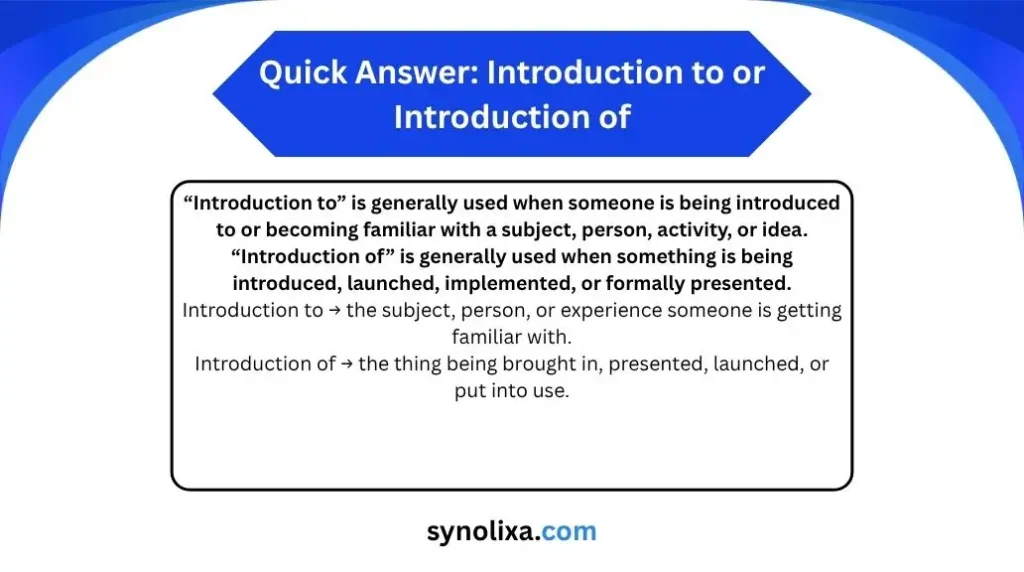
“Introduction to” is generally used when someone is being introduced to or becoming familiar with a subject, person, activity, or idea. “Introduction of” is generally used when something is being introduced, launched, implemented, or formally presented.
- Introduction to → the subject, person, or experience someone is getting familiar with.
- Introduction of → the thing being brought in, presented, launched, or put into use.
Examples:
- This is my introduction to photography.
- The introduction of new safety rules improved the workplace.
A simple way to remember the difference is:
to = toward knowledge or experience
of = the thing being introduced
Understanding the Basics: Introduction to or Introduction of
The easiest way to understand introduction to or introduction of is to look at the relationship between introduction and the noun that follows it.
What Does “Introduction to” Mean?
Introduction to usually means a first experience, basic knowledge, or an initial presentation involving a person, subject, activity, or idea.
For example:
This book is an introduction to economics.
The phrase tells us what the book helps the reader learn about. The reader is moving toward a basic understanding of economics.
Other examples include:
- an introduction to mathematics
- an introduction to cooking
- an introduction to American history
- an introduction to a new subject
- an introduction to the team
- an introduction to classical music
Cambridge Dictionary lists “introduction to” for meanings involving a first experience and basic knowledge, such as an introductory course or a first encounter with something.
What Does “Introduction of” Mean?
Introduction of usually identifies the thing that is being introduced, brought into use, presented, or launched.
For example:
The introduction of the new policy changed the process.
Here, the new policy is the thing that was introduced.
Other examples include:
- the introduction of a new product
- the introduction of new rules
- the introduction of a new system
- the introduction of technology
- the introduction of a new law
- the introduction of a new service
Cambridge Dictionary specifically gives “introduction of” in contexts where something is put into use or brought to a place for the first time.
Comparison Table
| Form | Type | Meaning | Example | Correct/Incorrect |
|---|---|---|---|---|
| introduction to | Prepositional phrase | Learning about or becoming familiar with something | This is an introduction to chemistry. | ✅ Correct |
| introduction to | Prepositional phrase | First experience with something | That trip was my introduction to skiing. | ✅ Correct |
| introduction to | Prepositional phrase | Being presented to a person | She received an introduction to the manager. | ✅ Correct |
| introduction of | Prepositional phrase | Bringing something into use | The introduction of new software helped the company. | ✅ Correct |
| introduction of | Prepositional phrase | Launching or presenting something | The introduction of the product attracted attention. | ✅ Correct |
| introduction of | Prepositional phrase | Bringing in a new rule or system | The introduction of new regulations caused debate. | ✅ Correct |
| introduction of for a course topic | Usually unnatural | Describing basic study of a subject | This is an introduction of biology. | ❌ Usually incorrect |
| introduction to for a newly launched product | Often changes the intended meaning | Identifying the product being launched | The introduction to the new phone was successful. | ⚠️ Context-dependent |
The important point is that neither preposition is automatically “correct” or “incorrect.” The intended meaning determines the appropriate choice.
Correct Meanings & Uses
1. Use “Introduction to” for a Subject
One of the most common uses of introduction to is when referring to basic knowledge about a subject.
Examples:
This course is an introduction to psychology.
The textbook provides an introduction to American literature.
We need an introduction to basic accounting.
In each sentence, the noun after to is the subject being studied.
Sentence Breakdown
This course = subject
is = linking verb
an introduction = noun phrase
to psychology = identifies the subject
The meaning is essentially:
This course helps beginners learn the basics of psychology.
That is why introduction to is common in course names, textbooks, tutorials, and educational materials.
2. Use “Introduction to” for a First Experience
Introduction to can also describe someone’s first experience with something.
For example:
My first trip to New York was my introduction to American city life.
That class was my introduction to computer programming.
The documentary was her introduction to marine biology.
Here, introduction means a first experience or first exposure.
Cambridge Dictionary recognizes this sense of introduction to, describing it as a person’s first experience of something.
Why “to” Works
Think about the expression:
“I was introduced to something.”
For example:
I was introduced to jazz.
The noun version naturally becomes:
My introduction to jazz was exciting.
This connection between introduce someone to something and introduction to something can make the pattern easier to remember.
3. Use “Introduction to” for Meeting a Person
The phrase can also refer to being introduced to another person.
For example:
I received an introduction to the company’s director.
Her introduction to the new team was brief but friendly.
The conference included an introduction to several industry leaders.
The verb pattern is also familiar:
She introduced me to her colleague.
So the noun phrase can use:
an introduction to her colleague
Cambridge gives examples of introduction to in the sense of meeting or being presented to another person.
4. Use “Introduction of” for Something New
Now consider a different meaning.
Suppose a company starts using a new computer system:
The introduction of the new computer system improved efficiency.
Here, the new computer system is being brought into use.
This is a classic use of introduction of.
Other examples:
The introduction of electric buses reduced fuel use.
The introduction of new software changed the workflow.
The introduction of the new policy created several questions.
The introduction of digital payments made transactions easier.
The pattern is:
introduction of + thing being introduced
5. Use “Introduction of” for New Rules or Policies
Professional and government writing frequently uses introduction of when discussing a new rule, policy, procedure, or system.
Examples:
The introduction of new workplace rules improved safety.
The introduction of the policy caused some confusion.
The introduction of stricter standards changed the process.
The introduction of a new training program helped employees.
In these examples, the focus is not on learning about the rule. The focus is on the act of bringing the rule into existence or use.
Cambridge’s definitions include the introduction of new working practices, systems, rules, and other things that are brought into use.
6. Use “Introduction of” for Products
When a company launches or makes a product available for the first time, introduction of is often appropriate.
For example:
The introduction of the new laptop attracted customers.
The company announced the introduction of a new product.
The introduction of the service expanded the company’s offerings.
Here, the product or service is the thing being introduced.
This meaning is especially common in business and marketing writing.
7. “Introduction to” and “Introduction of” Can Appear in the Same Topic
Sometimes both phrases can be correct in the same general situation because they emphasize different things.
Compare:
The introduction of the new software was successful.
This means the software was brought into use or launched.
Now compare:
The training session provided an introduction to the new software.
This means people learned the basics of the software.
Notice the difference:
Introduction of the software
→ The software was launched or implemented.
Introduction to the software
→ People became familiar with the software.
This is one of the most useful distinctions to remember.
Test Tip: How to Choose the Right Preposition
When you’re unsure whether to use to or of, ask yourself one question:
“Am I talking about learning/experiencing something, or am I talking about the thing being introduced?”
If you mean learning about or becoming familiar with something, choose:
introduction to
If you mean bringing, launching, implementing, or presenting something, choose:
introduction of
Quick Test
Try these:
- This class is an introduction ___ biology.
- The introduction ___ the new policy changed the workplace.
- That trip was my introduction ___ skiing.
Answers:
- to → introduction to biology
- of → introduction of the new policy
- to → introduction to skiing
Case Study: A Workplace Example
Imagine that a company has purchased a new project-management system.
The manager sends an email:
“Next Monday, we will begin using the new system.”
The company might describe this event as:
The introduction of the new project-management system
Why?
Because the company is bringing the system into use.
However, the manager may also schedule a training session called:
An Introduction to the New Project-Management System
Why?
Because employees will learn how the system works.
The Difference in One Workplace
The introduction of the new system
= the system is being implemented.
An introduction to the new system
= employees are learning about it.
This example shows why introduction to or introduction of is not simply a matter of choosing one “correct” phrase. Both can be correct when their meanings are different.
Grammar Rules Explanation
Why Does “Introduction” Work With Both “To” and “Of”?
The noun introduction can express several related ideas.
It can refer to:
- a beginning
- a first experience
- basic knowledge
- a formal presentation
- the act of putting something into use
Because these meanings are different, English uses different prepositions to establish the relationship between introduction and the following noun.
Cambridge Dictionary lists meanings of introduction that include a first part of something, a first experience, basic knowledge, formally presenting people, and putting something into use.
The “To” Pattern
A useful pattern is:
introduction to + subject/person/activity
Examples:
- introduction to English grammar
- introduction to business
- introduction to photography
- introduction to the team
- introduction to programming
The focus is usually on the person, subject, or experience that someone is being introduced to.
The “Of” Pattern
A useful pattern is:
introduction of + thing being introduced
Examples:
- introduction of a new law
- introduction of new technology
- introduction of a new product
- introduction of new procedures
- introduction of a new system
The focus is on the thing that is being brought in, launched, or implemented.
Connection With the Verb “Introduce”
The verb introduce has similar patterns.
For example:
The company introduced a new system.
The noun version can be:
The introduction of a new system was successful.
Cambridge defines introduce as putting something into use for the first time, as well as telling someone another person’s name when they first meet. It also recognizes introduce someone to something for helping someone experience something for the first time.
This gives you a useful grammar connection:
introduce something → introduction of something
introduce someone to something → introduction to something
Common Mistakes With “Introduction to or Introduction of”
Many errors happen because to and of can both sound natural after introduction.
Mistake 1: Using “of” for a Learning Course
❌ This is an introduction of biology.
In most educational contexts, this sounds unnatural because the course is not introducing biology as a new product or system.
Better:
✅ This is an introduction to biology.
Mistake 2: Using “to” for Implementation
❌ The introduction to the new regulations caused major changes.
If the intended meaning is that the regulations were officially brought into effect, of is usually clearer:
✅ The introduction of the new regulations caused major changes.
Mistake 3: Assuming One Phrase Is Always Correct
Neither introduction to nor introduction of is always correct.
The meaning determines the choice.
Why These Mistakes Happen
Fast Typing
When people type quickly, they often choose the first preposition that comes to mind.
Autocorrect
Autocorrect can change words or phrases without making the writer notice.
Lack of Knowledge
Many learners memorize the word introduction but do not learn the different patterns that follow it.
Similar Sentence Structures
Because both phrases contain the same noun, they can look interchangeable even when their meanings differ.
Similar Grammar Confusions
| Confusion | Correct Choice | Example |
|---|---|---|
| introduction to / introduction of | Depends on meaning | Introduction to biology / introduction of a new law |
| it’s / its | Depends on meaning | It’s cold. / Its color is blue. |
| your / you’re | Depends on meaning | Your book / You’re ready. |
| their / they’re | Depends on meaning | Their house / They’re here. |
| affect / effect | Depends on grammatical role | It affected me. / The effect was clear. |
| advice / advise | Noun vs. verb | I need advice. / I advise you to wait. |
| practice / practise | US English uses “practice” for both noun and verb | I practice daily. |
| then / than | Time vs. comparison | First this, then that. / Taller than me. |
The broader lesson is simple: similar-looking expressions do not always have identical grammatical functions.
Usage in Different Contexts
Everyday Conversation
In everyday English, introduction to is common when discussing a first experience.
Examples:
That movie was my introduction to science fiction.
This was my first introduction to hiking.
She gave me an introduction to her friends.
Introduction of is more likely when discussing a new change or addition.
The introduction of the new schedule caused confusion.
Professional Writing
Professional writing frequently uses both expressions.
Introduction to
Use it for:
- training
- courses
- presentations
- basic information
- learning materials
Example:
The company offers an introduction to workplace safety.
Introduction of
Use it for:
- policies
- procedures
- technology
- products
- services
- systems
Example:
The introduction of the new software improved communication.
This distinction can make professional writing more precise.
Creative Writing
Creative writing may use introduction to when describing a character’s first experience.
The old library became her introduction to forgotten stories.
Introduction of can be used when describing the arrival or presentation of something:
The introduction of the mysterious character changed the mood of the story.
Writers have more flexibility, but the underlying meanings remain useful.
Social Media and Texting
In casual writing, people often shorten introduction to intro.
For example:
“This playlist was my intro to jazz.”
Cambridge Dictionary recognizes intro as an informal short form of introduction, including uses related to first experiences and basic knowledge.
However, for formal writing, introduction is usually preferable.
Why It Matters
Choosing between introduction to and introduction of matters because a small preposition can change the meaning of an entire sentence.
Compare:
Introduction to the new system
This suggests learning about or becoming familiar with the system.
Introduction of the new system
This suggests launching, implementing, or bringing the system into use.
The difference is small in spelling but significant in meaning.
Clarity in Communication
Precise grammar helps readers understand your intended meaning without guessing.
Professionalism
Correct word combinations make workplace writing sound more polished and confident.
Digital Communication
Emails, websites, reports, posts, and online courses often depend on short sentences. When every word carries meaning, choosing the right preposition becomes especially important.
A useful principle is:
Clear writing makes the intended meaning easy to see.
Special Exception and Edge Cases
There is no major grammatical exception that makes introduction to or introduction of universally interchangeable. However, context can create phrases where both prepositions are grammatically possible but communicate different ideas.
Consider:
an introduction to the product
This could refer to information that helps someone become familiar with the product.
Now:
the introduction of the product
This normally refers to the product being launched, released, or brought into use.
Another important point is that introduction can have meanings beyond these two patterns. It can refer to the beginning of a book, speech, song, or other work. For example:
The introduction to the book explains the author’s purpose.
Here, to identifies the larger work connected to its opening section. Cambridge Dictionary defines an introduction as the first part of something and provides examples involving introductions to books and other works.
So, always consider the complete sentence rather than memorizing a single rule.
Introduction to or Introduction of: Quick Recap Checklist
Use this checklist whenever you’re unsure.
| Question | If Yes → Use |
|---|---|
| Is someone learning the basics of a subject? | introduction to |
| Is someone experiencing something for the first time? | introduction to |
| Is someone being presented to another person? | introduction to |
| Is a new system being implemented? | introduction of |
| Is a new product being launched? | introduction of |
| Is a new policy being brought into use? | introduction of |
| Is a new rule being established? | introduction of |
| Are you describing the beginning of a book or subject? | Usually introduction to + noun |
Practice Examples
Example 1
This course is an ________ computer science.
Answer: introduction to
Example 2
The ________ the new policy caused several changes.
Answer: introduction of
Example 3
That documentary was my ________ marine biology.
Answer: introduction to
Easy Memory Trick
Remember:
TO = where your knowledge or experience is directed.
OF = what is being introduced.
FAQs
Is “introduction to” correct?
Yes. Introduction to is correct when you mean becoming familiar with, learning about, or having a first experience with a subject, person, activity, or idea.
Example:
This is an introduction to American history.
Is “introduction of” correct?
Yes. Introduction of is correct when referring to something being brought into use, launched, implemented, or formally presented.
Example:
The introduction of new technology changed the workplace.
What is the difference between “introduction to” and “introduction of”?
Introduction to usually focuses on the person, subject, or experience someone is becoming familiar with. Introduction of usually focuses on the thing being introduced or brought into use.
Should I say “an introduction to English” or “an introduction of English”?
For a course, lesson, book, or basic overview of the language, say:
an introduction to English
“An introduction of English” would normally suggest that English itself is being introduced or presented in a different sense.
Should I say “the introduction of a new policy”?
Yes. The introduction of a new policy is a standard construction when you mean that the policy is being brought into effect or officially introduced.
Example:
The introduction of a new policy improved workplace safety.
Is “introduction to” used for people?
Yes. Introduction to can be used when someone is formally or informally presented to another person.
For example:
Her introduction to the new manager went smoothly.
The verb pattern is also common:
She introduced me to the new manager.
Can “introduction to” and “introduction of” be used in the same sentence?
Yes, if they express different meanings.
For example:
The introduction of the new software included an introduction to its main features.
The first phrase refers to the software being launched or implemented. The second refers to learning about the software.
Conclusion
Understanding introduction to or introduction of becomes much easier when you focus on meaning rather than memorizing a rigid rule. Both expressions are grammatically correct, but they normally serve different purposes.
Use introduction to when you mean learning about something, becoming familiar with something, having a first experience, or being introduced to a person or subject. For example, “This course is an introduction to biology.”
Use introduction of when you mean bringing something into use, launching it, implementing it, or formally presenting it. For example, “The introduction of the new system improved efficiency.”
The simplest memory trick is this: “to” points toward the subject or experience, while “of” identifies the thing being introduced. Once you understand that distinction, choosing the right phrase becomes much more natural.
Good grammar is not about making writing complicated. It is about making your meaning clear. When you choose the right preposition, your sentence does the explaining for you. ✨
Remember: introduction to = learning or experiencing; introduction of = bringing or presenting.

Hi, I am Noah Harrison. I work at Synolixa as an English language editor, reviewing and creating helpful content to make English learning easier and clearer.

[…] meaning, grammar rules, common mistakes, examples, and easy ways to remember the difference. ✨ Introduction to or Introduction of | Imitated vs Intimated | In the Street or On the […]