Have you ever written a sentence about people walking past an accident, store, park, or street performance and suddenly wondered, “Is it passerbyers, passersby, or passerby?” 🤔 You are not alone. This word causes confusion because its plural form does not follow the usual rule of simply adding -s or -es at the end. English has several unusual plural nouns, and passerby is one of them.
The good news is that the rule is simple once you understand how the word is built. Passerby is the correct singular form, while passersby is the correct plural form. Passerbyers is not standard English and should not be used when you mean more than one person passing by.
Understanding passerbyers or passersby or passerby can improve your grammar, writing accuracy, and confidence. Whether you are writing an email, school assignment, news report, social media post, or story, choosing the correct form helps your message sound natural and professional. Let’s break down the rule step by step. ✍️ Brite vs Bright | By Which or In Which | At the House or In the House
Quick Answer: Passerbyers or Passersby or Passerby
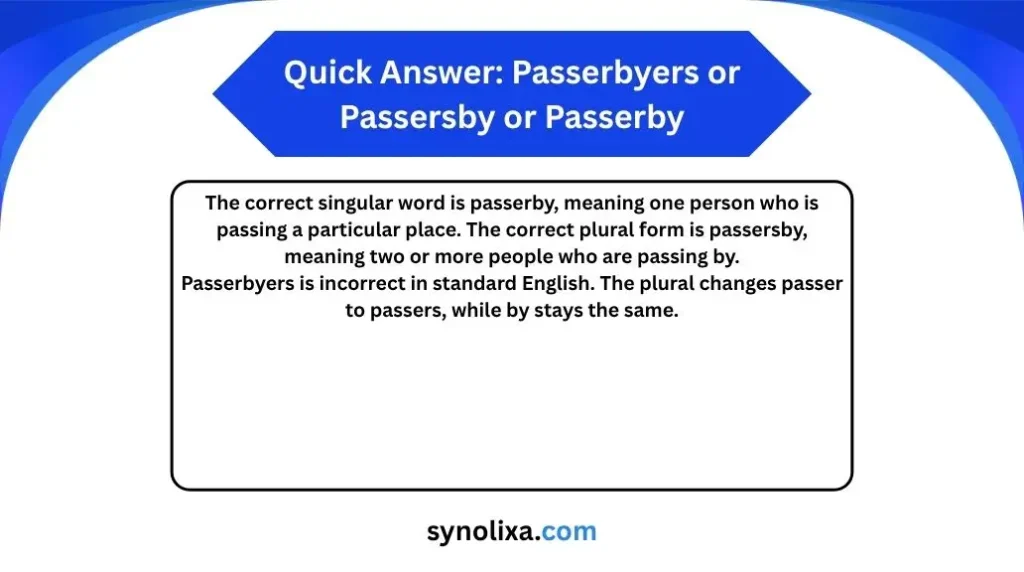
The correct singular word is passerby, meaning one person who is passing a particular place. The correct plural form is passersby, meaning two or more people who are passing by.
Passerbyers is incorrect in standard English. The plural changes passer to passers, while by stays the same.
- One person: passerby
- More than one person: passersby
- Incorrect: passerbyers
Example:
- A passerby called the police.
- Several passersby stopped to help.
Understanding the Basics: Passerbyers or Passersby or Passerby
The main difference between passerby and passersby is number.
A passerby is one person.
Passersby means more than one person.
The confusion happens because many English nouns become plural by adding -s or -es to the end. However, passerby is a compound noun. Its important noun part is passer, not by. Therefore, the plural marker goes on passer.
Comparison Table
| Form | Type | Meaning | Example | Correct/Incorrect |
|---|---|---|---|---|
| passerby | Singular noun | One person passing by | A passerby saw the event. | Correct |
| passersby | Plural noun | More than one person passing by | Several passersby watched. | Correct |
| passerbyers | Incorrect form | Not a standard English plural | The passerbyers stopped. | Incorrect |
Here is the easiest rule to remember:
One passer = passerby. More than one passer = passersby.
The word by does not become plural. Instead, the word passer takes the plural -s.
Correct Meanings and Uses
Passerby: Meaning and Correct Use
A passerby is a person who happens to be walking or traveling past a particular place.
The person does not need to stop or take part in what is happening. They are simply passing the location.
Examples:
- A passerby noticed smoke coming from the building.
- One passerby gave us directions.
- A helpful passerby picked up the dropped wallet.
- The passerby looked at the street performer.
- An injured dog was found by a passerby.
Sentence Breakdown
Take this sentence:
A passerby called for help.
- A = an article showing one person
- passerby = one person passing the location
- called = the action
- for help = explains why the person called
Because the sentence refers to only one person, passerby is correct.
Test Tip
Try replacing the word with one person.
If one person fits your meaning, use passerby.
Example:
One person saw the accident.
➡ Therefore: A passerby saw the accident.
Passersby: Meaning and Correct Use
Passersby is the plural of passerby. It refers to two or more people passing a place.
Examples:
- Several passersby stopped to watch.
- The police interviewed nearby passersby.
- A group of passersby offered assistance.
- Curious passersby gathered outside the store.
- Many passersby took photos of the unusual display.
Sentence Breakdown
Consider this sentence:
Several passersby witnessed the accident.
- Several = shows that there was more than one
- passersby = multiple people passing the place
- witnessed = the action
- the accident = what they saw
Because there is more than one person, passersby is the correct form.
Test Tip
Try replacing the word with several people or many people.
If that matches your meaning, use passersby.
Example:
Several people stopped and watched.
➡ Therefore: Several passersby stopped and watched.
Why Passerbyers Is Incorrect
Passerbyers may look logical because many people expect the plural ending to appear at the end of a word.
For example:
- car → cars
- teacher → teachers
- visitor → visitors
However, passerby follows a different pattern because it is a compound noun.
The word can be understood as:
passer + by
A passer is the person doing the passing. By functions as part of the compound expression. Since passer is the main noun, it becomes plural:
passer → passers
Then by remains unchanged:
passers + by = passersby
So:
❌ passerbyers
❌ passerbys
❌ passer-bys
✅ passersby
Test Tip
Find the main noun in the compound word. That is usually the part that becomes plural.
For passerby, the main noun is passer.
The Grammar Rule Behind Passerby and Passersby
To understand why passersby is correct, it helps to understand compound nouns.
A compound noun is a noun made from two or more words that work together as one unit. Some compound nouns form their plurals in unusual places.
In passerby, the word passer refers to a person. The word by helps describe the person’s relationship to a place or situation.
Standard dictionary usage, including forms listed by major dictionaries such as Merriam-Webster, recognizes passerby as the singular noun and passersby as its plural.
The rule is not to attach -s to the final letters automatically. Instead, English places the plural marker on the meaningful noun element when a compound noun follows this pattern.
Similar Examples
The same idea appears in several other compound nouns.
| Singular | Plural |
|---|---|
| passerby | passersby |
| mother-in-law | mothers-in-law |
| sister-in-law | sisters-in-law |
| attorney general | attorneys general |
| runner-up | runners-up |
| man-of-war | men-of-war |
Notice that the plural does not always appear at the end of the entire expression.
For example:
- mother-in-law → mothers-in-law
- not ❌ mother-in-laws
Likewise:
- passerby → passersby
- not ❌ passerbyers
This is why understanding the structure of the word is more useful than simply memorizing the spelling.
How to Remember Passerby vs. Passersby
A simple memory trick can prevent this mistake.
Think about the person doing the action.
A passer is a person who passes.
If there is one person:
one passer + by = one passerby
If there are several people:
many passers + by = many passersby
The word that changes is passer.
Easy Formula
Singular: passer + by = passerby
Plural: passers + by = passersby
Remember this short line:
Add the plural to the passer, not to the by.
This rule makes the correct spelling much easier to remember. 🧠
Passerbyers or Passersby or Passerby: Case Study
Imagine that you work for a local community center. A staff member sends this email after an outdoor event:
Incorrect email:
“Several passerbyers stopped near the entrance and asked what was happening.”
The sentence contains a grammar error because passerbyers is not the standard plural form.
Correct Version
“Several passersby stopped near the entrance and asked what was happening.”
Now the sentence is grammatically correct and sounds natural.
Why?
The word several tells us that there was more than one person. Therefore, we need the plural form.
- One person → passerby
- Several people → passersby
Another Workplace Example
Incorrect:
“Our security team spoke with three passerbyers.”
Correct:
“Our security team spoke with three passersby.”
Everyday Conversation
Person A: “Who saw the dog run into the park?”
Person B: “A few passersby saw it.”
Because a few means more than one, passersby is the correct choice.
This shows how the rule works in real communication. You do not need complicated grammar knowledge. You simply need to identify whether you are talking about one person or multiple people.
Grammar Rules Explanation
The grammar rule is based on how certain compound nouns form plurals.
Most regular nouns take their plural ending at the end:
- book → books
- chair → chairs
- student → students
But some compound nouns contain a main noun followed by another word. In these cases, the plural may be added to the main noun instead of the final word.
Passerby belongs to this group.
Step 1: Identify the Main Noun
The person is the passer.
The word by does not identify the person. It helps complete the compound expression.
Step 2: Make the Main Noun Plural
passer → passers
Step 3: Keep the Remaining Part
passers + by → passersby
That gives us the correct plural.
Why “Passerbyers” Does Not Work
Adding -ers to the end creates a form that does not follow the standard grammatical structure of the word.
English does not treat passerbyers as the plural of passerby. The recognized plural is passersby.
Grammar Test
Ask yourself:
Where is the person in the word?
The answer is passer.
Since passer is the noun referring to the person, it takes the plural form.
passer → passers
That is the key grammar rule.
Common Mistakes With Passerby, Passersby, and Similar Words
Grammar mistakes often happen because English has many patterns. People naturally expect words to follow the most common pattern.
For example, someone may think:
passerby + s = passerbys
or:
passerby + ers = passerbyers
However, both forms are incorrect.
Why These Mistakes Happen
Fast Typing
When people type quickly, they may focus on the meaning rather than the exact grammar.
A writer may know that multiple people are involved and quickly add letters to the end without checking the compound noun rule.
Autocorrect
Autocorrect tools can sometimes fail to recognize context or may not correct an unusual plural form.
Never assume that a word is correct simply because a device does not flag it.
Lack of Knowledge
Many people have never learned how compound nouns form plurals.
Once you understand the pattern, passersby becomes much easier to remember.
Similar Grammar Confusions
| Confusion | Correct Rule | Example |
|---|---|---|
| it’s / its | It’s = it is; its = possession | It’s raining. The dog wagged its tail. |
| your / you’re | Your = possession; you’re = you are | Your book is here. You’re welcome. |
| there / their / they’re | Place / possession / they are | They’re going there with their friends. |
| then / than | Time/order / comparison | Finish your work, then rest. She is taller than me. |
| affect / effect | Usually verb / usually noun | The weather can affect the result. |
| who / whom | Subject / object in formal grammar | Who called? Whom did you invite? |
| passerby / passersby | Singular / plural | One passerby; many passersby. |
These mistakes are different, but they have something in common: small changes can affect correctness and clarity.
Usage in Everyday Conversation
In everyday speech, passerby and passersby are useful when talking about people who happen to be near a place.
Singular Examples
- A passerby helped me find the station.
- One passerby heard the loud noise.
- A passerby asked if everything was okay.
Plural Examples
- Passersby watched the parade.
- Several passersby stopped to help.
- The musicians attracted many passersby.
In casual conversation, you may also say:
- people walking by
- people passing by
- someone walking past
- people nearby
For example:
“Several passersby stopped to watch.”
This can also become:
“Several people walking by stopped to watch.”
Both can work, but passersby is shorter and more formal.
Usage in Professional Writing
Correct grammar matters in professional writing because errors can affect how readers view your attention to detail.
You may see passerby or passersby in:
- incident reports
- news articles
- security reports
- workplace emails
- public safety notices
- research reports
- official statements
Example: Incident Report
Correct:
“At approximately 3:00 p.m., two passersby reported the damaged sign.”
Example: Workplace Email
Correct:
“Several passersby asked whether the building was open to the public.”
Example: News Writing
Correct:
“A passerby alerted emergency services after noticing the problem.”
In formal writing, use the correct singular and plural forms consistently. Avoid passerbyers, as it may make the writing look unpolished.
Usage in Creative Writing
Creative writing often uses passerby and passersby to describe movement, atmosphere, and scenes.
Singular
“A lone passerby paused beneath the streetlight and looked toward the empty road.”
The word passerby creates the image of one person moving through the scene.
Plural
“Passersby hurried along the sidewalk, unaware of the quiet drama unfolding behind the café window.”
Here, passersby helps create a sense of a busy public place.
Writers can use these words to show contrast:
- one person who notices something
- many people who ignore it
- strangers moving through a scene
- a crowd gathering around an event
Creative Writing Tip
Use passerby when one unknown person matters to the scene.
Use passersby when the focus is on several unknown people or the general public.
Usage on Social Media and in Texting
Social media writing is usually casual, but correct grammar can still make a post easier to understand.
Correct Examples
- “A kind passerby helped me today. 😊”
- “So many passersby stopped to watch!”
- “The street musician had several passersby dancing.”
- “One passerby took this amazing photo.”
- “Passersby could not believe what they were seeing!”
In fast texting, people may avoid the word completely and write:
“Some people walking by helped.”
That is perfectly understandable. However, if you choose to use the word, remember:
One = passerby
More than one = passersby
Social Media Tip
Short posts often need quick clarity. The correct plural passersby may look unusual, but it is the standard form.
Do not change it to passerbyers just because it seems easier to pronounce or type.
Why Passerbyers or Passersby or Passerby Matters
You may wonder whether this small grammar difference really matters. In most cases, readers can probably guess your meaning. Still, correct usage matters for several important reasons.
Clarity in Communication
Using the right singular or plural form tells readers exactly how many people you mean.
- A passerby = one person
- Passersby = multiple people
This small difference makes your meaning precise.
Professionalism
Correct grammar shows care and attention to detail.
In school, work, publishing, journalism, and business communication, small errors can make writing appear rushed.
Writing Accuracy
Strong writing depends on choosing words accurately.
The goal is not to use difficult words. The goal is to use the right words correctly.
Digital Communication
People communicate through emails, comments, messages, posts, and online documents every day.
Because written communication often lacks facial expressions and tone, clear grammar can help reduce confusion.
“Clear writing begins with choosing the right word for the right meaning.”
The difference between passerby and passersby is small, but learning these details builds stronger writing habits.
Special Exceptions and Edge Cases
There is no standard grammar exception that makes passerbyers the accepted plural of passerby.
The normal standard forms are:
- passerby for singular
- passersby for plural
However, you may encounter unusual spellings in usernames, fictional names, business names, product names, or creative branding. A company or creator could intentionally use a nonstandard spelling.
For example, a fictional business might choose a name such as Passerbyers Café for branding purposes.
That does not change the grammar rule. A brand name can use creative spelling, but standard English writing should still use passersby as the plural.
Another Edge Case: “Passers-by”
Some publications or style traditions may use the hyphenated spelling passers-by. The meaning is the same: more than one person passing by.
However, passersby is widely recognized as the standard closed compound spelling in modern English dictionaries and general usage.
For everyday writing, the simplest choice is:
passerby → singular
passersby → plural
Quick Recap Checklist
Use this checklist whenever you are unsure about passerbyers or passersby or passerby.
| Question | If Yes → Use |
|---|---|
| Are you talking about one person passing by? | passerby |
| Are you talking about two or more people passing by? | passersby |
| Are you adding a plural ending to “by”? | Do not do this |
| Did you write “passerbyers”? | Change it to passersby |
| Can you replace the word with “one person”? | passerby |
| Can you replace the word with “several people”? | passersby |
Practice Example 1
Sentence: A ________ saw the missing cat.
Answer: passerby
Why? The article a tells us that one person is involved.
Practice Example 2
Sentence: Several ________ stopped near the entrance.
Answer: passersby
Why? Several means more than one person.
Practice Example 3
Sentence: The police asked nearby ________ for information.
Answer: passersby
Why? The sentence refers to multiple people.
More Examples to Build Confidence
Sometimes the best way to learn a grammar rule is to see it repeatedly in natural sentences.
Correct Singular Examples
- A passerby found the lost phone.
- The passerby waited for the light to change.
- One passerby offered useful information.
- A curious passerby stopped outside the shop.
- The passerby called the local office.
- An elderly passerby asked for directions.
Correct Plural Examples
- Passersby gathered around the street performer.
- Several passersby noticed the broken window.
- Nearby passersby offered assistance.
- The event attracted hundreds of passersby.
- Some passersby continued walking without stopping.
- Curious passersby asked questions about the display.
Incorrect Examples
- ❌ Several passerbyers watched the show.
- ❌ Two passerbys gave directions.
- ❌ Many passerby stopped to help.
Corrected Versions
- ✅ Several passersby watched the show.
- ✅ Two passersby gave directions.
- ✅ Many passersby stopped to help.
Notice that passersby works after numbers and quantity words such as:
- two
- three
- several
- many
- a few
- dozens of
Passerby vs. Person Passing By
You do not always have to use the noun passerby.
Sometimes a longer phrase sounds more natural.
Passerby
“A passerby helped the child.”
Person Passing By
“A person passing by helped the child.”
Both sentences are correct.
The difference is mainly style and structure.
Passerby is:
- shorter
- more compact
- useful in formal and written contexts
Person passing by is:
- more descriptive
- conversational
- useful when you want to emphasize the action
Plural Comparison
Passersby stopped to watch.
People passing by stopped to watch.
Again, both are correct.
If you are worried about the unusual plural passersby, you can use people passing by. However, when you want the single-word plural noun, passersby is the correct choice.
A Simple Way to Check Your Sentence
Before publishing, sending, or submitting your writing, use this three-step check.
Step 1: Count the People
Ask:
Am I talking about one person or more than one?
One person → passerby
More than one → passersby
Step 2: Look for Clue Words
Words such as these usually require the plural:
- two
- several
- many
- a few
- dozens
- hundreds
Example:
“Many ________ stopped.”
The correct answer is passersby.
Step 3: Check the Spelling
If you see:
passerbyers
change it.
If you see:
passerbys
change it.
The standard plural is:
passersby ✅
This quick check takes only a few seconds and can prevent a common grammar error.
FAQs About Passerbyers or Passersby or Passerby
1. Which is correct: passerbyers or passersby?
Passersby is correct when referring to more than one person passing by. Passerbyers is not a standard English plural.
2. What is the singular form of passersby?
The singular form is passerby. It means one person who is passing a particular place.
Example: “A passerby stopped to help.”
3. Why is the plural passersby instead of passerbys?
The main noun in the compound is passer, so the plural -s is added there: passer → passers. The word by remains unchanged, creating passersby.
4. Can I say “two passerby”?
No. When you mean two or more people, use the plural passersby.
Correct: “Two passersby saw the event.”
5. Is “passerbyers” ever correct?
Not as the standard plural of passerby. A creative brand, fictional name, or username might intentionally use that spelling, but standard grammar uses passersby.
6. Is passersby one word or two words?
Passersby is generally written as one word. The singular form is passerby, also written as one word.
Conclusion
The confusion around passerbyers or passersby or passerby becomes easy to solve once you know the grammar rule. Passerby is the singular form and refers to one person passing a place. Passersby is the plural form and refers to two or more people. Passerbyers is not standard English and should be avoided in normal writing.
The key is to remember that passerby is a compound noun. The person is the passer, so that is the part that becomes plural: passer → passers. The word by stays unchanged.
When you are unsure, use the simplest test: ask whether you mean one person or several people. One means passerby. More than one means passersby.
Mastering small grammar rules like this improves your writing, strengthens your confidence, and helps your message stay clear. Remember it this way: pluralize the passer, not the by—and you will always get passersby right. ✨

Hi, I am Ava Mitchell. I work at Synolixa as an English content writer, creating simple and useful resources about synonyms, vocabulary, and English usage.

[…] pronunciation, common mistakes, examples, and practical ways to remember which word to use. 😊 Passerbyers or Passersby or Passerby | Brite vs Bright | By Which or In […]