Have you ever typed “momma” or “mama” and stopped to wonder which spelling is actually correct? You are not alone. These two words look slightly different, but the good news is that the choice is not as complicated as it may seem. 😊
Mama and momma can both refer to a mother. However, they are not equally common. In standard American English, mama is the more common and generally preferred spelling. Momma is also a recognized English word, but it is a less common variant of mama. Merriam-Webster lists momma as a “less common spelling of mama,” while its main entry for mama lists momma as a variant.
This difference matters when you are writing an article, school assignment, email, social media post, story, or personal message. Knowing when to use each form can make your writing clearer and more natural.
So, should you write “mama” or “momma”? Let’s look at the meanings, grammar rules, examples, common mistakes, and real-world usage so you can choose confidently. Too vs To | Thank You Both or Thanks to Both of You | Openned or Opened
Quick Answer: Momma or Mama?
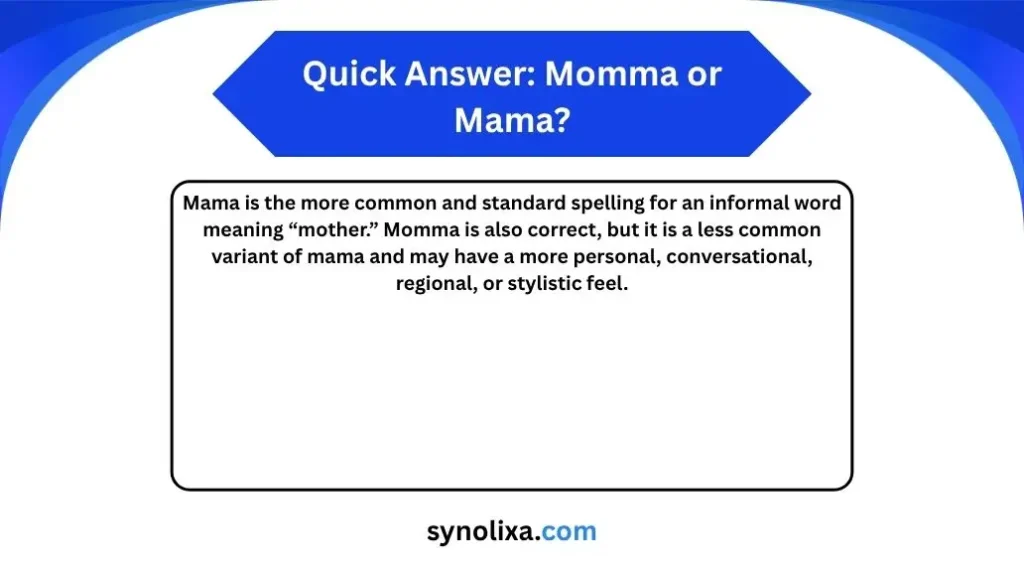
Mama is the more common and standard spelling for an informal word meaning “mother.” Momma is also correct, but it is a less common variant of mama and may have a more personal, conversational, regional, or stylistic feel.
For most general writing, mama is the safest choice.
- ✅ Mama — standard and more common
- ✅ Momma — correct, but less common
- ❌ Neither spelling is automatically wrong
The key point is that this is not a simple correct-versus-incorrect spelling issue. Both forms are recognized in English, but mama is usually the better default choice.
Understanding the Basics: Momma or Mama
The easiest way to understand momma vs. mama is to focus on usage rather than treating one spelling as a misspelling of the other.
Basic Comparison Table
| Form | Type | Meaning | Example | Correct/Incorrect |
|---|---|---|---|---|
| mama | Informal noun | Mother | “My mama taught me how to cook.” | ✅ Correct |
| momma | Variant noun | Mother | “Her momma was waiting outside.” | ✅ Correct |
| mother | Standard noun | Female parent | “Her mother called yesterday.” | ✅ Correct |
| mom | Informal noun | Mother | “My mom is at work.” | ✅ Correct |
| mamma | Less common variant | Mother | “Her mamma smiled.” | ✅ Correct, but less common |
Merriam-Webster defines mama as “mother” and notes that mamma and momma are variants. Its separate momma entry describes it as a less common spelling of mama.
What Does “Mama” Mean?
Mama is an informal noun used to refer to a mother. It is often associated with family speech, childhood language, affection, or a warm conversational style.
Examples include:
- “My mama makes the best soup.”
- “I called my mama after school.”
- “Her mama was proud of her.”
- “Mama, can you help me?”
- “My mama always gives good advice.”
The word can sound warm and personal, but it does not have to be childish. Adults can use mama when talking about their mothers, and writers can use it in informal or creative contexts.
What Does “Momma” Mean?
Momma has essentially the same basic meaning: mother.
The important difference is spelling and usage frequency rather than meaning. Merriam-Webster specifically identifies momma as a less common spelling of mama.
For example:
- “Her momma always supported her.”
- “The child ran toward her momma.”
- “My momma taught me to be kind.”
- “That little boy called for his momma.”
Because momma is less common, it can sometimes create a stronger conversational or stylistic impression.
Correct Meanings and Uses
Using “Mama” for Your Mother
The most common use of mama is as an informal term for one’s mother.
For example:
“I called my mama before leaving home.”
Here is the sentence breakdown:
- I = subject
- called = verb
- my = possessive determiner
- mama = noun
- before leaving home = time-related phrase
The word mama functions as a noun because it names a person.
Using “Mama” as a Direct Address
You can also use Mama when speaking directly to your mother.
For example:
“Mama, can you help me?”
When a word is used as a direct address, a comma is normally used to separate it from the rest of the sentence.
Compare:
- ✅ “Mama, can you help me?”
- ✅ “Can you help me, Mama?”
- ❌ “Mama can you help me?”
The comma makes the sentence easier to read.
Using “Momma” in Personal or Informal Writing
Momma can be useful when the spelling reflects someone’s normal speech, family tradition, character voice, or personal preference.
For example:
“Her momma always told her to keep trying.”
This sentence is grammatically fine. The writer has simply selected the less common spelling.
You might see momma in:
- personal stories
- dialogue
- song or creative titles
- social media posts
- regional speech
- family-centered writing
- character dialogue
The important point is that less common does not mean incorrect.
Mama and Animal Names
Mama is not limited to human mothers. English speakers also use it informally for female animals with young.
For example:
“The mama bear stayed close to her cubs.”
Here, mama means the mother animal.
This type of usage is common in everyday and informal writing.
“Mama” in Compound Expressions
Mama also appears in established expressions and combinations.
Examples include:
- mama bear
- mama’s boy
- mama bird
- baby mama
However, each expression can have its own meaning and tone. For example, baby mama is a slang term with a specific meaning and should not be treated as a simple synonym for mother. Merriam-Webster lists baby mama as a slang term with its own definition.
Test Tip: How Can You Choose Between Mama and Momma?
Try this simple test:
If you need the normal, widely recognized informal word for “mother,” choose “mama.”
If you are intentionally using a less common spelling because it fits a person’s speech, family style, regional voice, or creative tone, momma can work.
Quick Test
Ask yourself:
“Am I simply looking for the usual spelling?”
If yes → mama
“Am I intentionally using a less common variant?”
If yes → momma
This simple test will work in most situations.
Case Study: Mama or Momma in Real-Life Writing
Imagine that you are writing an email to a teacher about a family event.
You might write:
“My mama is visiting us this weekend, so I may need to leave school early on Friday.”
The word mama works naturally in a personal context.
Now imagine that you are writing a short story. One character might say:
“My momma always told me to keep my promises.”
The writer may choose momma because the spelling contributes to the character’s voice.
Neither sentence has a grammatical problem.
The difference is style and frequency, not basic meaning.
Workplace Example
In professional writing, it is usually better to use mother if the relationship needs to be stated formally.
For example:
“I need to accompany my mother to an appointment.”
This sounds more formal than:
“I need to accompany my mama to an appointment.”
The second sentence is not necessarily grammatically wrong. It simply sounds more personal and informal.
Social Media Example
On social media, either spelling may be appropriate depending on the writer’s voice.
Examples:
- “Happy birthday to my mama! ❤️”
- “My momma is my biggest supporter. 💕”
Both are understandable. The first uses the more common spelling; the second uses a recognized variant.
Grammar Rules Explanation
Is “Mama” Grammatically Correct?
Yes.
Mama is a noun. It can appear in ordinary noun positions in a sentence.
Examples:
- “My mama is a teacher.”
- “I visited my mama yesterday.”
- “Mama made dinner.”
- “I gave Mama a card.”
It can function as a subject, object, or form of direct address depending on the sentence.
Is “Momma” Grammatically Correct?
Yes.
Momma is also a noun meaning mother. Merriam-Webster explicitly recognizes it as a less common spelling of mama.
Examples:
- “My momma is very kind.”
- “I called my momma last night.”
- “Momma, look at this!”
- “Her momma helped her prepare.”
Therefore, saying that momma is always wrong would be inaccurate.
Which One Does Merriam-Webster Prefer?
Merriam-Webster’s entries provide an important clue about usage. Its main entry is mama, which it defines as “mother,” and it lists momma among the variants. The separate momma entry describes it as a less common spelling of mama.
So, if you want the most broadly useful spelling, mama is the better default.
Is “Mamma” the Same Thing?
Usually, yes, when it refers to a mother.
Merriam-Webster lists mamma as a less common spelling of mama. However, mamma also has a completely different technical meaning in biology: a mammary gland and its associated parts.
That means context matters.
For example:
“Her mamma lives nearby.”
Here, mamma means mother.
But:
“The mammal has a developed mamma.”
Here, the word has a biological meaning.
Common Mistakes With Mama and Momma
Why do people get mama vs. momma confused?
There are several simple reasons.
1. Similar Pronunciation
Both words are pronounced similarly in many varieties of English. When words sound alike or nearly alike, spelling differences can be easy to overlook.
2. Fast Typing
When people type quickly, they may add or remove a letter without noticing.
For example:
- mama → momma
- momma → mama
This does not necessarily mean the writer does not know English grammar.
3. Autocorrect
Autocorrect can also influence spelling. A phone may suggest one form over another depending on its dictionary and language settings.
4. Family Preference
Some families naturally use mama. Others use momma. Personal usage can become a strong habit.
5. Regional and Cultural Differences
Informal family terms can vary across regions, communities, and cultures. What sounds natural to one speaker may sound unusual to another.
Similar Grammar and Spelling Confusions
| Confusion | Correct Forms | Main Difference |
|---|---|---|
| it’s / its | Both correct | “It’s” = it is; “its” = possessive |
| your / you’re | Both correct | “Your” = possessive; “you’re” = you are |
| their / there / they’re | All correct | Different meanings and functions |
| then / than | Both correct | Time/order vs. comparison |
| affect / effect | Both correct | Different grammatical roles and meanings |
| mama / momma | Both correct | Momma is a less common variant of mama |
The key lesson is simple: a spelling difference does not always mean one word is wrong.
Usage in Different Contexts
Everyday Conversation
In everyday conversation, both mama and momma can sound natural.
Examples:
- “My mama is coming over.”
- “Ask your momma.”
- “Mama, where are my shoes?”
- “Her momma called earlier.”
Your choice may depend on how you normally speak.
Professional Writing
Professional writing usually favors more neutral terms.
For example:
“My mother will be unavailable this afternoon.”
This sounds more formal than:
“My mama will be unavailable this afternoon.”
That does not make mama grammatically wrong. It simply makes mother a better fit for formal communication.
Creative Writing
Creative writers have more freedom.
A writer may choose mama because it sounds warm and familiar:
“Mama smiled from the doorway.”
Another writer may choose momma to create a particular character voice:
“Momma always knew when something was wrong.”
In creative writing, spelling can help establish personality and tone.
Social Media and Texting
Social media is highly flexible.
You might see:
- “Love you, mama! 💕”
- “My momma is the best.”
- “Missing my mama today. ❤️”
- “Proud momma moment!”
These are informal uses, so personal style often matters more than strict formality.
Family Communication
Family messages are another place where personal preference is important.
For example:
“Good morning, Mama! Hope you have a great day.”
If your family normally writes momma, then:
“Good morning, Momma! Hope you have a great day.”
can work just as well.
Why It Matters: Clarity, Professionalism, and Accuracy
At first, mama vs. momma may seem like a tiny spelling question. In reality, it teaches an important lesson about English: language is shaped by both rules and usage.
Clarity in Communication
Choosing a familiar spelling helps readers understand your meaning quickly.
Mama is widely recognized, so it is usually the clearest default.
Professionalism
In formal writing, word choice should match the situation.
Using mother in a formal report can sound more appropriate than mama or momma.
Digital Communication
Online writing moves quickly. People type on phones, use autocorrect, and often write informally.
Knowing that both mama and momma exist can prevent unnecessary corrections.
A Simple Reminder
Choose the spelling that fits both the meaning and the context.
That is the most useful rule to remember.
Special Exceptions and Edge Cases
There is an important exception to the idea that mama and momma are always interchangeable: names, titles, quotations, and established expressions may use a specific spelling.
If someone officially calls herself “Momma,” you should preserve that spelling.
For example, if a fictional character’s name is Momma Rose, changing it to Mama Rose could alter the intended title or characterization.
Brand and Business Names
A business, product, book, organization, or character may intentionally use Momma rather than Mama.
In such cases, use the official spelling.
Proper names do not need to follow the same choice you would make in ordinary prose.
Creative and Regional Voice
A writer may also choose momma because it better represents a speaker’s voice.
That is a stylistic decision, not necessarily a grammar error.
The Word “Mama” in Other Expressions
Some expressions have established spellings. Do not automatically change a familiar expression just because another form is possible.
For instance, mama bear is a common informal expression, while baby mama has a specific slang meaning. Merriam-Webster recognizes baby mama as its own expression and also notes less common variants such as baby mamma and baby momma.
Mama or Momma: Which Is Better for SEO and Online Writing?
If you are writing online content and need a general spelling, mama is usually the stronger default because it is the main dictionary form and is more common.
However, that does not mean you should remove momma completely.
If your article targets searches such as:
- momma or mama
- is momma correct
- is mama correct
- mama vs. momma
- how to spell mama
- how to spell momma
- momma meaning
- mama meaning
then naturally mentioning both spellings can help answer readers’ questions.
The best approach is to write naturally rather than repeat the keyword excessively.
Example SEO-Friendly Sentence
Mama is the more common spelling, while momma is a recognized but less common variant.
This sentence gives readers a direct answer and clearly explains the relationship between the two forms.
Quick Recap Checklist
Use this table whenever you are unsure.
| Question | If Yes → Use |
|---|---|
| Do you want the more common informal word for mother? | Mama |
| Are you intentionally using a recognized variant? | Momma |
| Are you writing a formal document? | Mother |
| Are you reproducing someone’s chosen spelling or name? | Use their spelling |
| Are you writing dialogue or creative fiction? | Mama or momma, depending on voice |
| Are you writing a casual social media post? | Mama or momma |
| Are you unsure which form to choose in general writing? | Mama |
Practice Examples
Example 1:
“I called my ___ before dinner.”
Best general choice: mama
“I called my mama before dinner.”
Example 2:
“The character shouted, ‘___, wait for me!’”
Either can work:
“Mama, wait for me!”
or:
“Momma, wait for me!”
Choose the spelling that fits the character’s voice.
Example 3:
“I need to take my ___ to the doctor.”
For formal or neutral writing:
“I need to take my mother to the doctor.”
This is more appropriate than either informal form in a professional context.
FAQs
1. Is “mama” or “momma” correct?
Both mama and momma are correct English words when they mean “mother.” However, mama is the more common spelling, while momma is a less common variant.
2. Is “momma” a misspelling of “mama”?
No. Momma is not simply a misspelling of mama. Merriam-Webster recognizes momma as a less common spelling of mama.
3. Which is more common: “mama” or “momma”?
Mama is more common in standard English usage. Merriam-Webster’s dictionary structure supports this by listing mama as the main entry and describing momma as a less common spelling.
4. Should I use “mama” in formal writing?
Usually, mother is better for formal writing. Mama is an informal term, so it may sound too personal or conversational in a formal report, business document, or academic paper.
5. Can I use “momma” in a sentence?
Yes. Momma can be used as a noun meaning mother.
For example:
“Her momma was waiting at home.”
The spelling is recognized in English, although it is less common than mama.
6. Is “mamma” also correct?
Yes, mamma can be a variant spelling of mama when it means mother. However, mamma also has a technical biological meaning referring to a mammary gland, so context is important.
Conclusion
So, momma or mama—which should you use? The simplest answer is mama. It is the more common spelling and the main dictionary form for the informal word meaning “mother.” Momma is also correct, but it is a less common variant that may be preferred for personal, regional, conversational, or creative reasons. Merriam-Webster confirms this distinction by listing momma as a less common spelling of mama.
For general writing, choose mama. For formal writing, consider mother. If you are writing dialogue, preserving someone’s personal spelling, or creating a particular voice, momma may be exactly right.
The important thing is not to assume that one spelling is always wrong. English allows variation, and context helps determine the best choice.
Remember: “Mama” is the common choice, “momma” is a valid variant, and “mother” is the formal choice. Choose the word that fits your message. ✨

Hi, I am Ava Mitchell. I work at Synolixa as an English content writer, creating simple and useful resources about synonyms, vocabulary, and English usage.
[…] look at the difference in simple terms so you can choose the right word with confidence. ✍️ Momma or Mama | Too vs To | Thank You Both or Thanks to Both of […]
[…] Once you understand how helping verbs such as has, have, and had work, this mistake becomes much easier to avoid. In this guide, we will explain has ran or has run, show you real examples, cover common mistakes, and give you easy tests you can use whenever you are unsure. ✅ Affirm vs Confirm | Acception vs Exception | Momma or Mama […]