Have you ever written a sentence and suddenly wondered, “Should I use too or to?” 🤔 You are not alone. Too vs. to is one of the most common word-choice problems in English because both words usually sound exactly the same. However, they have completely different meanings and grammatical functions.
The good news is that learning the difference does not have to be difficult. Once you understand what each word does, you can usually choose the correct one in just a few seconds. To is commonly used to show direction, connection, purpose, or an infinitive verb. Too is mainly used to mean “also” or “more than necessary.”
For example, in the sentence, “I want to go too,” both words are correct, but they perform different jobs. The first to comes before the verb go, while too means “also.”
This complete guide explains too vs. to in simple US English. You will learn their meanings, grammar rules, differences, common mistakes, practical examples, memory tricks, and answers to frequently asked questions. Thank You Both or Thanks to Both of You | Openned or Opened | Targetted or Targeted
Quick Answer: Too vs To
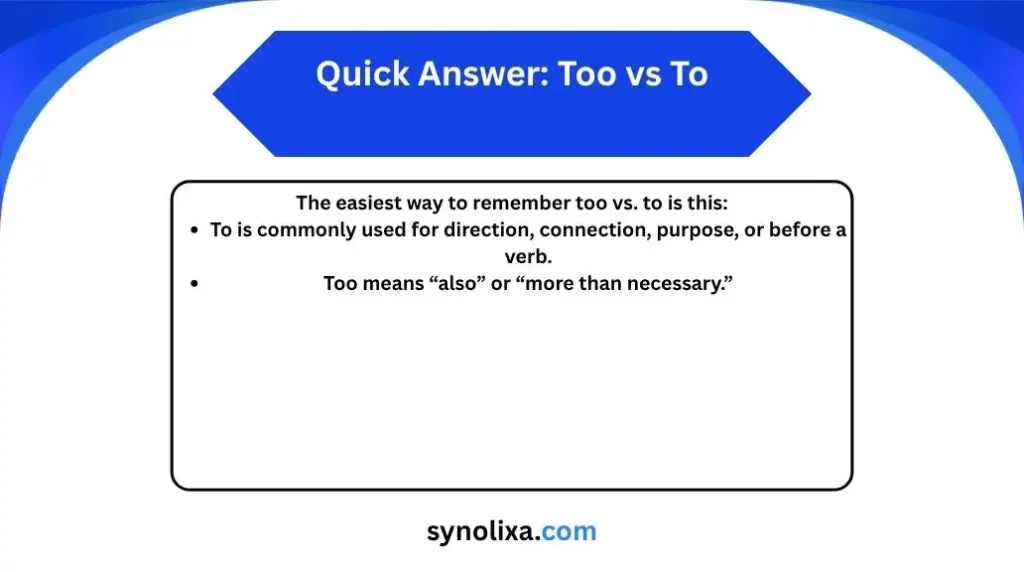
The easiest way to remember too vs. to is this:
- To is commonly used for direction, connection, purpose, or before a verb.
- Too means “also” or “more than necessary.”
For example:
I want to visit the museum too.
Here, to comes before the verb visit, while too means also.
Another example is:
The coffee is too hot to drink.
Here, too means excessively, while the second to introduces the verb drink.
So, remember:
To = direction, purpose, connection, or action
Too = also or excessive
Understanding the Basics of Too vs. To
The words too and to are homophones. Homophones are words that sound alike but have different meanings or spellings.
This is why people often confuse them in writing. When you hear someone say “to” or “too,” the sound alone usually does not tell you which spelling is intended. You must understand the meaning and grammatical role of the word.
What Is “To”?
To has several common uses.
It can:
- Show direction or movement.
- Connect one person or thing to another.
- Show purpose.
- Introduce an infinitive verb.
- Show a relationship between things.
- Express a range or limit in some constructions.
Examples:
- She walked to school.
- Give the letter to John.
- I want to learn.
- He went outside to exercise.
- Listen to me.
What Is “Too”?
Too is an adverb. It has two main meanings.
First, it can mean “also.”
I want to come too.
Second, it can mean “more than is desirable, necessary, or appropriate.”
The box is too heavy.
The sentence means the box is heavier than desired or practical.
Too vs. To Comparison Table
| Form | Type | Meaning | Example | Correct/Incorrect |
|---|---|---|---|---|
| to | Preposition | Direction | She went to school. | ✅ Correct |
| to | Infinitive marker | Introduces a verb | I want to learn. | ✅ Correct |
| to | Preposition | Connection or relationship | Give it to me. | ✅ Correct |
| too | Adverb | Also | I want one too. | ✅ Correct |
| too | Adverb | Excessively | It is too cold. | ✅ Correct |
| too | Adverb | Direction | She went too school. | ❌ Incorrect |
| too | Adverb | Infinitive marker | I want too go. | ❌ Incorrect |
| to | Preposition | Also | I want one to. | ❌ Incorrect |
The most important lesson is that too and to cannot normally be substituted for each other.
Correct Meanings and Uses of “To”
Understanding the different jobs of to makes the word much easier to recognize.
“To” Shows Direction
One of the most common uses of to is to show movement toward a destination.
Examples:
- We went to the park.
- She drove to the office.
- He walked to the bus stop.
- They traveled to New York.
- I ran to the door.
Look at this sentence:
Maria went to the library.
The word to tells us where Maria went.
It connects the action went with the destination library.
“To” Shows a Recipient
To can also show who receives something.
Examples:
- I gave the book to Sarah.
- Please send this email to your manager.
- He handed the keys to his brother.
- She gave the gift to her friend.
In each example, to introduces the person who receives something.
“To” Comes Before an Infinitive Verb
Another very important use of to is with an infinitive.
The basic pattern is:
to + base verb
Examples:
- to read
- to write
- to eat
- to sleep
- to learn
- to work
- to study
- to travel
Complete sentences include:
- I want to read.
- She needs to sleep.
- We plan to travel.
- He decided to stay.
- They hope to win.
Consider:
I want to learn English.
The word to introduces the base verb learn.
This is one of the easiest ways to identify to.
“To” Shows Purpose
You can use to to explain the purpose of an action.
Examples:
- I went outside to get some fresh air.
- She studied hard to pass the exam.
- He called me to ask a question.
- We saved money to buy a house.
- They left early to avoid traffic.
For example:
He went to the store to buy milk.
The first to shows the destination. The second to explains the purpose.
“To” Shows a Relationship
The word to can connect one thing with another.
Examples:
- This belongs to me.
- Please listen to the teacher.
- She spoke to her friend.
- This answer is similar to mine.
- The key belongs to the back door.
In these examples, to does not mean “also” or “excessively.” Therefore, too would not be correct.
Correct Meanings and Uses of “Too”
The word too has two major uses.
“Too” Means “Also”
The first meaning of too is “also.”
Examples:
- I like pizza too.
- She is coming too.
- He wants to join us too.
- I enjoyed the movie too.
- They are invited too.
Consider:
I want to go too.
This means:
I also want to go.
The word too adds another person or thing to the statement.
“Too” Means “Excessively”
The second major meaning of too is something like “more than necessary” or “more than wanted.”
Examples:
- The soup is too hot.
- The bag is too heavy.
- The music is too loud.
- The room is too small.
- The test is too difficult.
Compare:
The soup is hot.
This simply says that the soup has a high temperature.
But:
The soup is too hot.
This suggests that the soup is hotter than is desirable or suitable.
“Too” With Adjectives
Too often comes before an adjective.
Common patterns include:
too + adjective
Examples:
- too expensive
- too difficult
- too noisy
- too cold
- too hot
- too large
- too small
- too slow
- too fast
Examples in sentences:
The shoes are too expensive.
The room is too noisy.
The water is too cold.
“Too Much”
Use too much with uncountable nouns or with verbs when discussing an excessive amount.
Examples:
- There is too much sugar in the tea.
- I have too much work today.
- He spends too much money.
- She talks too much.
“Too Many”
Use too many with countable plural nouns.
Examples:
- There are too many people here.
- I have too many books.
- She asked too many questions.
- We bought too many apples.
The important idea is that too expresses an amount or degree that goes beyond what is wanted, needed, or appropriate.
How to Tell the Difference Between Too and To
When you are unsure about too vs. to, do not focus on pronunciation. Instead, ask what the word means.
Test 1: Can You Replace It With “Also”?
If yes, use too.
Example:
I want to come too.
Replace too with also:
I also want to come.
The meaning works, so too is correct.
Test 2: Does It Mean “Excessively”?
If yes, use too.
Example:
The shirt is too large.
The meaning is that the shirt is larger than desired.
Therefore, too is correct.
Test 3: Is It Showing Direction?
If yes, use to.
Example:
She went to the store.
The word identifies the destination, so to is correct.
Test 4: Is It Before a Base Verb?
If yes, to is often the correct choice.
Example:
I want to study.
Because study is a base verb, to introduces the infinitive.
Test Tip 🧠
Use this simple question:
Does the word mean “also” or “excessively”?
- If yes → too
- If no → to may be correct
This test does not replace every grammar rule, but it works for many common too vs. to mistakes.
Too vs. To in the Same Sentence
One of the best ways to understand the difference is to see both words used together.
Consider:
I want to go too.
The first to introduces the verb go.
The second too means also.
Another example:
It is too cold to swim.
Here:
- too = excessively
- to swim = infinitive
Another example:
The box is too heavy to carry.
Again:
- too heavy = excessively heavy
- to carry = infinitive
These sentences prove that the two words may appear close together while still having completely different grammatical functions.
Common Mistakes With Too vs. To
Because these words sound alike, mistakes are common.
Mistake 1: “I Want Too Go”
❌ Incorrect:
I want too go.
✅ Correct:
I want to go.
Why?
The word go is a base verb. The correct infinitive is to go.
Mistake 2: “I Like It To”
If you mean also, this is incorrect.
❌ I like it to.
✅ I like it too.
Here, too means “also.”
Mistake 3: “She Went Too School”
❌ Incorrect:
She went too school.
✅ Correct:
She went to school.
The word to shows the destination.
Mistake 4: “This Is To Expensive”
❌ Incorrect:
This is to expensive.
✅ Correct:
This is too expensive.
The meaning is “more expensive than acceptable,” so too is required.
Mistake 5: “Can I Come To?”
This sentence can be correct in a particular context.
For example:
“Do you want to come with us?”
“Yes, I want to.”
Here, to is an infinitive marker, and the verb come is understood.
However, if you mean “also,” you would use too:
“Can I come too?”
That means:
“Can I also come?”
Context matters.
Why People Confuse Too and To
There are several reasons these words cause problems.
They Sound the Same
The biggest reason is pronunciation. In ordinary speech, to and too can sound identical.
When people write what they hear, they may choose the wrong spelling.
Fast Typing
Typing quickly can cause mistakes.
Someone may know the difference but still type:
I want too go.
instead of:
I want to go.
This is a typing error, not necessarily a lack of grammar knowledge.
Autocorrect
Predictive text and autocorrect may sometimes suggest a different word from the one the writer intended.
That is why proofreading remains useful.
Lack of Grammar Knowledge
Some people have never learned the distinction. Once they understand the basic rules, the difference becomes much easier.
Habit
If someone repeatedly sees or writes the wrong form, the error can become a habit.
Regular practice can help replace that habit with the correct form.
Similar Grammar Confusions
Too vs. to is part of a larger group of commonly confused English words.
| Confusing Words | Main Difference | Example |
|---|---|---|
| to / too | Direction or infinitive / also or excessive | Go to school. I want to go too. |
| your / you’re | Possessive / you are | Your book is here. You’re early. |
| its / it’s | Possessive / it is or it has | The dog wagged its tail. It’s cold. |
| there / their / they’re | Place / possession / they are | Go there. Their car is new. They’re ready. |
| then / than | Time or sequence / comparison | Eat first, then study. She is taller than me. |
| who’s / whose | Who is/who has / possession | Who’s there? Whose bag is this? |
| affect / effect | Usually a verb / usually a noun | Noise can affect sleep. The effect was clear. |
Learning these pairs can improve your overall writing accuracy.
Too vs. To in Everyday Conversation
In spoken English, the difference may not be obvious because the words can sound alike.
For example:
“I am going to the store.”
The listener understands the intended meaning from the sentence.
Similarly:
“I want to go too.”
The context makes the meaning clear.
Although spoken mistakes may go unnoticed, written mistakes are more visible.
That is why it is especially important to understand too vs. to when writing emails, school assignments, applications, social media posts, and professional documents.
Too vs. To in Professional Writing
Professional writing requires clear and accurate word choice.
Consider this email sentence:
❌
I would like too schedule a meeting.
The correct version is:
✅
I would like to schedule a meeting.
Why?
Because to schedule is an infinitive.
Now consider:
I would like to attend the meeting too.
Here, too means “also.”
A simple spelling mistake can make a message look rushed. Correct word choice helps your writing appear more polished and professional.
Professional Examples
- I would like to discuss this issue.
- Please send the report to me.
- We need to review the proposal.
- I would like to attend too.
- The deadline is too close.
- The document is too long.
Too vs. To in Creative Writing
Writers use both words frequently.
For example:
She wanted to leave, too.
This means she also wanted to leave.
Another example:
The night was too quiet to feel normal.
Here, too expresses an excessive degree, while to feel is an infinitive.
Correct word choice helps readers understand your meaning without distraction.
Too vs. To in Texting and Social Media
People often use informal spelling online. You may see to, too, and two used incorrectly in texts or social media posts.
For example:
❌ “I want too go!”
✅ “I want to go!”
Or:
❌ “I want to go to!”
If the intended meaning is “also,” the correct version is:
✅ “I want to go too!”
Casual communication may be less formal, but knowing the correct forms helps you avoid confusion and makes your writing stronger.
Why Correct Usage Matters
At first, too vs. to may seem like a very small grammar issue. After all, the words are short.
But small words can have a big effect on meaning.
Clarity
Correct word choice allows readers to understand your sentence immediately.
Compare:
I want to help.
with:
I want too help.
The first sentence follows the standard infinitive pattern. The second contains a word-choice error.
Professionalism
Correct grammar can make workplace emails, applications, reports, and other formal writing appear more careful.
Digital Communication
People often read online content quickly. A clear sentence is easier to understand and less likely to be misread.
Confidence
Knowing the difference between commonly confused words gives you more confidence when writing.
A useful principle is:
Small words can make a big difference in clear communication.
A Simple Memory Trick for Too vs. To
Here is one of the easiest ways to remember the difference.
Remember the Extra “O”
The word too has an extra o.
Think of that extra o as something extra.
When too means “also,” it adds something extra:
I want to come too.
When too means “excessively,” it describes something extra in degree:
The bag is too heavy.
So you can remember:
Too = extra O = extra meaning.
Meanwhile:
To = direction, purpose, connection, or action.
This is a memory trick rather than a complete grammar rule, but it is very useful.
Too vs. To vs. Two
There is one more word that often gets confused with too and to: two.
To
Used for direction, purpose, connection, or infinitives.
I went to the store.
Too
Means “also” or “excessively.”
I went too.
Two
Refers to the number 2.
I bought two books.
Now look at this sentence:
I gave two books to Alex too.
All three words are correct.
- two = number
- to = recipient
- too = also
This is an excellent example to use when learning the difference among these three homophones.
Special Cases and Edge Cases
There is no ordinary standard-English situation in which too simply replaces to when you mean direction or an infinitive.
However, to and too can appear in unusual sentence structures where context matters.
For example:
I have too much work to do.
The first word, too, means “more than is desirable.”
The second word, to, introduces the verb do.
Another example:
She was too tired to study.
Again:
- too tired = excessively tired
- to study = infinitive
These constructions are useful because they show that the words can work together without having the same function.
Quick Recap Checklist
Use this checklist when you are unsure about too vs. to.
| Question | If Yes → Use |
|---|---|
| Does it mean “also”? | too |
| Does it mean “excessively”? | too |
| Does it show movement toward a place? | to |
| Does it identify a recipient? | to |
| Does it introduce a base verb? | to |
| Does it show purpose? | to |
| Is it part of “too much”? | too |
| Is it part of “too many”? | too |
| Can you replace it with “also”? | too |
Practice Examples
1. I want ___ learn English.
Answer: to
I want to learn English.
2. I want to learn English ___.
Answer: too
I want to learn English too.
3. The coffee is ___ hot.
Answer: too
The coffee is too hot.
4. She went ___ the library.
Answer: to
She went to the library.
5. We have ___ many questions.
Answer: too
We have too many questions.
Frequently Asked Questions About Too vs. To
What is the difference between “too” and “to”?
To is commonly used for direction, purpose, connection, and infinitive verbs. Too means “also” or “more than necessary or desirable.”
Example:
I want to go too.
The first to introduces the verb go, while too means “also.”
Is it “I want to” or “I want too”?
Use to when it introduces an understood or following verb.
I want to leave.
If you mean “I also want something,” use too.
I want one too.
Is “too much” correct?
Yes. Too much means more than is needed, wanted, or appropriate.
Examples:
There is too much noise.
He spends too much money.
Is “too many” correct?
Yes. Use too many with countable plural nouns.
Examples:
There are too many people here.
I have too many books.
Can “too” mean “also”?
Yes. This is one of its most common meanings.
I like this song too.
This means:
I also like this song.
How can I remember “too” and “to”?
Remember the extra o in too. You can associate the extra letter with something extra.
- too = also or excessively
- to = direction, purpose, connection, or infinitive
If too can be replaced with also, you have probably chosen the correct word.
Conclusion: Too vs. To
The difference between too vs. to becomes much easier when you focus on meaning instead of sound. Although these words often sound identical, they perform different jobs in English.
Use to when you are talking about direction, a recipient, purpose, a relationship, or an infinitive verb:
She went to school.
I want to learn.
Use too when you mean “also”:
I want to learn too.
Or when you mean “more than necessary, wanted, or appropriate”:
The lesson is too difficult.
The easiest memory trick is to notice the extra o in too. Think of it as a reminder of something extra—either another person or thing (“also”) or an excessive amount or degree.
When you are unsure, pause and ask what the word is doing in the sentence. Is it showing direction or introducing a verb? Choose to. Does it mean “also” or “excessively”? Choose too.
Once you understand this simple distinction, one of English’s most common spelling problems becomes much easier to avoid. Remember: “to” points, connects, or introduces an action; “too” adds or exceeds. Keep that rule in mind, and you will be able to use both words correctly with confidence. ✨

Hi, I am Noah Harrison. I work at Synolixa as an English language editor, reviewing and creating helpful content to make English learning easier and clearer.
[…] grammar rules, examples, common mistakes, and real-world usage so you can choose confidently. Too vs To | Thank You Both or Thanks to Both of You | Openned or […]