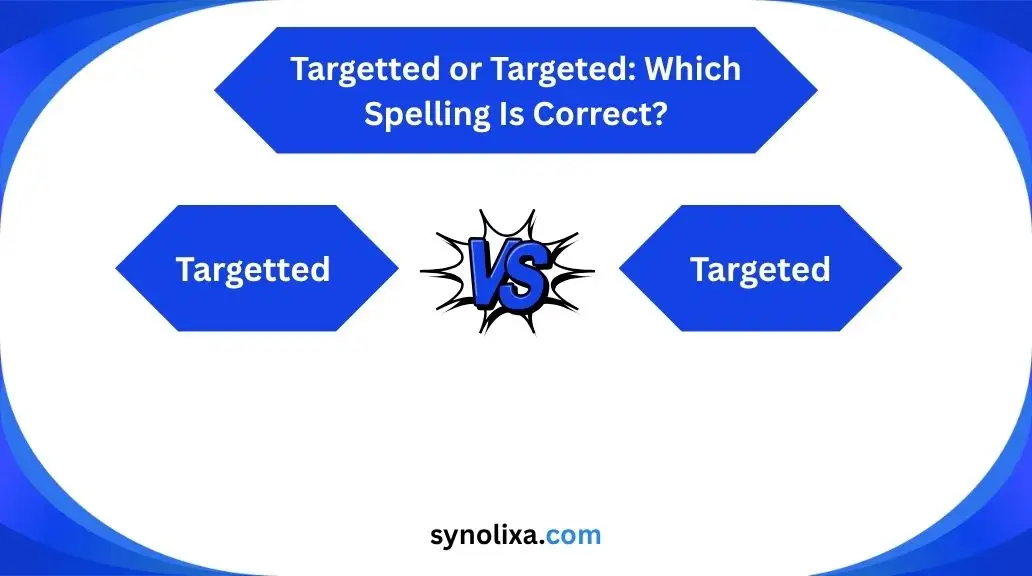
Have you ever typed a word, looked at it twice, and wondered whether it needs an extra letter? 🤔 Targetted or targeted is one of those spelling questions that can make even careful writers pause. The confusion is understandable because English has many words that double their final consonant when endings such as -ed or -ing are added. For example, plan becomes planned, and stop becomes stopped. So, it may seem logical to write targetted.
However, in standard modern English, the correct spelling is targeted, with only one t before -ed. Merriam-Webster lists targeted as the past-tense and past-participle form of target, while Cambridge Dictionary also uses targeted as the standard adjective and verb form.
The word targeted means directed toward a particular person, group, thing, goal, or purpose. It is common in everyday English, business writing, education, marketing, technology, and many other fields.
So, if you are deciding between targetted or targeted, choose targeted. ✅ Reinforce vs Reenforce | Messege vs Message | Emersion vs Immersion
Quick Answer: Targetted or Targeted?
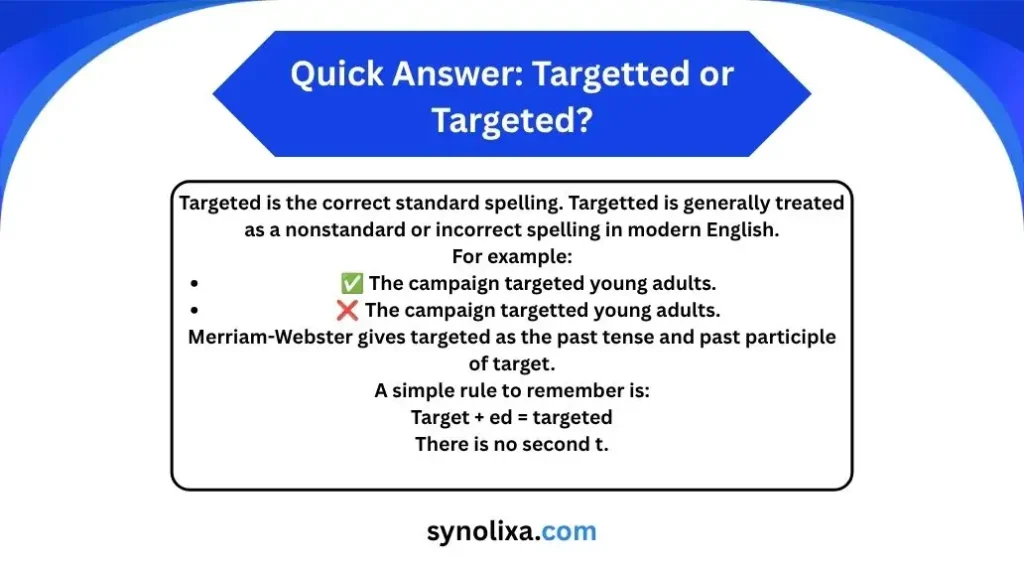
Targeted is the correct standard spelling. Targetted is generally treated as a nonstandard or incorrect spelling in modern English.
For example:
- ✅ The campaign targeted young adults.
- ❌ The campaign targetted young adults.
Merriam-Webster gives targeted as the past tense and past participle of target.
A simple rule to remember is:
Target + ed = targeted
There is no second t.
Understanding the Basics: Targetted or Targeted
The main difference between these two forms is spelling.
Targeted is the standard form used in American English and is also the normal form found in major modern dictionaries. It can function as the past tense or past participle of the verb target, and it can also function as an adjective.
Targetted may appear in informal writing or as a variant in some sources, but it is not the preferred standard spelling for ordinary modern English. Wiktionary, for example, describes it as an uncommon nonstandard spelling.
Comparison Table
| Form | Type | Meaning | Example | Correct/Incorrect |
|---|---|---|---|---|
| targeted | Verb / adjective | Directed toward a particular target | The company targeted new customers. | ✅ Correct |
| targetted | Nonstandard spelling | Intended to mean “targeted” | The company targetted new customers. | ❌ Avoid |
| target | Verb / noun | To aim at, select, or focus on something | We need to target the right audience. | ✅ Correct |
| targeting | Present participle | Directing attention or action toward something | The company is targeting students. | ✅ Correct |
The safest choice for school, work, websites, emails, and formal writing is targeted.
What Does “Targeted” Mean?
The word targeted comes from the verb target.
Merriam-Webster defines target as a verb meaning to make someone or something a target or to direct something toward a target. It also lists targeted among the verb’s forms.
In simple terms, targeted means:
- aimed at something
- directed toward someone
- focused on a particular group
- selected for a specific purpose
- intended for a particular goal
Example 1: Targeted Advertising
The company created targeted advertising for college students.
Here, targeted describes advertising that is designed for a particular audience.
Sentence breakdown:
- The company = subject
- created = verb
- targeted advertising = object phrase
- for college students = identifies the intended audience
Cambridge Dictionary similarly defines targeted as something directed at a particular person or thing and gives examples involving targeted advertising and marketing.
Example 2: Targeted Support
The school offered targeted support to students who needed extra help.
The support was not intended for everyone. It was focused on a particular group.
Example 3: Targeted Research
The researchers conducted targeted searches for specific information.
The searches were focused rather than general.
Example 4: Targeted Message
She wrote a targeted message for the new customers.
The message was created with a specific audience in mind.
Why Is “Targetted” Usually Considered Incorrect?
The confusion comes from the spelling rules for doubling consonants.
English does have situations where a final consonant is doubled before an ending is added. Consider:
- stop → stopped
- plan → planned
- fit → fitted
- shop → shopped
Because these examples are common, writers may assume that target should behave in exactly the same way.
But English spelling is not based on one universal doubling rule that applies to every word ending in a consonant.
The standard form is:
target + ed = targeted
Not:
target + ted = targetted
Major dictionaries support targeted as the standard form. Merriam-Webster explicitly gives “targeted; targeting; targets” under the verb target.
The Important Point
You should not decide whether to double the final t simply by looking at other words.
Instead, learn the established spelling of the word:
target → targeted → targeting
This is the form you should use in standard American English.
Grammar Rules Behind “Targeted”
Understanding the grammar can make the spelling easier to remember.
“Targeted” as a Past-Tense Verb
When something happened in the past, targeted can be the past tense of target.
Example:
The company targeted a new market last year.
The action happened in the past.
Another example:
The teacher targeted the main problem during the lesson.
Again, targeted describes a completed action.
“Targeted” as a Past Participle
The word can also appear as a past participle.
For example:
The campaign has targeted younger customers.
Here, has targeted forms the present perfect tense.
It can also appear in passive constructions:
The audience was targeted by the campaign.
“Targeted” as an Adjective
Targeted can describe something that is specially directed toward a person, group, purpose, or goal.
For example:
The company launched a targeted campaign.
Here, targeted functions as an adjective modifying campaign.
Cambridge Dictionary specifically lists targeted as an adjective meaning directed toward a particular person, thing, group, or activity.
Targeted vs. Targetting
There is another spelling that sometimes causes confusion: targetting.
The standard spelling is:
- ✅ targeting
- ❌ targetting
The same basic idea applies. The standard modern form does not double the final t.
Examples:
- ✅ The company is targeting a new audience.
- ❌ The company is targetting a new audience.
Merriam-Webster lists targeting as the present participle of target.
Therefore, the useful word family is:
| Base Word | Past Form | -ing Form |
|---|---|---|
| target | targeted | targeting |
This makes the spelling pattern easy to memorize.
Test Tip: How to Check the Spelling
If you are unsure whether to write targetted or targeted, use this quick test:
Step 1: Find the base word
The base word is:
target
Step 2: Add -ed
Add the normal past-tense ending:
target + ed
Step 3: Read the result
You get:
targeted
Step 4: Remember the word family
Think:
target → targeted → targeting
If you remember the complete family, you are less likely to add an unnecessary second t.
Targeted in Everyday English
The word targeted is very common in everyday communication.
You might hear or read:
- targeted help
- targeted advice
- targeted advertising
- targeted content
- targeted training
- targeted messages
- targeted questions
- targeted support
- targeted searches
- targeted improvements
For example:
The teacher gave targeted advice to each student.
Or:
The app provides targeted recommendations.
The word is useful because it communicates the idea of specific focus in a single word.
Targeted in Professional Writing
In professional English, accurate spelling matters.
Consider a workplace email:
We developed a targeted marketing strategy for our new customers.
This sounds clear and professional.
Writing targetted instead may distract the reader because the spelling does not match the standard form most readers expect.
Common Business Examples
- targeted marketing
- targeted campaigns
- targeted communication
- targeted customers
- targeted research
- targeted services
- targeted solutions
- targeted training
Cambridge’s Business English Dictionary uses targeted for activities directed toward a particular group or activity, including targeted advertising and marketing.
Targeted in Creative Writing
Creative writers can also use targeted naturally.
For example:
His criticism was targeted at the central idea, not the person behind it.
Or:
The story uses targeted details to build a clear picture of the setting.
The word can help writers show that something is deliberate and focused.
However, good writing does not require using targeted repeatedly. Depending on the sentence, words such as focused, directed, aimed, or specific may sometimes sound more natural.
Targeted in Social Media and Texting
Social media has made spelling mistakes very common. People often type quickly, use autocorrect, or write without checking their messages.
You may therefore see:
“This ad was targetted at me.”
But in standard writing, use:
“This ad was targeted at me.”
Social media is informal, so minor spelling mistakes may not cause serious problems. Still, if you are writing a public post, professional profile, business page, school assignment, or formal message, targeted is the better choice.
Case Study: A Workplace Email
Imagine that a marketing employee needs to send an email to a manager.
Incorrect Version
We have targetted a new group of customers for the campaign.
The meaning is understandable, but targetted is not the standard spelling.
Correct Version
We have targeted a new group of customers for the campaign.
The corrected sentence uses the standard form.
Why the Correct Version Works
The sentence contains:
- We = subject
- have targeted = present perfect verb
- a new group of customers = object
- for the campaign = purpose
The spelling targeted works naturally and correctly in this professional context.
Another Workplace Example
The team targeted small businesses during the first stage of the campaign.
This means the team focused its efforts on small businesses.
Why Do People Write “Targetted”?
There are several common reasons.
1. Confusion About Consonant Doubling
Writers may remember words such as planned and stopped and assume the same rule applies to target.
2. Fast Typing
When people type quickly, they may add an extra letter without noticing.
3. Autocorrect or Spell-Checking Limitations
Digital tools are useful, but they do not replace knowledge of standard spelling. Different dictionaries and language settings can also behave differently.
4. Exposure to Nonstandard Writing
If someone repeatedly sees targetted online, they may assume it is correct.
5. Pronunciation Can Be Misleading
English spelling and pronunciation do not always provide a simple one-to-one guide. Writers should learn the established spelling rather than rely entirely on sound.
Common Spelling Confusions
Targetted or targeted is part of a much larger group of English spelling and grammar questions.
| Confusion | Correct Form | Common Error | Main Issue |
|---|---|---|---|
| targetted / targeted | targeted | targetted | Extra consonant |
| it’s / its | it’s / its | mixing them | Contraction vs. possessive |
| your / you’re | your / you’re | mixing them | Possessive vs. contraction |
| they’re / their / there | they’re / their / there | mixing them | Different meanings |
| affect / effect | affect / effect | mixing them | Different grammatical roles |
| then / than | then / than | mixing them | Time vs. comparison |
| definitely / definately | definitely | definately | Misspelling |
| separate / seperate | separate | seperate | Misspelling |
The lesson is simple: English contains many forms that look or sound similar, so checking the word’s meaning and standard spelling is important.
Targeted vs. Targetted: A Simple Memory Trick
Try this:
🎯 One target, one t before -ed.
The base word is:
target
Add -ed:
targeted
You do not need to add another t.
Another useful memory line is:
Aim at a target → use targeted.
So:
- target → present
- targeted → past
- targeting → ongoing action
This three-word pattern is worth remembering.
Why It Matters: Clarity and Professionalism
Correct spelling is more than a school exercise. It helps readers understand your message quickly.
1. Clarity
Standard spelling reduces distractions.
Compare:
The program targeted new users.
with:
The program targetted new users.
The second sentence may still be understandable, but the spelling error can interrupt the reader’s flow.
2. Professionalism
In professional documents, spelling mistakes can make writing appear less carefully edited.
This matters in:
- resumes
- reports
- business emails
- presentations
- websites
- academic assignments
- marketing materials
3. Digital Communication
Online writing moves quickly. A correctly spelled word makes your message easier to trust and understand.
A Short Quote
“Clear writing respects the reader’s time.”
That principle applies to even a single word such as targeted.
Is “Targetted” Ever an Exception?
There is an important nuance.
You may occasionally encounter targetted in British-oriented or historical material, and some sources describe it as an uncommon variant. Wiktionary labels it a usually British, nonstandard spelling of targeted.
However, this does not mean you should normally use targetted in modern standard American English.
For US English, the safe and standard choice is:
targeted
If you are writing an American English article, report, email, assignment, or website, use targeted consistently.
The same applies to the related form:
targeting
rather than targetting.
Targeted or Targetted in American English?
For American English, choose targeted.
Examples:
- ✅ targeted audience
- ✅ targeted campaign
- ✅ targeted advertising
- ✅ targeted approach
- ✅ targeted support
- ✅ targeted research
- ✅ targeted message
Avoid:
- ❌ targetted audience
- ❌ targetted campaign
- ❌ targetted advertising
- ❌ targetted approach
Merriam-Webster’s current entry gives targeted as the standard past-tense and past-participle form of target.
Targeted or Targetted in British English?
You may encounter targetted in some British-oriented contexts, but it is uncommon and nonstandard according to the sources discussed above.
Modern dictionaries and general usage overwhelmingly make targeted the practical choice for ordinary writing.
Therefore, unless you are deliberately reproducing a historical or unusual source spelling, use:
targeted
This is especially important when writing for an international audience, because targeted is immediately recognizable and widely accepted.
Usage Examples: Correct Sentences
Here are several examples showing how targeted works in different contexts.
Business
The company launched a targeted advertising campaign.
Education
The teacher provided targeted support to struggling students.
Technology
The software delivers targeted recommendations.
Marketing
The team created targeted content for new customers.
Research
The study used targeted searches to find relevant data.
Communication
She sent a targeted message to the selected group.
General Conversation
The question was targeted at a specific issue.
Personal Development
He created a targeted plan to improve his writing.
In every example, targeted is spelled with one t after the -e.
Quick Recap Checklist
Use this checklist whenever you are unsure.
| Question | If Yes → Use |
|---|---|
| Are you using the past tense of target? | targeted |
| Are you describing something aimed at a specific group? | targeted |
| Are you writing in standard US English? | targeted |
| Are you writing professional or academic content? | targeted |
| Are you tempted to add a second “t”? | Don’t → targeted |
Practice Example 1
Choose the correct form:
The company ______ a younger audience.
Answer:
targeted
Practice Example 2
Choose the correct form:
The program offers ______ support.
Answer:
targeted
Practice Example 3
Choose the correct form:
The team is ______ new customers.
Answer:
targeting
Notice that neither standard form uses the extra t.
Targeted vs. Targetted: Quick Comparison
| Feature | Targeted | Targetted |
|---|---|---|
| Standard US English | ✅ Yes | ❌ No |
| Standard spelling | ✅ Yes | ❌ No |
| Past tense of target | ✅ Yes | ❌ Avoid |
| Past participle | ✅ Yes | ❌ Avoid |
| Common adjective | ✅ Yes | ❌ Avoid |
| Used in professional writing | ✅ Yes | ❌ Avoid |
| Contains unnecessary extra “t” | No | Yes |
The choice is therefore straightforward:
Targeted is the correct standard spelling.
Frequently Asked Questions
1. Is “targetted” or “targeted” correct?
Targeted is the standard correct spelling in modern English, especially in American English. Merriam-Webster lists targeted as the past-tense and past-participle form of target.
2. Why is “targetted” wrong?
Targetted adds an extra t that is not used in the standard spelling. The established form is targeted.
3. Is “targeted” a real word?
Yes. Targeted is both a past-tense/past-participle form of target and an adjective meaning directed toward a particular person, group, thing, or purpose.
4. Is “targetted” acceptable in British English?
You may encounter targetted in some British-oriented sources, but it is uncommon and considered nonstandard by sources such as Wiktionary. For normal modern writing, targeted is the safer choice.
5. Is “targeting” spelled with one or two t’s?
The standard spelling is targeting, with one t at the end of the base word. Merriam-Webster lists targeting as the present participle of target.
6. What is the easiest way to remember “targeted”?
Remember:
target + ed = targeted
Think of the word family as:
target → targeted → targeting
No extra t is needed.
Conclusion
When you are choosing between targetted or targeted, the answer is clear: targeted is the standard spelling you should use in modern US English. It is the past-tense and past-participle form of the verb target, and it can also work as an adjective for something directed toward a specific person, group, thing, or goal. Merriam-Webster and Cambridge Dictionary both support the standard use of targeted.
The spelling mistake usually happens because English has many words that double their final consonants before -ed. That pattern can make targetted look logical, but it is not the standard form for ordinary modern American English.
So, remember the simple pattern:
Target → Targeted → Targeting
If you are writing an email, article, assignment, report, social media post, or professional document, choose targeted.
🎯 One target. One t. Targeted is the standard choice.

Hi, I am Ava Mitchell. I work at Synolixa as an English content writer, creating simple and useful resources about synonyms, vocabulary, and English usage.
[…] the spelling easily. By the end, you should never need to wonder about openned or opened again. ✅ Targetted or Targeted | Reinforce vs Reenforce | Messege vs […]