Have you ever wondered about thus far vs so far when writing an email, school assignment, professional report, or everyday message? Both expressions mean “up to now” or “until this point,” so it can be difficult to decide which one sounds best. Although they share the same basic meaning, they differ slightly in tone, formality, and common usage.
Understanding thus far vs so far is simple once you know how each phrase works. “So far” is more common in everyday American English and casual conversations. “Thus far” often sounds more formal and is frequently used in reports, academic discussions, and analytical writing. However, both expressions are grammatically correct, and neither is automatically better in every situation.
For example, you might tell a friend, “So far, the movie is great.” In a formal report, you could write, “Thus far, the investigation has revealed no major problems.” Both sentences communicate progress up to the present point.
In this guide, you will learn the meanings, grammar rules, differences, and practical uses of thus far vs so far. You will also discover common mistakes, review examples, and practice choosing the most natural expression for different situations. Sorry for Bothering You vs Sorry to Bother You | Continuous vs Contious | Tortuous vs Torturous
Quick Answer: Thus Far vs So Far
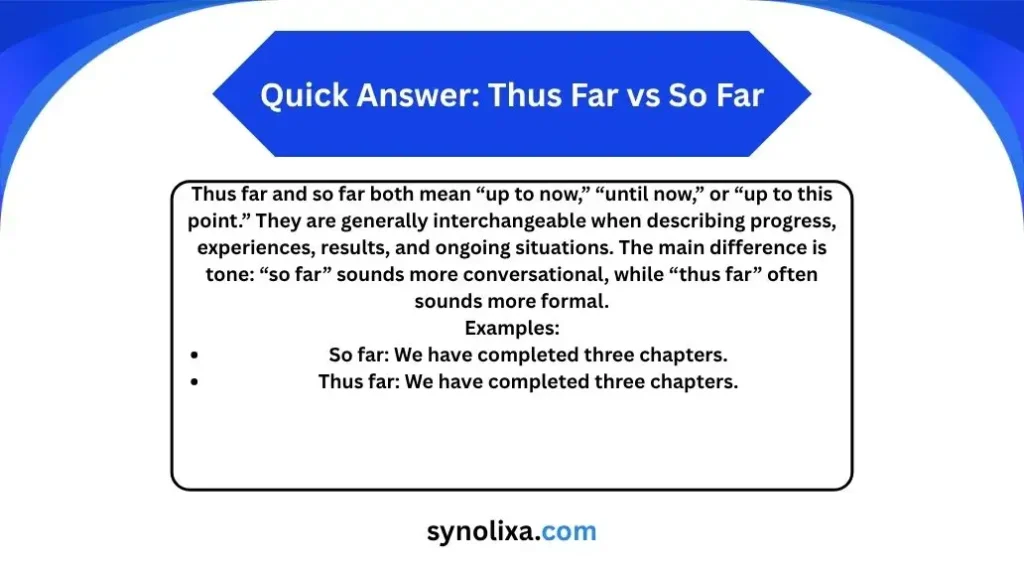
Thus far and so far both mean “up to now,” “until now,” or “up to this point.” They are generally interchangeable when describing progress, experiences, results, and ongoing situations. The main difference is tone: “so far” sounds more conversational, while “thus far” often sounds more formal.
Examples:
- So far: We have completed three chapters.
- Thus far: We have completed three chapters.
Both sentences are correct. The best choice depends on your audience, writing style, and purpose.
Understanding the Basics of Thus Far vs So Far
To understand thus far vs so far, remember that both phrases describe something that has happened or remained true up to a particular point in time.
Imagine that you started learning Spanish three months ago. Someone asks how your lessons are going. You might say, “So far, I have learned fifty new words.” In a formal progress report, you could write, “Thus far, the student has learned fifty new words.”
The information is the same, but the tone changes slightly.
Comparison Table: Thus Far vs So Far
| Form | Type | Meaning | Example | Correct/Incorrect |
|---|---|---|---|---|
| So far | Adverbial phrase | Up to now | So far, everything is going well. | Correct |
| Thus far | Adverbial phrase | Up to this point | Thus far, the results have been positive. | Correct |
| So far | Adverbial phrase | Progress until the present | We have sold 100 tickets so far. | Correct |
| Thus far | Adverbial phrase | Progress up to a particular point | Thus far, the team has met its goals. | Correct |
| So far | Adverbial phrase | Current experience | The book is interesting so far. | Correct |
| Thus far | Adverbial phrase | Current state in formal writing | Thus far, no evidence supports the claim. | Correct |
| Thus farly | Nonstandard expression | Incorrect form | We have thus farly succeeded. | Incorrect |
| So fars | Nonstandard expression | Incorrect form | We have made progress so fars. | Incorrect |
The central lesson about thus far vs so far is that both are accepted English expressions. The choice generally depends on style and context, not on a strict rule that makes one phrase correct and the other incorrect.
What Does “So Far” Mean?
“So far” means “up to now,” “until now,” or “up to this point.” It is commonly used to describe progress, current experiences, results, and situations that may continue.
Examples:
- So far, I have enjoyed my new job.
- We have received ten applications so far.
- The weather has been pleasant so far.
- So far, nobody has reported a problem.
This phrase is especially common in spoken American English because it sounds direct and natural.
What Does “Thus Far” Mean?
“Thus far” also means “up to this point” or “until now.” It often appears in formal reports, academic writing, professional summaries, and literary passages.
Examples:
- Thus far, the research has produced encouraging results.
- The committee has reviewed six proposals thus far.
- Thus far, the evidence remains inconclusive.
- No significant changes have occurred thus far.
When comparing thus far vs so far, remember that “thus far” may sound more formal, but it does not automatically make a sentence more accurate or professional.
Correct Meanings and Uses of So Far
Understanding the common uses of “so far” makes the difference between thus far vs so far easier to recognize.
1. Using “So Far” to Describe Progress
Use “so far” when explaining how much progress someone has made up to the present.
Examples:
- I have finished four assignments so far.
- Our company has hired twelve employees so far.
- She has completed half of the project so far.
- We have raised $2,000 so far.
Sentence breakdown:
“I have finished four assignments so far.”
- Subject: I
- Verb phrase: have finished
- Object: four assignments
- Time expression: so far
The phrase tells readers how much work has been completed up to now. Additional work may remain.
When comparing thus far vs so far in a progress report, either phrase can communicate this meaning.
2. Using “So Far” for Current Experiences
“So far” can describe your experience with something that is still happening.
Examples:
- The course has been helpful so far.
- I have enjoyed the new restaurant so far.
- The trip has been enjoyable so far.
- Everything is working well so far.
These statements describe an experience up to the current moment. They do not guarantee that the experience will remain the same.
For example, “The course has been helpful so far” describes your experience to date without making a prediction about future lessons.
3. Using “So Far” to Report Results
“So far” is useful when discussing results that have been recorded or observed.
Examples:
- The test results have been encouraging so far.
- We have found three possible solutions so far.
- The campaign has attracted 500 visitors so far.
- No errors have appeared so far.
This usage is common in workplace updates, research summaries, and everyday discussions.
Both thus far vs so far can be used in these sentences, although “thus far” may give a report a more formal tone.
4. Using “So Far” in Questions
“So far” frequently appears in questions about progress or personal experiences.
Examples:
- How is your new job going so far?
- What have you learned so far?
- How many customers have responded so far?
- Has the team made any progress so far?
These questions ask about developments up to the present point. They do not necessarily mean that the activity has ended.
In everyday conversation, “so far” is generally more natural than “thus far.”
5. Using “So Far” at the Beginning or End
“So far” can appear at the beginning or end of a sentence.
Examples:
- So far, we have completed the first stage.
- I have enjoyed the lessons so far.
- So far, the team has performed well.
- We have not received a reply so far.
The first position emphasizes the progress update. The final position often creates a more conversational rhythm.
The same general placement options are available when using “thus far,” so word order alone does not determine which phrase is correct.
Correct Meanings and Uses of Thus Far
The phrase “thus far” performs many of the same functions as “so far.” The difference between thus far vs so far is mainly stylistic, because “thus far” tends to sound more formal or literary.
1. Using “Thus Far” in Formal Reports
“Thus far” works well when reporting progress in a structured document.
Examples:
- Thus far, the project has remained within budget.
- The department has completed three reviews thus far.
- Thus far, the investigation has uncovered no major concerns.
- The organization has met its annual targets thus far.
Sentence breakdown:
“Thus far, the project has remained within budget.”
- Subject: the project
- Verb phrase: has remained
- Complement: within budget
- Time expression: thus far
The phrase indicates that the project has stayed within budget up to the current point.
2. Using “Thus Far” in Academic Writing
Academic writing often discusses evidence, research, theories, and findings that are still developing.
Examples:
- Thus far, the study has identified two significant patterns.
- The available evidence has not supported the hypothesis thus far.
- Thus far, researchers have observed no consistent relationship.
- The analysis has produced several useful findings thus far.
However, academic writers do not have to use “thus far.” “So far,” “to date,” and “up to this point” can also be suitable, depending on the context and style guidelines.
3. Using “Thus Far” in Professional Emails
“Thus far” can work in an email that summarizes completed work or current findings.
Examples:
- Thus far, I have completed the requested revisions.
- The team has identified two possible solutions thus far.
- Thus far, we have received feedback from eight departments.
- I have reviewed the available documents thus far.
For a friendly message, “so far” may sound more natural:
“Everything is going well so far.”
For a formal status report, this version may be suitable:
“Thus far, the project has progressed according to plan.”
Neither expression is always better. Choose the phrase that fits your audience and purpose.
4. Using “Thus Far” in Analytical Writing
Writers can use “thus far” when discussing conclusions based on information currently available.
Examples:
- Thus far, the evidence suggests that the policy has been effective.
- No reliable explanation has emerged thus far.
- Thus far, the findings remain consistent with the original prediction.
- The available data have revealed no clear pattern thus far.
This usage helps communicate that a conclusion is based on current evidence rather than on every possible future development.
5. Using “Thus Far” in Literary Writing
In creative and reflective writing, “thus far” can create a thoughtful or formal tone.
Examples:
- Thus far, his journey had taught him the value of patience.
- She considered everything she had achieved thus far.
- Thus far, their efforts had brought them closer to their goal.
- The story had been peaceful thus far, but the characters sensed a change ahead.
In these examples, the time expression can refer to a point in a past narrative. The surrounding sentence determines the appropriate verb tense.
Thus Far vs So Far: Five Key Differences
Although thus far vs so far has a simple central distinction, understanding the following points can help you choose the most appropriate expression.
Difference 1: Formality
“So far” is generally more conversational, while “thus far” often sounds more formal.
Compare:
- Conversational: So far, the meeting has been productive.
- Formal: Thus far, the meeting has been productive.
Both sentences are correct. The second may suit a formal report, while the first sounds natural in an everyday discussion.
Difference 2: Everyday Usage
“So far” is common in conversations, text messages, and informal writing.
Examples:
- How is your day going so far?
- So far, everything looks good.
- I have watched two episodes so far.
“Thus far” is understandable in these situations but may sound unnecessarily formal.
Difference 3: Professional and Academic Tone
“Thus far” often suits formal summaries and analytical writing.
Examples:
- Thus far, the research has supported the proposed explanation.
- Thus far, the company has achieved its quarterly objectives.
Nevertheless, “so far” is also correct in professional writing. Natural wording and clarity are more important than using the more formal expression.
Difference 4: Sentence Placement
Both phrases can appear at the beginning or end of a sentence.
Examples:
- Beginning: So far, the plan has worked.
- Beginning: Thus far, the plan has worked.
- Ending: The plan has worked so far.
- Ending: The plan has worked thus far.
Neither expression is restricted to one position. Sentence structure and emphasis guide the choice.
Difference 5: Meaning and Time Reference
In most ordinary situations, both expressions refer to the same period.
Compare:
- We have completed five tasks so far.
- We have completed five tasks thus far.
Both sentences indicate that five tasks have been completed up to the relevant point. Neither expression guarantees that the activity will continue.
Grammar Rules for Thus Far vs So Far
The most important grammar rule for thus far vs so far is straightforward: both are standard expressions, and neither is inherently incorrect.
They function as adverbial phrases that provide a time reference. They can modify a verb phrase or describe the time frame relevant to a statement.
Rule 1: Both Phrases Work with the Present Perfect
The present perfect often describes an activity or result that connects the past with the present.
Examples:
- I have learned a lot so far.
- I have learned a lot thus far.
- The team has completed six stages so far.
- The team has completed six stages thus far.
Both expressions work naturally because the progress made earlier remains relevant now.
Rule 2: Both Phrases Can Appear with Other Tenses
Neither expression is limited to the present perfect.
Examples:
- The weather has been pleasant so far.
- So far, the weather is pleasant.
- The story had been interesting thus far.
- The journey had been peaceful so far.
The past-tense examples are appropriate when the phrases refer to a point in a past narrative. Verb tense depends on the timeline and intended meaning.
Rule 3: Avoid Unnecessary Prepositions
Do not add extra prepositions that make a sentence awkward.
Incorrect: “Up to so far, we have made progress.”
Correct: “So far, we have made progress.”
Incorrect: “Until thus far, no problems have occurred.”
Correct: “Thus far, no problems have occurred.”
If you want a longer alternative, use “up to this point” or “until now.”
Rule 4: Use Punctuation Correctly
When either expression begins a sentence as an introductory phrase, a comma is often appropriate.
Examples:
- So far, the experiment has been successful.
- Thus far, no additional information has emerged.
At the end of a sentence, a comma is usually unnecessary.
Examples:
- The experiment has been successful so far.
- No additional information has emerged thus far.
Rule 5: Understand Their Grammatical Function
“So far” and “thus far” generally function as adverbial phrases rather than adjectives.
Examples:
- The project has progressed well so far.
- The project has progressed well thus far.
The word “far” can also describe distance, as in “a far destination.” This is a different use and does not change the basic distinction between the two time expressions.
What Standard Grammar References Tell Us
Standard dictionaries, including Merriam-Webster, can help readers check definitions, meanings, and established usage. When researching thus far vs so far, focus on how the phrases are defined and used rather than assuming that one is grammatically correct and the other is not.
The central distinction is one of tone and usage. Both expressions are accepted English.
Common Mistakes with Thus Far vs So Far
Writers sometimes make mistakes because the phrases have similar meanings or because they try to make ordinary writing sound more formal.
Mistake 1: Assuming “Thus Far” Is Always Correct
A common misconception is that “thus far” is grammatically correct but “so far” is too informal for professional writing.
Correction: Both expressions are correct. “So far” is acceptable in professional communication when it fits the sentence.
Examples:
- Correct: We have received five proposals so far.
- Correct: We have received five proposals thus far.
Mistake 2: Repeating “Thus Far” Unnecessarily
A formal document does not need to use the same expression repeatedly.
Wordy: “Thus far, we have thus far completed the first stage.”
Better: “Thus far, we have completed the first stage.”
The revised sentence is shorter and clearer.
Mistake 3: Confusing “So Far” with “So Much”
“So far” refers to a time frame. “So much” usually refers to a large amount or degree.
Compare:
- We have learned so much.
- We have learned a lot so far.
- We have learned so much so far.
In the final example, “so much” describes the amount learned, while “so far” establishes the time frame.
Mistake 4: Combining Similar Time Expressions
Avoid wording such as “up until so far” when you mean “up to now.”
Wordy: “Up until now so far, the project has been successful.”
Better: “So far, the project has been successful.”
Another correct option is “Up until now, the project has been successful.”
Choose one expression rather than combining phrases that repeat the same meaning.
Mistake 5: Choosing Formality Instead of Clarity
A formal expression does not automatically improve a sentence.
Natural: “How is your new class going so far?”
More formal: “How is your new class proceeding thus far?”
Both sentences are understandable, but the first is generally more natural in everyday conversation.
Table of Similar Grammar Confusions
| Confusing Forms | Main Difference | Example |
|---|---|---|
| It’s / Its | “It’s” means “it is” or “it has”; “its” shows possession. | It’s a useful tool. The tool has its own case. |
| Your / You’re | “Your” shows possession; “you’re” means “you are.” | You’re holding your book. |
| Their / There | “Their” shows possession; “there” refers to a place or introduces a statement. | Their car is parked there. |
| Then / Than | “Then” relates to time or sequence; “than” makes comparisons. | We ate, then left. She is taller than I am. |
| Affect / Effect | “Affect” is usually a verb; “effect” is usually a noun. | The change may affect us. The effect was clear. |
| Already / All ready | “Already” means by this time; “all ready” means completely prepared. | We have already left. We are all ready. |
| Up to now / So far | Both refer to the present point. | Up to now, everything has worked. |
| Thus far / So far | Both mean “until now”; their tone may differ. | Thus far, the results are positive. |
Why These Mistakes Happen
Several everyday habits contribute to grammar and usage errors:
- Fast typing: Writers may choose the first phrase that comes to mind without reviewing the sentence.
- Autocorrect: Automated suggestions can change words or punctuation without improving meaning.
- Lack of knowledge: Writers may believe similar expressions have strict differences when their meanings overlap.
- Overthinking formality: A writer may replace simple wording with unnecessarily complicated language.
- Limited proofreading: A quick review may miss repetition, awkward phrasing, or punctuation errors.
To avoid these mistakes, understand the meaning of each expression and reread the sentence to check whether it sounds natural.
Thus Far vs So Far in Different Contexts
The most effective way to choose between thus far vs so far is to consider your audience and purpose.
1. Everyday Conversation
In everyday American English, “so far” is usually the more natural choice.
Examples:
- How is your new job going so far?
- So far, I like the new neighborhood.
- We have watched three episodes so far.
- The food has been excellent so far.
You can use “thus far” in conversation, but it may sound formal or deliberate.
2. Professional Writing
Both expressions are appropriate in workplace communication.
Use “so far” for a direct, friendly update:
“Everything is going well so far, and we expect to finish the next stage tomorrow.”
Use “thus far” for a more formal progress summary:
“Thus far, the department has completed all scheduled reviews.”
The best choice depends on the workplace culture and the tone of the document.
3. Academic Writing
Academic writers can use either expression to describe research, evidence, or analysis.
Examples:
- So far, the results support the original hypothesis.
- Thus far, the results support the original hypothesis.
- No significant differences have been observed so far.
- No significant differences have been observed thus far.
The versions using “thus far” may sound more formal, but readability should remain the priority.
4. Creative Writing
Both expressions work in fiction, essays, and reflective writing.
“So far” tends to sound immediate and conversational:
“So far, the journey had been easier than Maya expected.”
“Thus far” can create a more reflective or literary tone:
“Thus far, the journey had taught Maya more about herself than she had anticipated.”
Choose the phrase that best matches the narrator’s voice and the surrounding prose.
5. Social Media and Texting
“So far” is generally preferable in short messages because it is familiar and concise.
Examples:
- Best weekend so far! 😊
- So far, this year has been full of surprises.
- Loving the new series so far.
- Three chapters done so far! 📚
“Thus far” can work when you want a formal, humorous, or dramatic effect.
Example:
“Thus far, my coffee has been the most productive member of the team. ☕”
The contrast between formal wording and a casual subject creates the humor.
Why Understanding Thus Far vs So Far Matters
Understanding thus far vs so far helps you write with greater precision. Although the expressions share a meaning, choosing the appropriate tone can make your message more effective.
Clarity in Communication
Clear writing helps readers understand your point without unnecessary effort.
For example, “We have received ten applications so far” is direct and easy to understand. “Thus far, we have received ten applications” communicates the same information in a slightly more formal tone.
Both sentences are clear. The goal is to use wording that fits your audience.
Professionalism
Professional writing should be accurate, respectful, and easy to read. It does not require complicated vocabulary.
Use “so far” when it sounds natural. Choose “thus far” when it suits the style of a report or analytical discussion.
Professionalism comes from making appropriate language choices, not from making every sentence sound formal.
Accuracy in Digital Communication
Emails, workplace chats, online reports, and social media updates often communicate progress in just a few words. Choosing the correct expression helps readers understand the intended time frame.
Compare:
- The software works so far.
- The software has worked well so far.
The second sentence is often more natural when describing performance observed over time. This difference concerns the verb construction, not the choice between “thus far” and “so far.”
A Short Quote About Clear Writing
“Clarity is more important than complexity.”
This original writing principle captures the lesson: choose the expression that communicates your meaning naturally and accurately.
Special Exceptions and Edge Cases: Thus Far vs So Far
There is no general grammatical exception that makes either expression incorrect in all situations. However, context can affect which phrase is most suitable.
1. Differences in Tone
Although the basic meanings overlap, the expressions can create different impressions.
Examples:
- “How are you feeling so far?” sounds natural when asking about an ongoing experience.
- “How are you feeling thus far?” sounds more formal and may feel awkward in casual conversation.
Both are understandable, but the first is generally more idiomatic in everyday speech.
2. Referring to a Point in the Past
Both expressions can refer to a point in a past narrative.
Examples:
- The journey had been peaceful so far.
- The journey had been peaceful thus far.
Here, the expressions refer to the point reached in the story rather than necessarily referring to the actual present.
3. When “So Far” Describes Physical Distance
The words “so” and “far” can appear together in a construction that describes distance.
Example: “I did not realize the station was so far away.”
In this sentence, “so far” describes distance rather than progress up to the present. “Thus far” would not normally replace it without changing the meaning.
Compare:
- The station is so far away. (Distance)
- We have walked so far today. (Distance covered)
- We have completed three miles so far today. (Progress up to now)
Context determines the intended meaning.
4. When Another Expression Is More Precise
Sometimes “to date,” “until now,” or “up to this point” may communicate your meaning more precisely.
Examples:
- To date, the company has released four products.
- Until now, I had not understood the problem.
- Up to this point, the argument has been convincing.
These expressions overlap with thus far vs so far, but they are not perfect substitutes in every sentence.
5. Brand Names and Titles
A company, publication, product, or creative work may use “Thus Far” or “So Far” as part of a proper name or title. In such cases, follow the official spelling and capitalization.
In ordinary sentences, both expressions are generally written in lowercase unless they begin a sentence or appear in a title that uses title case.
Case Study: Thus Far vs So Far in a Workplace Update
Consider a project manager named Alex who needs to update a team about a website redesign. The team has completed the homepage, reviewed the navigation, and started testing the mobile layout.
Alex has two ways to communicate the update.
Version 1: Friendly Team Message
“Hi, everyone! We have finished the homepage and navigation review. Mobile testing is underway, and I will share another update tomorrow. So far, everything is progressing well.”
This version sounds conversational and is suitable for an internal team chat.
Version 2: Formal Progress Report
“Thus far, the team has completed the homepage and navigation review. Mobile testing is underway, and a further update will be provided tomorrow.”
This version sounds more formal and is suitable for a structured project report.
What Does This Example Teach Us?
Both versions are grammatically acceptable, but the first suits a friendly message while the second suits a formal report.
The writer should also consider whether the time expression is necessary. If the sequence of events already communicates the status, removing an extra phrase may improve clarity.
A concise alternative is:
“We have completed the homepage and navigation review. Mobile testing is underway, and I will share another update tomorrow.”
Practical lesson: Use thus far vs so far when the time frame matters. Do not add either expression simply to make a sentence sound more polished.
Quick Recap Checklist: Thus Far vs So Far
Use this checklist to choose the correct expression for your sentence.
| Question | If Yes, Use |
|---|---|
| Are you describing progress up to the present? | Either “so far” or “thus far” |
| Are you writing a casual message? | Usually “so far” |
| Are you writing a formal report? | “Thus far” may fit well; “so far” is also correct |
| Do you want a natural, conversational tone? | “So far” |
| Do you want a slightly more formal or literary tone? | “Thus far” |
| Are you describing physical distance? | “So far” in the appropriate distance construction |
| Are you unsure which expression sounds better? | Choose the clearest, most natural option |
Practice Examples: Thus Far vs So Far
Choose the more natural expression for each sentence.
1. “How is your new school going ___?”
Best answer: so far
Explanation: “So far” is the more natural expression in a casual question.
2. “___, the investigation has found no evidence of misconduct.”
Best answer: Either “Thus far” or “So far”
Explanation: Both are correct. “Thus far” creates a somewhat more formal tone.
3. “The team has completed four stages ___.”
Best answer: Either “so far” or “thus far”
Explanation: Both phrases correctly describe progress up to the present. “So far” is more conversational, while “thus far” is more formal.
FAQs
1. What is the main difference between thus far and so far?
Both expressions mean “up to now” or “until this point.” The main difference is tone: “so far” is more common in everyday conversation, while “thus far” often sounds more formal or literary.
2. Is “thus far” more formal than “so far”?
Yes. “Thus far” generally sounds more formal and is often used in reports, academic discussions, and analytical writing. However, “so far” is also acceptable in professional and academic contexts.
3. Are thus far and so far interchangeable?
Usually, yes. When describing progress, results, or experiences up to a point in time, either expression can work. “So far” is generally more natural in casual questions and everyday conversation.
4. Is “so far” grammatically correct in formal writing?
Yes. “So far” is grammatically correct and can be used in professional reports, academic papers, and formal emails. Choose it when it communicates your meaning clearly and suits the document’s tone.
5. Can I use “thus far” at the end of a sentence?
Yes. For example, “The project has progressed according to plan thus far” is grammatically correct. You can also write, “Thus far, the project has progressed according to plan.”
6. Should I use “thus far” or “so far” in an essay?
Either expression may be appropriate. “Thus far” can suit a formal or analytical essay, while “so far” often sounds more direct and readable. Consider your audience, purpose, and any style guidelines you must follow.
Conclusion
Understanding thus far vs so far is simple once you recognize that both expressions mean “up to now” or “until this point.” Neither phrase is inherently incorrect, and both can describe progress, results, experiences, and situations that extend to a particular point in time.
The main difference is style. “So far” is generally more common in everyday American English, casual conversations, and friendly messages. “Thus far” often creates a more formal, analytical, or literary tone, making it useful in certain reports and academic discussions.
Remember to consider your audience before choosing either expression. You do not need formal wording to sound professional, and you do not need to avoid “so far” in serious writing. Clear, natural language should always be your priority.
When you are unsure, read the sentence aloud and choose the phrase that best fits its purpose. With regular practice, you will recognize which expression sounds most natural in different situations.
Final rule to remember: “So far” is the everyday favorite, while “thus far” is the more formal alternative—but both are correct when used appropriately.

Hi, I am Ava Mitchell. I work at Synolixa as an English content writer, creating simple and useful resources about synonyms, vocabulary, and English usage.
[…] mistakes. By the end, you will know how to choose the most appropriate form for your sentence. Thus Far vs So Far | Sorry for Bothering You vs Sorry to Bother You | Continuous vs […]