Have you ever struggled to choose between tortuous and torturous while writing an email, describing a difficult experience, or explaining a complicated situation? These two words look almost identical, and both can describe something unpleasant or difficult. However, tortuous vs torturous is a common word-choice problem because the words have different meanings and are not interchangeable.
The main difference is simple: tortuous describes something full of twists, turns, or complications, while torturous describes something that causes severe pain, suffering, or distress. For example, you might drive along a tortuous mountain road, but you might describe a long, uncomfortable wait as torturous.
Although both words share the Latin root associated with twisting, their modern meanings have developed in different directions. Using the wrong word can change the meaning of a sentence and leave readers confused.
In this guide, you will learn the meanings of tortuous and torturous, discover when to use each word, and explore practical examples from everyday conversations, professional writing, and creative storytelling. You will also find grammar tips, common mistakes, a comparison table, practice questions, and frequently asked questions.
By the end, you will know how to choose the correct word confidently. Loot vs Lute | Appal vs Appall | Die vs Dice
Quick Answer: Tortuous vs Torturous
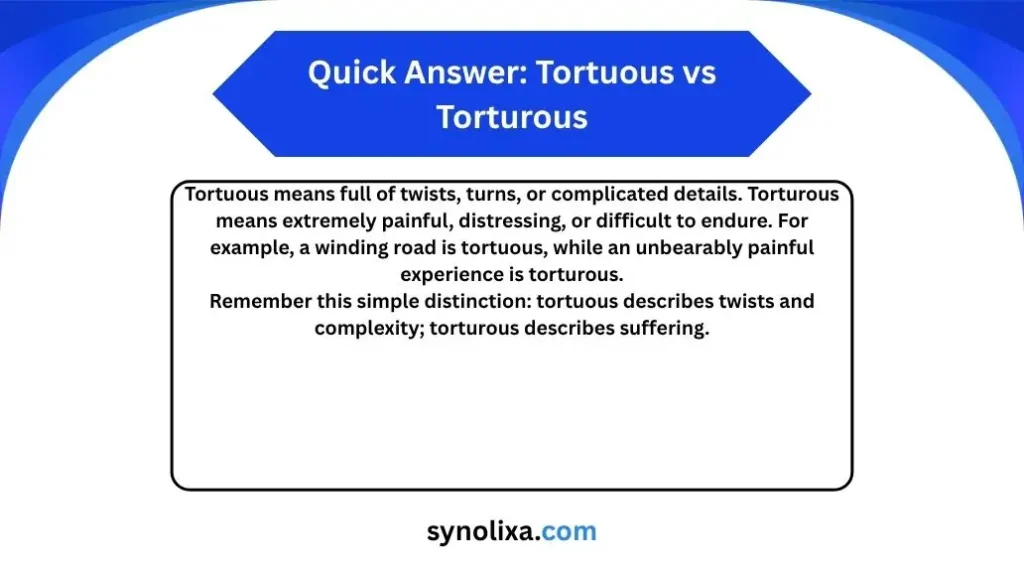
Tortuous means full of twists, turns, or complicated details. Torturous means extremely painful, distressing, or difficult to endure. For example, a winding road is tortuous, while an unbearably painful experience is torturous.
Remember this simple distinction: tortuous describes twists and complexity; torturous describes suffering.
Understanding the Basics of Tortuous vs Torturous
The easiest way to understand these words is to focus on what each one describes.
- Tortuous: Something that twists, winds, or follows a complicated path.
- Torturous: Something that causes or involves intense pain, discomfort, or emotional suffering.
Both words are adjectives. This means they describe nouns, such as roads, journeys, experiences, processes, and situations.
However, their meanings are different enough that replacing one with the other can create an unintended message.
Comparison Table
| Feature | Tortuous | Torturous |
|---|---|---|
| Form | Adjective | Adjective |
| Type | Descriptive adjective | Descriptive adjective |
| Main meaning | Twisting, winding, or complicated | Painful, distressing, or agonizing |
| Common use | Roads, arguments, procedures, journeys | Experiences, waits, treatments, ordeals |
| Example | The tortuous trail crossed the mountain. | The torturous wait lasted for hours. |
| Correct usage | A tortuous route | A torturous experience |
| Incorrect usage | A tortuous experience when you specifically mean intensely painful | A torturous route when you specifically mean winding |
The final two examples need context. A route can be both winding and unpleasant, and an experience can involve complicated circumstances as well as suffering. The words are not automatically incorrect in those situations. The important question is which meaning you want to communicate.
Why Are These Words Confused?
There are three main reasons.
1. They look similar. Both words begin with “tort” and contain nearly the same letters.
2. They share a historical connection. Both ultimately relate to the Latin idea of twisting or turning.
3. Their meanings sometimes overlap in real situations. A complicated legal process might be emotionally exhausting, while a winding journey might be physically uncomfortable.
Despite these similarities, the words emphasize different qualities. Tortuous emphasizes the structure or course of something. Torturous emphasizes the suffering associated with it.
Correct Meanings and Uses of Tortuous
1. Tortuous Means Full of Twists and Turns
The most straightforward meaning of tortuous is winding or twisting.
It is often used to describe roads, paths, rivers, trails, and other physical routes that change direction repeatedly.
Examples:
- The tortuous road climbed through the mountains.
- We followed a tortuous path through the forest.
- The river followed a tortuous course across the valley.
- The hikers carefully navigated the tortuous trail.
Sentence breakdown:
Consider this sentence:
“The tortuous road led us to a small village.”
- The road: The noun being described.
- Tortuous: The adjective explaining that the road winds or twists.
- Led us to a small village: The remaining information about the road.
The word tortuous describes the road’s shape, not necessarily how painful or uncomfortable the journey was.
A winding road may be beautiful, exciting, or difficult to drive on. The adjective simply highlights its twisting course.
2. Tortuous Means Complicated or Indirect
Tortuous can also describe something that is complicated, difficult to follow, or indirect.
This meaning is especially common in professional writing, politics, law, academic discussions, and explanations.
Examples:
- The company followed a tortuous approval process.
- Her tortuous explanation confused the audience.
- The negotiations took a tortuous path toward an agreement.
- The case involved a tortuous series of legal arguments.
Sentence breakdown:
“The tortuous approval process delayed the project.”
- Approval process: The noun phrase.
- Tortuous: Indicates that the process involved many complications or indirect steps.
- Delayed the project: Explains the result.
Here, tortuous does not necessarily mean the process caused physical pain. It means the process was complicated, difficult to navigate, or unnecessarily indirect.
For instance, an application that requires numerous forms, repeated reviews, and several layers of approval might reasonably be called a tortuous process.
3. Tortuous Describes Complicated Reasoning
The word is also useful when describing an argument, explanation, or line of reasoning that takes many indirect steps.
Examples:
- The speaker presented a tortuous argument that few people could follow.
- His tortuous reasoning made a simple problem seem complicated.
- The report contained a tortuous explanation of the financial decision.
In these sentences, the word suggests that the reasoning is difficult to follow because it moves through complicated or indirect steps.
It does not automatically mean the argument is incorrect. An argument may be logically valid yet tortuous because it is unnecessarily complicated.
Compare these sentences:
- “Her argument was tortuous.” This suggests that the argument was complicated or difficult to follow.
- “Her argument was torturous.” This suggests that listening to it felt extremely unpleasant or distressing.
The second sentence uses a much stronger emotional description.
4. Tortuous in Figurative Writing
Writers frequently use tortuous figuratively to describe complicated journeys, relationships, decisions, or paths toward success.
Examples:
- His tortuous journey toward a career in medicine included several changes in direction.
- Their relationship followed a tortuous course before they reached an understanding.
- The negotiations took a tortuous route toward a final agreement.
These examples use the idea of a winding path to communicate a process that was not straightforward.
Writing tip: Use tortuous when you want readers to imagine twists, detours, obstacles, or complexity.
Correct Meanings and Uses of Torturous
1. Torturous Means Extremely Painful
Torturous describes something that causes or involves intense physical pain or suffering.
Examples:
- The patient described the experience as torturous.
- The injury made even simple movements feel torturous.
- The treatment was a torturous experience for the injured animal.
The exact meaning depends on context. The word may describe physical suffering, an experience of severe discomfort, or a situation that feels extremely difficult to endure.
Sentence breakdown:
“The recovery period was torturous.”
- Recovery period: The noun phrase being described.
- Torturous: Indicates that the period involved intense suffering or discomfort.
The word does not describe a winding path or complicated structure. It emphasizes how difficult the experience was to endure.
2. Torturous Means Emotionally Distressing
Torturous can also describe emotional suffering, anxiety, uncertainty, or distress.
Examples:
- Waiting for the important news was torturous.
- The uncertainty became torturous for the entire family.
- It was torturous to watch the team lose after months of preparation.
- The days leading up to the final decision felt torturous.
In these examples, the suffering is emotional rather than necessarily physical.
A person waiting for an important result might feel anxious because they do not know what will happen. Calling the wait torturous emphasizes the intensity of that emotional discomfort.
The word is stronger than unpleasant, annoying, or inconvenient. It suggests an experience that feels extremely difficult to bear.
3. Torturous Describes an Unbearable Wait
One common use of torturous is to describe waiting that feels painfully long.
Examples:
- The torturous wait for the examination results seemed endless.
- Every minute of the delay felt torturous.
- The family endured a torturous wait for the missing travel documents.
Notice that the wait does not need to involve literal physical pain. The word communicates the person’s emotional experience.
Compare:
- “The tortuous wait involved several complicated administrative stages.” This emphasizes complexity or an indirect process.
- “The torturous wait made everyone anxious.” This emphasizes emotional suffering.
Both sentences can be grammatically correct because they describe different aspects of a situation.
4. Torturous in Creative Writing
Authors use torturous to create a strong emotional effect. It helps communicate how deeply a character experiences a situation.
Examples:
- The character endured a torturous journey through the freezing wilderness.
- The torturous silence made the conversation uncomfortable.
- The final hours before the announcement were torturous for the contestants.
In creative writing, the word can describe an event, a period, a sensation, or a psychological experience.
However, it is a powerful adjective. Using it for every minor inconvenience can weaken its impact.
For example, “The five-minute wait for coffee was torturous” might be humorous or exaggerated in casual conversation. In formal writing, frustrating or annoying may be more appropriate if the discomfort was mild.
Tortuous vs Torturous: Examples in Real Sentences
The best way to understand the distinction is to compare the words in similar situations.
Example 1: A Mountain Road
Correct: “The tortuous mountain road required careful driving.”
Why? The road contains many bends and turns.
Possible but different: “The torturous mountain drive exhausted the passengers.”
Why? This sentence focuses on how unpleasant or exhausting the drive felt, not on the road’s physical shape.
Example 2: A Complicated Application
Correct: “The tortuous application process involved six separate reviews.”
Why? The sentence emphasizes complexity and multiple stages.
Possible but different: “The application process became torturous for the frustrated applicant.”
Why? This version emphasizes the applicant’s suffering and frustration.
Example 3: Waiting for Results
Correct: “The torturous wait for the results left her feeling anxious.”
Why? The sentence describes emotional distress.
Different meaning: “The tortuous route through the approval system delayed the results.”
Why? Here, tortuous describes the complicated process.
Example 4: An Argument
Correct: “The lawyer presented a tortuous argument with many indirect points.”
Why? The reasoning was complicated.
Different meaning: “Listening to the long argument was torturous for the exhausted audience.”
Why? The sentence describes the audience’s unpleasant experience.
Example 5: A Difficult Journey
Both words may be correct in one sentence if they describe separate qualities.
“The travelers endured a torturous journey along a tortuous mountain road.”
- Torturous journey: The journey was extremely unpleasant or difficult to endure.
- Tortuous mountain road: The road contained many bends and turns.
This sentence illustrates the central difference perfectly.
A Practical Test Tip
When you are unsure which word to choose, ask yourself one question:
Am I describing twists and complexity, or pain and suffering?
- If you mean a winding path, indirect process, or complicated explanation, choose tortuous.
- If you mean intense discomfort, distress, or suffering, choose torturous.
Try replacing the word with a simpler expression.
If “winding” or “complicated” preserves the meaning, tortuous is probably the better choice.
If “painful,” “agonizing,” or “extremely distressing” preserves the meaning, torturous is probably the better choice.
Remember that context matters. A complicated experience can also be painful, so choose the adjective that communicates your main point.
Case Study: Using Tortuous and Torturous at Work
Imagine that Maya works for a company that is launching a new product. She must submit several documents, receive approval from different departments, and wait for the final decision.
At the end of the process, she writes an email to her manager.
Incorrect or Unclear Version
“Completing the approval process was torturous because it involved many steps.”
This sentence is understandable, but it may not communicate Maya’s main point precisely. If she wants to emphasize the process’s complexity, tortuous is more accurate.
Improved Version
“The approval process was tortuous because it involved multiple reviews, repeated paperwork, and several unexpected delays.”
This version highlights the indirect and complicated process.
Maya might then describe how the experience affected her:
“Waiting three weeks for the final decision was torturous because I could not confirm the product launch date.”
Here, torturous communicates emotional strain caused by uncertainty.
What Can We Learn?
The two words can describe different aspects of the same workplace experience.
- Tortuous process: A complicated sequence of steps.
- Torturous wait: An extremely distressing period of uncertainty.
Using each word precisely makes the email clearer and more professional. It also helps the reader understand whether Maya is criticizing the process’s design or explaining how the delay affected her.
Grammar Rules: Why Tortuous and Torturous Are Different
1. Both Words Are Adjectives
Tortuous and torturous both function as adjectives. They can appear before a noun or after a linking verb.
Examples:
- The tortuous road was difficult to navigate.
- The road was tortuous.
- The wait was torturous.
- The torturous experience affected everyone involved.
Both words follow ordinary English adjective patterns. The difference is semantic, meaning it concerns what the words mean rather than how they are grammatically formed.
2. They Have Different Semantic Emphases
The main rule is about meaning:
- Tortuous: Characterized by twisting, indirectness, or complexity.
- Torturous: Characterized by pain, distress, or severe discomfort.
This difference remains the same whether the adjective appears in a formal report, casual conversation, or creative story.
3. Their Word Origins Explain the Similarity
Both words are connected historically to the Latin word torquere, meaning “to twist.”
Tortuous developed the sense of twisting or winding, including figurative complexity.
Torturous developed its association with torture and the suffering connected with it.
Their shared history helps explain why they look similar, but their modern meanings are distinct.
4. What Do Dictionaries Say?
Standard references such as Merriam-Webster distinguish the two words by meaning. Tortuous is associated with winding, twisting, or being circuitous. Torturous is associated with torture, pain, or intense suffering.
These definitions support the practical rule used throughout this article: use tortuous for winding or complicated things and torturous for experiences involving intense suffering.
Neither word is inherently more grammatically correct than the other. The correct choice depends on the meaning of the sentence.
5. Are They Interchangeable?
No, not when you want to preserve a specific meaning.
Consider the following examples:
- “The tortuous road crossed the desert.” This describes the road’s shape.
- “The torturous journey crossed the desert.” This describes the journey as extremely difficult to endure.
The two sentences are not identical in meaning. One emphasizes the route, while the other emphasizes the experience.
However, language depends on context. A road could be both tortuous and torturous if it twists through dangerous terrain and makes travel extremely difficult.
Common Mistakes With Tortuous and Torturous
Mistake 1: Choosing by Spelling Alone
Because the words look similar, writers sometimes choose whichever spelling comes to mind first.
Incorrect for the intended meaning: “The torturous road curved around the mountain.”
Better: “The tortuous road curved around the mountain.”
If the intended point is that the road contains many bends, tortuous is the clearer choice.
Mistake 2: Using Tortuous to Mean Painful
Incorrect for the intended meaning: “The tortuous headache made it difficult to concentrate.”
Better: “The torturous headache made it difficult to concentrate.”
The second sentence emphasizes pain. Depending on the intended tone, “severe headache” or “painful headache” may be more natural.
Mistake 3: Using Torturous to Mean Complicated
Unclear for the intended meaning: “The torturous instructions contained many confusing steps.”
Better: “The tortuous instructions contained many confusing steps.”
Here, tortuous emphasizes the instructions’ complexity. Another natural option is “The instructions were complicated and difficult to follow.”
Mistake 4: Overusing Strong Language
Not every difficult experience is torturous.
For example, a mildly delayed package is usually better described as frustrating than torturous. The stronger word should be reserved for situations that genuinely feel extremely distressing or painful, unless you are intentionally exaggerating for humor.
Mistake 5: Trusting Autocorrect Without Reviewing the Sentence
Spell-checking tools may accept both words because both are legitimate English words. They may not recognize that the selected word does not match the sentence’s meaning.
Always review the full sentence, not just the spelling.
Other Commonly Confused Words
| Word pair | Main difference | Example |
|---|---|---|
| It’s / Its | “It’s” means “it is” or “it has”; “its” shows possession. | It’s raining. The dog wagged its tail. |
| Your / You’re | “Your” shows possession; “you’re” means “you are.” | Your book is here. You’re welcome. |
| Affect / Effect | “Affect” is usually a verb; “effect” is usually a noun. | The change may affect sales. The effect was noticeable. |
| Principal / Principle | “Principal” can mean main or a school leader; “principle” means a rule or belief. | The principal explained the principle. |
| Tortuous / Torturous | Twisting or complicated versus painful or distressing. | A tortuous route; a torturous wait. |
Why Do These Mistakes Happen?
Several factors contribute to word-choice errors:
- Fast typing: Writers may select a familiar-looking word without checking its exact meaning.
- Autocorrect: A device may accept the spelling even when the word is inappropriate for the sentence.
- Lack of knowledge: Writers may have learned the words separately without understanding the distinction.
- Similar pronunciation and spelling: Words with similar forms are easy to confuse.
- Limited proofreading: A quick review may catch spelling errors but miss errors in meaning.
The solution is simple: learn each word’s central meaning and check whether it fits the sentence.
Usage in Different Contexts
1. Everyday Conversation
In casual conversation, people often choose simpler words. Still, both adjectives can be useful.
Examples:
- “That was a tortuous route. We kept turning onto different roads.”
- “The wait at the airport was torturous. We had no idea when the flight would leave.”
The first sentence describes a complicated route. The second communicates the frustration and distress of waiting.
For everyday speech, you can often replace tortuous with winding or complicated, and torturous with agonizing or extremely unpleasant.
2. Professional Writing
Professional writing benefits from precise word choice, especially in reports, emails, proposals, and evaluations.
Examples:
- “The company revised its tortuous approval procedure.”
- “The extended delay created a torturous experience for customers awaiting essential information.”
The first example highlights an inefficient or complicated procedure. The second emphasizes the distress experienced by customers.
However, professional writing should remain measured. If the situation is merely inconvenient, difficult, complicated, or frustrating may communicate the point more accurately.
3. Academic Writing
In academic contexts, tortuous may describe complicated arguments, processes, or explanations.
Examples:
- “The author follows a tortuous line of reasoning.”
- “The research team documented the tortuous development of the policy.”
Torturous may appear when a study discusses painful experiences or intense distress.
Examples:
- “Participants described the prolonged uncertainty as torturous.”
- “The report examined the psychological effects of torturous conditions.”
Academic writers should select words that match the evidence and avoid exaggeration.
4. Creative Writing
Creative writers can use these words to build imagery and emotional depth.
Examples:
- “The tortuous path disappeared between the cliffs.”
- “The torturous silence stretched across the room.”
- “She followed a tortuous chain of clues before discovering the truth.”
Tortuous helps readers imagine turns, detours, and complicated developments. Torturous communicates suffering or emotional strain.
Using both words in a story can help distinguish the external setting from a character’s internal experience.
5. Social Media and Texting
On social media, writers often favor short, expressive language.
Examples:
- “That tortuous road trip took us through every mountain pass.”
- “Waiting for the results was torturous!”
- “The tortuous process of planning this event is finally over.”
These examples are natural when the meanings are clear. Still, simpler alternatives may sound more conversational:
- “That road was so winding.”
- “Waiting was unbearable.”
- “Planning this event was complicated.”
The best word depends on your audience, tone, and intended message.
Why the Difference Matters
Choosing between tortuous and torturous matters because small differences in wording can significantly affect a sentence’s meaning.
1. Clarity in Communication
Readers need to understand what you are describing.
If you call a route torturous when you mean that it twists repeatedly, the reader may interpret the word as a comment about the difficulty or discomfort of traveling along it.
If you describe a complicated argument as torturous, readers may assume that listening to it was distressing rather than that its logic was difficult to follow.
The right adjective reduces ambiguity.
2. Professionalism
Accurate vocabulary shows that you understand the words you use. In professional documents, careful word choice can make your writing more credible and easier to follow.
For example, “The tortuous approval process caused repeated delays” identifies a complicated procedure. “The delays created a torturous experience for customers” identifies the resulting distress.
These sentences communicate related but different points.
3. Accuracy in Digital Communication
Online writing is often brief. Readers may not have enough context to infer what you intended.
Using the right word in a post, email, report, or message helps prevent misunderstandings. Proofreading is especially important because spell-checking software may accept both words.
4. Stronger and More Precise Writing
Precise adjectives allow writers to communicate more with fewer words.
Instead of writing, “The road had lots of twists and turns,” you might write, “The road was tortuous.”
Instead of writing, “The wait was extremely difficult and emotionally painful,” you might write, “The wait was torturous.”
A useful principle is:
“Choose the word that expresses your meaning, not merely the word that looks familiar.”
This is a practical writing reminder rather than a quotation attributed to a particular author.
Special Exceptions and Edge Cases
There is no general grammar exception that makes tortuous and torturous interchangeable. However, some situations allow either word because they emphasize different features of the same event.
1. A Journey Can Be Both Tortuous and Torturous
Consider this sentence:
“The tortuous journey through the mountains became torturous after the weather changed.”
The journey is tortuous because the route is winding. It becomes torturous because the conditions make the experience extremely difficult to endure.
Both words are correct because they describe different aspects of the journey.
2. A Process Can Be Complicated and Distressing
A long administrative process may involve many indirect steps and cause significant frustration.
You could write:
“The tortuous claims process became torturous for the family.”
The first adjective describes the process’s complexity. The second describes the family’s distress.
This distinction is useful in workplace reports, news writing, and personal accounts.
3. Figurative and Humorous Usage
Writers sometimes use torturous humorously to exaggerate a minor inconvenience.
For example:
“Choosing a movie took a torturous twenty minutes.”
This is a figurative, exaggerated use. It may suit a humorous social media post, but it would be too strong for a formal report about a minor delay.
Similarly, tortuous can be used figuratively to describe a complicated explanation or a circuitous argument.
4. Is There a Brand or Proper-Noun Exception?
Neither word has a special grammatical status merely because it appears in a product name, title, or brand name. A proper noun may use unusual spelling or capitalization, but that does not change the ordinary meanings of the adjectives in standard English.
For regular writing, remember the standard distinction: tortuous means winding or complicated; torturous means painful or distressing.
Quick Recap Checklist
Use this checklist before choosing between the two words.
| Question | If Yes → Use |
|---|---|
| Does it describe a winding road, trail, or river? | Tortuous |
| Does it describe an indirect or complicated process? | Tortuous |
| Does it describe confusing or complicated reasoning? | Tortuous |
| Does it describe intense physical pain? | Torturous |
| Does it describe emotional suffering or an unbearable wait? | Torturous |
| Does it describe both a winding route and a painful experience? | Use both where appropriate |
Practice Examples
Choose tortuous or torturous for each sentence.
1. The hikers followed a ______ trail through the forest.
2. Waiting for the final decision was ______ for the anxious applicant.
3. The lawyer presented a ______ argument that was difficult to follow.
Answers and Explanations
1. Tortuous. The sentence describes a trail that twists or winds through the forest.
2. Torturous. The sentence emphasizes emotional distress caused by waiting.
3. Tortuous. The argument is complicated and difficult to follow.
Try creating one sentence with each word. This will help you remember the difference more effectively than memorizing definitions alone.
FAQs
1. What is the main difference between tortuous and torturous?
Tortuous means winding, indirect, or complicated. Torturous means extremely painful, distressing, or difficult to endure. A tortuous road has many bends, while a torturous experience causes significant suffering.
2. Is a tortuous road correct English?
Yes. A tortuous road is a road with many twists and turns. The adjective describes its winding shape, not necessarily the discomfort of traveling on it.
3. Can an experience be tortuous?
Yes, when the experience involves a complicated, indirect, or winding course of events. However, if you want to emphasize intense pain or distress, torturous is usually more appropriate.
4. Is waiting tortuous or torturous?
It depends on what you mean. A wait can be torturous if it causes intense anxiety or distress. A process involving a tortuous series of administrative steps may create a complicated path toward a decision.
5. Can tortuous and torturous be used in the same sentence?
Yes. For example: “The tortuous mountain route made the journey torturous.” Tortuous describes the winding route, while torturous describes the difficult experience.
6. What is an easy trick to remember tortuous vs torturous?
Remember tortuous = twists and torturous = suffering. Use tortuous for winding routes or complicated processes, and torturous for experiences involving intense pain or distress.
Conclusion
Understanding tortuous vs torturous becomes easy when you focus on the meaning of each word. Tortuous describes something winding, indirect, or complicated. It is commonly used for roads, trails, arguments, explanations, and processes that involve twists or unnecessary complexity. Torturous, on the other hand, describes something painful, distressing, or extremely difficult to endure. It often appears in descriptions of physical suffering, emotional strain, and unbearable waits.
Both words are adjectives, and both are correct English. The important difference is how they communicate meaning. A tortuous route may make a journey complicated, while a torturous journey may make the traveler suffer. Sometimes, a single experience can be both tortuous and torturous, depending on the details you want to emphasize.
To remember the rule, keep this simple distinction in mind: tortuous means twisting or complicated, while torturous means painful or distressing. Choose the word that accurately expresses your intended meaning, and your writing will become clearer, stronger, and more precise.

Hi, I am Ethan Parker. I work at Synolixa as a grammar and writing specialist, helping readers understand English grammar and improve their writing skills.


[…] vs contious and use the correct form confidently in academic, professional, and casual writing. Tortuous vs Torturous | Loot vs Lute | Appal vs […]