Appal vs appall is a common spelling confusion in English because both words have the same meaning but follow different regional spelling conventions. Have you ever wondered which spelling to use when describing something shocking, frightening, or deeply upsetting? You are not alone. These two words look almost identical, which can make it difficult to know which form is correct in a particular context.
Both appal and appall are verbs that mean to shock, horrify, or greatly dismay someone. The main difference is regional spelling: appal is commonly used in British English, while appall is the standard spelling in American English. If you are writing for a US audience, appall is generally the preferred choice.
Understanding the difference between appal vs appall can help you avoid spelling mistakes in school assignments, professional emails, blog posts, and social media content. Although both forms are recognized English words, choosing the appropriate spelling makes your writing more consistent and professional.
In this guide, you will learn the meanings of both words, explore practical examples, understand their grammatical forms, and discover common mistakes to avoid. By the end, you will know exactly when to use appal and when to choose appall. Die vs Dice | Tear vs Tare | Attain vs Obtain
Quick Answer: Appal vs Appall
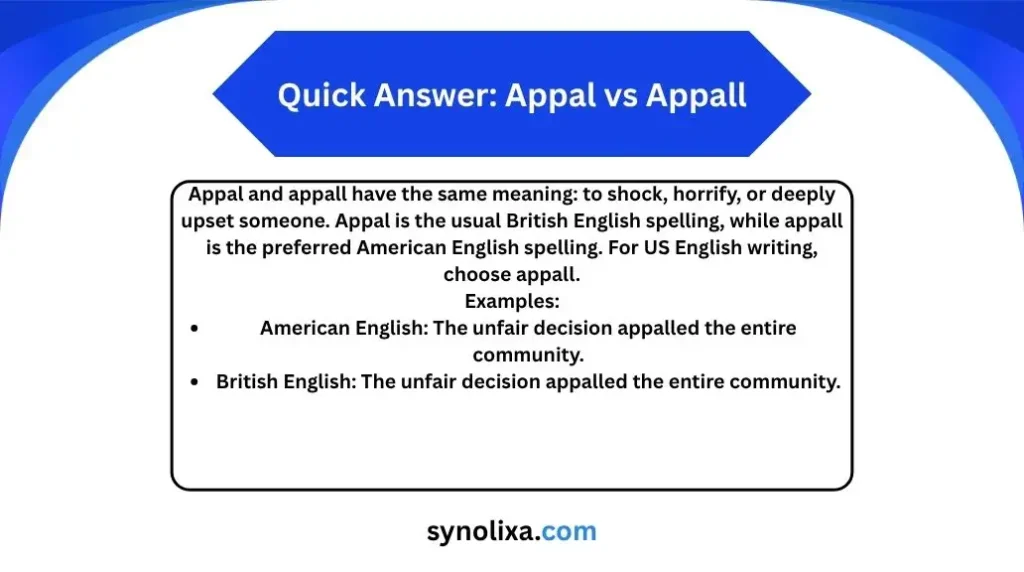
Appal and appall have the same meaning: to shock, horrify, or deeply upset someone. Appal is the usual British English spelling, while appall is the preferred American English spelling. For US English writing, choose appall.
Examples:
- American English: The unfair decision appalled the entire community.
- British English: The unfair decision appalled the entire community.
Notice that both examples use appalled, which has the same spelling in both varieties.
Understanding the Basics of Appal vs Appall
The easiest way to understand appal vs appall is to remember that the difference is mainly regional spelling, not meaning.
Both words describe a strong emotional reaction to something terrible, unacceptable, frightening, or deeply disappointing. They are verbs, so they describe an action or state involving the person who experiences that reaction.
Comparison Table: Appal vs Appall
| Feature | Appal | Appall |
|---|---|---|
| Word type | Verb | Verb |
| Main meaning | To shock or horrify | To shock or horrify |
| Standard spelling | British English | American English |
| Present tense | Appal | Appall |
| Third-person singular | Appals | Appalls |
| Past tense | Appalled | Appalled |
| Present participle | Appalling | Appalling |
| Example | The report may appal readers. | The report may appall readers. |
| Preferred in US English? | Generally no | Yes |
Both spellings are valid. The important point is that American English normally uses appall, while British English commonly uses appal.
Why Do the Words Look Different?
The difference comes from regional spelling conventions. English has many words that are spelled differently in American and British English.
For example:
- Color / colour: American English uses color, while British English uses colour.
- Traveling / travelling: American English generally uses traveling, while British English often uses travelling.
- Canceled / cancelled: American English commonly uses canceled, while British English often uses cancelled.
- Appall / appal: American English generally uses appall, while British English commonly uses appal.
These differences do not necessarily change the meanings of the words. They reflect different spelling conventions that developed over time.
When writing for an American audience, consistency is the key. If you use American spellings throughout your article, choose appall rather than switching between regional forms.
Correct Meanings and Uses of Appal and Appall
Both words communicate a strong negative reaction. They are particularly useful when ordinary words such as surprise, upset, or disappoint do not express the seriousness of a situation.
1. Appall: To Shock Someone Deeply
In American English, appall means to shock, horrify, or greatly disturb someone.
It often describes a reaction to something morally wrong, cruel, unfair, dangerous, or otherwise unacceptable.
Examples:
- The cruelty of the decision appalled the audience.
- The manager’s dishonest behavior appalled his colleagues.
- The report’s findings appall anyone who reads them carefully.
- The community was appalled by the lack of accountability.
Sentence breakdown:
Consider this sentence:
“The manager’s dishonest behavior appalled his colleagues.”
- Subject: The manager’s dishonest behavior
- Verb: Appalled
- Object: His colleagues
The behavior caused the colleagues to experience shock and dismay. The verb appalled communicates a stronger reaction than simply saying that the colleagues disliked the behavior.
When to use it: Choose appall when you want to describe something that causes deep shock or moral outrage in American English.
2. Appal: The British English Equivalent
Appal has the same meaning as appall. It is commonly used in British English and appears in British publications and other writing that follows British spelling conventions.
Examples:
- The disturbing report may appal the public.
- Such unfair treatment would appal most reasonable people.
- The decision could appal anyone who values fairness.
- The conditions were enough to appal even experienced investigators.
Sentence breakdown:
Consider this sentence:
“Such unfair treatment would appal most reasonable people.”
- Subject: Such unfair treatment
- Verb phrase: Would appal
- Object: Most reasonable people
The sentence says that unfair treatment would deeply shock or upset those people.
In American English, the equivalent sentence would normally use appall.
When to use it: Choose appal when writing in British English or when a publication specifically requests British spelling.
3. Appalling: Describing Something Shocking
Appalling is the present participle of both appal and appall. It can function as part of a verb phrase or as an adjective.
As an adjective, it describes something extremely bad, shocking, or unacceptable.
Examples:
- The service at the restaurant was appalling.
- The investigation revealed appalling conditions.
- His appalling behavior disappointed the entire team.
- The organization received criticism for its appalling decisions.
Sentence breakdown:
“The investigation revealed appalling conditions.”
- Subject: The investigation
- Verb: Revealed
- Object: Appalling conditions
- Adjective: Appalling
Here, appalling describes the conditions. It tells readers that the conditions were extremely bad or disturbing.
The spelling remains appalling in both standard American and British English.
4. Appalled: Describing Someone’s Reaction
Appalled is the past-tense form and past participle of both verbs. It often describes how a person felt after encountering something shocking.
Examples:
- I was appalled by the rude response.
- The parents were appalled by the school’s decision.
- She looked appalled when she heard the news.
- We were appalled to discover the extent of the problem.
Sentence breakdown:
“She looked appalled when she heard the news.”
- Subject: She
- Linking verb: Looked
- Descriptive word: Appalled
- Time clause: When she heard the news
The word appalled describes her reaction to the news. It does not change its spelling based on whether the writer follows American or British English.
5. Appall as a Stronger Alternative to Upset
Although upset and appall can both describe negative reactions, they do not communicate the same intensity.
Upset is broad. It can describe mild disappointment, sadness, frustration, or distress.
Appall usually expresses a much stronger reaction. It suggests shock, horror, or deep disapproval.
Compare these examples:
- Mild reaction: The rude comment upset me.
- Strong reaction: The cruel comment appalled me.
The second sentence communicates a more intense response to the comment.
Another comparison:
- The poor service disappointed the customer.
- The dangerous conditions appalled the customer.
The second example suggests that the conditions were so bad that they caused deep shock or dismay.
Test Tip: If you mean that something deeply shocked or horrified someone, appall is often appropriate in American English. If you mean ordinary sadness or disappointment, upset or disappoint may be more accurate.
Appal vs Appall: Verb Forms and Examples
Understanding the different forms of these verbs makes it easier to use them correctly in complete sentences.
Present Tense
Use appall in American English when describing a current or general reaction.
Examples:
- These findings appall the public.
- The level of dishonesty appalls me.
- Such behavior can appall even experienced professionals.
The verb changes according to the subject.
With a plural subject, use appall. With a third-person singular subject such as he, she, or it, use appalls.
Examples:
- The findings appall readers.
- The finding appalls readers.
The second sentence uses a singular subject, so the verb takes an additional s.
Past Tense
The past tense is appalled in both American and British English.
Examples:
- The announcement appalled the audience.
- His response appalled everyone in the room.
- The team was appalled by the discovery.
The past-tense spelling has two ls before -ed. It does not become appaled.
Future Tense
Use will appall when describing a reaction that may occur in the future.
Examples:
- The evidence will appall the investigators.
- Such behavior will appall many readers.
- The final report will appall anyone who expects honesty.
The verb remains in its base form after will.
Present Continuous Form
Use is appalling, are appalling, or am appalling when the action is in progress.
Examples:
- The repeated dishonesty is appalling the employees.
- The new evidence is appalling the public.
- These findings are appalling the investigators.
This form is less common than the adjective appalling, but it is grammatically possible when the sentence describes an ongoing reaction.
Perfect Tenses
Use has appalled, have appalled, or had appalled when the sentence requires a perfect tense.
Examples:
- The decision has appalled many citizens.
- The findings have appalled the research team.
- The announcement had appalled the staff before the meeting began.
The past participle is appalled in all these examples.
A Quick Verb-Form Reference
| Grammatical form | American English | British English |
|---|---|---|
| Base form | Appall | Appal |
| Third-person singular | Appalls | Appals |
| Simple past | Appalled | Appalled |
| Present participle | Appalling | Appalling |
| Past participle | Appalled | Appalled |
The base form is where the regional spelling difference is most visible. Several other forms are spelled identically.
Real-Life Case Study: Appal vs Appall in a Workplace Email
Imagine that a company has discovered that an employee’s complaint about unfair treatment was ignored for several months. A team leader wants to address the issue in an email to colleagues.
Incorrect or Inconsistent American English
“After reviewing the complaint, I can say that the way this matter was handled would appal most employees.”
The sentence is understandable, and appal is a recognized spelling. However, it is inconsistent with standard American English spelling conventions.
Preferred American English Version
“After reviewing the complaint, I can say that the way this matter was handled would appall most employees.”
The revised sentence uses the preferred American spelling.
Why Is the Second Version Better?
The second version follows standard American English conventions. It also communicates the seriousness of the situation without relying on exaggerated language.
The word appall is appropriate because the sentence expresses a strong reaction to unfair treatment.
Another Workplace Example
A manager writes:
“The findings of the internal review were appalling, and the leadership team was appalled by the lack of transparency.”
This sentence is correct in American English.
- Appalling describes the findings.
- Appalled describes the leadership team’s reaction.
Both forms are spelled the same way in American and British English.
Practical Lesson
When writing professional emails, reports, or workplace policies:
- Decide whether your document follows American or British English.
- Use the correct regional spelling consistently.
- Check the sentence to make sure the word expresses the intended degree of shock.
- Proofread the entire document rather than checking only one word.
Consistency makes professional writing easier to read and more credible.
Grammar Rules Explanation: Why Appal and Appall Are Both Correct
The apparent conflict between appal and appall is not a conflict between correct and incorrect English. It is a difference between regional spelling standards.
Rule 1: Follow Your Chosen Variety of English
American and British English sometimes use different spellings for the same word.
In standard American English, appall is the usual spelling. In standard British English, appal is common.
Neither form is universally incorrect. The appropriate choice depends on the audience and the style guide you follow.
For a US English article, school assignment, or business email, use appall.
Rule 2: Preserve the Standard Forms
When using the American form, the usual verb forms are:
- Appall
- Appalls
- Appalled
- Appalling
When using the British form, the usual forms are:
- Appal
- Appals
- Appalled
- Appalling
Notice that the past tense and participles are the same in both varieties.
Rule 3: Use the Correct Verb Form for the Sentence
Choosing the regional spelling is only one part of using the word correctly. You must also choose the appropriate grammatical form.
Examples:
- Correct: The report appalls readers.
- Correct: The report appalled readers.
- Correct: The report is appalling readers.
- Correct: The report has appalled readers.
The forms correspond to different grammatical structures and time references.
Incorrect forms such as appaled or appalld do not follow standard spelling.
What Do Dictionaries Say?
Major dictionaries, including Merriam-Webster, recognize appall as an American English spelling. British dictionaries commonly list appal as the corresponding British form.
Dictionary entries can also help you distinguish the verb from related forms such as appalled and appalling.
For reliable editing, check a reputable dictionary and follow the style guide required by your school, employer, or publication.
The central rule remains simple: Use appall in American English and appal in British English.
Common Mistakes With Appal vs Appall
Writers can confuse these words for several reasons. The difference is small, and the spelling conventions are not always taught explicitly.
Mistake 1: Treating Appal as a Universal Misspelling
Some American writers assume that appal is always wrong because it differs from the spelling they learned.
However, appal is a recognized British English spelling. It is not automatically an error.
Better approach: Check the variety of English required for the document before deciding that a regional spelling is incorrect.
Mistake 2: Using Appal in an American English Article
A writer may use appal in a US-focused article because the spelling looks familiar or appears in a British source.
Although readers will generally understand the word, appall is the better choice for consistent American English.
Better approach: Use appall when writing for an American audience.
Mistake 3: Writing Appaled Instead of Appalled
Some writers remove one l when adding the past-tense ending.
Incorrect: The decision appaled the committee.
Correct: The decision appalled the committee.
The standard past-tense spelling contains two ls before -ed.
Mistake 4: Confusing Appalled With Appalling
These forms have related meanings, but they serve different grammatical purposes.
- Appalled usually describes a person’s reaction.
- Appalling usually describes something that causes shock or horror.
Examples:
- Correct: The audience was appalled.
- Correct: The performance was appalling.
The second sentence describes the performance, while the first describes the audience’s reaction.
Mistake 5: Using Appall for Every Negative Emotion
Appall is a strong word. It may sound exaggerated when describing a small inconvenience.
Less natural: I was appalled that the store ran out of my favorite pen.
More natural: I was disappointed that the store ran out of my favorite pen.
The stronger word may still be appropriate if the situation involves genuinely shocking or unacceptable behavior.
Why Do These Mistakes Happen?
Fast typing: When typing quickly, writers may choose the spelling that comes to mind first without considering their audience.
Autocorrect: Some keyboards or writing tools may replace a regional spelling with a preferred dictionary form. Autocorrect settings can also vary by language or region.
Lack of knowledge: Writers may not know that American and British English recognize different spellings of the same verb.
Inconsistent editing: A document may combine American and British spellings because different sources or writers contributed to it.
The best solution is to select a spelling standard and review your writing for consistency.
Similar Grammar and Spelling Confusions
| Word pair | Correct usage | Common mistake |
|---|---|---|
| It’s / Its | It’s raining. The dog wagged its tail. | Confusing possession with contraction |
| Your / You’re | Your book is here. You’re welcome. | Using one form for both meanings |
| Affect / Effect | The change may affect results. The effect was clear. | Mixing up verb and noun usage |
| Advice / Advise | I need advice. Please advise me. | Confusing noun and verb forms |
| Principal / Principle | The principal spoke. Follow the principle. | Choosing the wrong word |
| Appal / Appall | British: appal; American: appall | Ignoring regional spelling |
| Appalled / Appalling | I was appalled. It was appalling. | Confusing reaction and description |
These examples demonstrate why spelling, grammar, and context all matter in clear writing.
Usage of Appal vs Appall in Different Contexts
The correct spelling depends on the type of English you are using, but the meaning remains the same.
1. Everyday Conversation
In everyday American conversation, appall can describe a strong reaction to an unacceptable event or behavior.
Examples:
- The way he treated his friends appalls me.
- I was appalled by the rude comment.
- That kind of dishonesty would appall anyone.
In casual speech, people may choose simpler words such as shock, upset, or horrify. However, appall is useful when you want to emphasize the seriousness of a reaction.
2. Professional Writing
Professional writing often requires precise vocabulary and consistent spelling.
Examples:
- The findings appall the review committee.
- The organization was appalled by the lack of transparency.
- The investigation uncovered appalling working conditions.
Use appall in American business reports, formal emails, workplace documents, and academic writing that follows US English conventions.
Avoid using the word merely to sound formal. Choose it when the situation genuinely involves deep shock or disapproval.
3. Creative Writing
Writers can use appall to create emotional intensity in novels, short stories, scripts, and descriptive passages.
Examples:
- The revelation appalled the entire family.
- She stared at the appalling scene in disbelief.
- His betrayal appalled even his closest allies.
The word can help establish a character’s reaction or show the seriousness of a fictional event.
For example:
“The discovery appalled Mara, but she remained silent.”
This sentence communicates both the intensity of Mara’s reaction and her decision not to speak.
4. Social Media and Texting
On social media, appall can appear in comments, posts, reviews, and discussions about troubling events.
Examples:
- The decision appalls me.
- I was appalled by the lack of honesty.
- The conditions described in the report are appalling.
Because online writing often reaches international audiences, spelling consistency can be especially useful.
If your account, publication, or organization targets American readers, use appall. If you follow British English conventions, appal is appropriate.
In informal texting, a simpler phrase such as “That really shocked me” may sound more natural. The best choice depends on your tone and audience.
5. Academic Writing
In an academic paper, use appall when it fits the argument and the chosen style.
Example:
“The documented conditions appalled the review panel and prompted further investigation.”
The word is grammatically correct, but an academic writer should also consider whether it is sufficiently precise and objective.
For example, “The documented conditions raised serious ethical concerns” may be more appropriate in a neutral research report.
The goal is not to use the strongest word possible. The goal is to communicate accurately.
Why the Difference Matters
The distinction between appal and appall may look minor, but understanding it can improve writing in several ways.
1. Clarity in Communication
Using a consistent spelling standard helps readers understand that you are following an established form of English.
Although both spellings have the same meaning, switching between them without a reason may distract readers from the message.
2. Professionalism
Spelling consistency shows attention to detail. This is especially important in business reports, published articles, job applications, and academic work.
A single regional spelling difference may not prevent understanding, but repeated inconsistencies can make a document appear poorly edited.
3. Accuracy in Digital Communication
Online content can reach readers from different countries. A US-based website may use American English, while a UK publication may use British English.
Selecting a standard before writing makes editing easier and helps maintain a consistent style across pages and articles.
4. Better Vocabulary Choices
Understanding appall also helps you recognize the difference between mild disappointment and deep shock.
Compare:
- “The delay disappointed me.”
- “The dishonesty appalled me.”
The first sentence expresses dissatisfaction. The second conveys a much stronger emotional response.
As a useful reminder: “Clear spelling supports clear communication.”
The quote expresses the main lesson: small writing decisions can help readers focus on what you mean.
Special Exceptions and Edge Cases
Although the spelling distinction is straightforward, a few situations deserve attention.
1. British Sources Used in American Writing
Suppose you are quoting a British article that uses appal. If you reproduce the source’s wording exactly, preserve its original spelling unless your publication’s quotation policy says otherwise.
Outside the quotation, use the spelling required by your own style guide.
2. International Publications
Some organizations use a house style that differs from the usual spelling conventions of their home country. Others accept multiple English varieties.
If you are writing for an international publication, check its style guide rather than assuming every editor follows the same convention.
3. Appalled and Appalling
The past-tense form appalled and the participle or adjective appalling use the same spelling in standard American and British English.
Examples:
- American English: The discovery appalled the team.
- British English: The discovery appalled the team.
- American English: The discovery was appalling.
- British English: The discovery was appalling.
These forms do not require you to choose between appalled and appaled.
4. Proper Names and Titles
A company, publication, creative work, or organization may use a particular spelling as part of its official name or title.
Do not automatically alter an official name to match your preferred spelling standard. Preserve proper names accurately.
However, the existence of a name using a particular spelling does not change the general American or British spelling convention for the verb.
5. Historical or Quoted Text
Older documents may follow spelling practices that differ from those used today. When discussing historical material, reproduce the original spelling when accuracy requires it.
In your own modern American English prose, use appall.
Quick Recap Checklist: Appal vs Appall
Use this table to choose the correct spelling.
| Question | If Yes → Use |
|---|---|
| Are you writing standard American English? | Appall |
| Are you writing standard British English? | Appal |
| Do you mean to shock or horrify someone? | Appall in American English; appal in British English |
| Are you describing someone’s past reaction? | Appalled |
| Are you describing something shocking or extremely bad? | Appalling |
| Are you following a specific publication’s style guide? | Follow its required spelling |
| Are you quoting a source that uses the other regional spelling? | Preserve the source spelling when quoting accurately |
Practice Examples
Test your understanding with these three examples.
Example 1
The dishonest announcement will ______ the public.
Correct answer: appall
Explanation: The sentence follows American English, and the base form follows will.
Example 2
The audience was ______ by the disturbing revelation.
Correct answer: appalled
Explanation: Appalled describes the audience’s reaction and has the same spelling in American and British English.
Example 3
The report describes ______ working conditions.
Correct answer: appalling
Explanation: Appalling describes the working conditions.
Mini Practice Quiz
Choose the best answer for each sentence.
- The decision ______ many American readers.
- A. appal
- B. appalls
- C. appalled
- The team was ______ by the results.
- A. appaled
- B. appalled
- C. appalling
- The ______ conditions led to an investigation.
- A. appalling
- B. appalled
- C. appal
Answers: 1. B, 2. B, 3. A.
In the first sentence, decision is singular, so appalls is the correct present-tense form. In the second, appalled describes the team’s reaction. In the third, appalling describes the conditions.
FAQs
1. Is appal or appall correct in American English?
Appall is the standard spelling in American English. It means to shock, horrify, or deeply upset someone. The spelling appal is commonly associated with British English.
Example: “The findings appall the investigators.”
2. What is the difference between appal and appall?
The difference is regional spelling, not meaning. Both words mean to shock or horrify someone. American English generally uses appall, while British English commonly uses appal.
3. Is appal a misspelling of appall?
No. Appal is a recognized British English spelling. It is not universally incorrect, although appall is the preferred spelling for standard American English writing.
4. What is the past tense of appall?
The past tense of appall is appalled. It is spelled the same way in American and British English.
Example: “The announcement appalled the entire community.”
5. What is the difference between appalled and appalling?
Appalled usually describes a person’s reaction, while appalling often describes something that causes shock or horror.
Examples:
- “We were appalled by the decision.”
- “The decision was appalling.”
6. Is appalling spelled the same in American and British English?
Yes. Appalling is the standard spelling in both American and British English. It describes something extremely bad, shocking, or unacceptable.
Example: “The report revealed appalling conditions.”
Conclusion
Understanding appal vs appall is simple once you recognize that both words have the same meaning but follow different regional spelling conventions. Appal is commonly used in British English, while appall is the preferred spelling in American English.
If you are writing an American English article, email, school assignment, or business report, choose appall. Remember that its other common forms are appalls, appalled, and appalling. These forms help you express a strong reaction to something shocking, disturbing, or deeply unacceptable.
You should also consider the intensity of the word. Appall is stronger than upset or disappoint, so use it when the situation deserves that level of emphasis. Most importantly, follow one spelling standard throughout your writing and check the requirements of your publication or organization.
Once you learn this simple distinction, you can use both forms with confidence. Choose the right spelling for your audience, express your meaning clearly, and let accuracy strengthen every sentence you write.

Hi, I am Ava Mitchell. I work at Synolixa as an English content writer, creating simple and useful resources about synonyms, vocabulary, and English usage.


[…] mistakes, practical examples, and simple ways to remember which spelling belongs in each situation. Appal vs Appall | Die vs Dice | Tear vs […]
[…] the end, you will know how to choose the correct word confidently. Loot vs Lute | Appal vs Appall | Die vs […]