Have you ever paused while writing because you were unsure whether to use attain vs obtain? You are not alone. These two verbs look and sound similar, and both can relate to getting or gaining something. However, they are not always interchangeable. Choosing the right word depends on what you are trying to express.
In simple terms, attain usually focuses on reaching, achieving, or accomplishing something, often after effort, growth, or progress. Obtain usually focuses on getting, acquiring, or securing something. For example, you might attain a goal, but you would normally obtain a document. You can attain a high level of skill, while you might obtain permission to do something.
The difference becomes especially important in professional, academic, and formal writing. Using the correct word can make your sentence more precise and natural.
This guide explains attain vs obtain with simple definitions, examples, grammar rules, common mistakes, practical contexts, and easy memory tips. By the end, you will know exactly when to use each verb. ✨ Who Else or Whom Else | Day Off vs Off Day | Some of Whom or Some of Who
Quick Answer: Attain vs Obtain
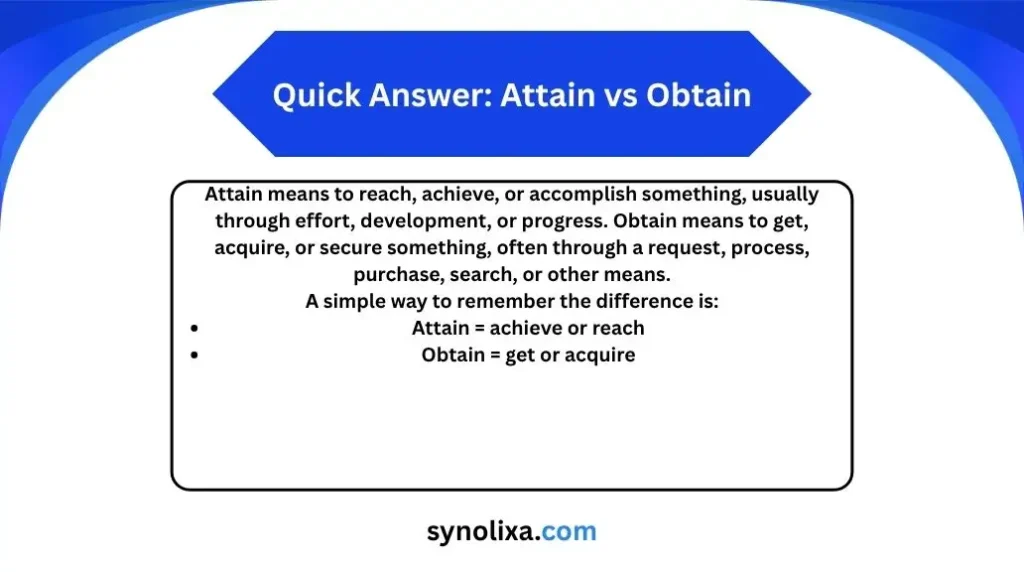
Attain means to reach, achieve, or accomplish something, usually through effort, development, or progress. Obtain means to get, acquire, or secure something, often through a request, process, purchase, search, or other means.
A simple way to remember the difference is:
- Attain = achieve or reach
- Obtain = get or acquire
For example:
- She worked hard to attain her goal.
- She contacted the office to obtain a copy of the report.
Both words are correct. The important question is what kind of “getting” you mean.
Understanding the Basics of Attain vs Obtain
The core difference between attain and obtain is the type of result being described.
Attain generally emphasizes reaching a goal, level, condition, age, or achievement. It often suggests progress toward a desired result.
Obtain generally emphasizes acquiring or securing something. The thing obtained may be physical, such as a document or object, or intangible, such as information or permission.
Merriam-Webster’s discussion of obtain notes that the two words can overlap because both can mean something like “get” or “acquire.” However, the choice depends on what is being acquired and how.
Comparison Table
| Form | Type | Meaning | Example | Correct/Incorrect |
|---|---|---|---|---|
| attain | Verb | To achieve or reach | She attained her goal. | ✅ Correct |
| obtain | Verb | To get or acquire | She obtained the required permit. | ✅ Correct |
| attain | Verb | To reach a level or condition | He attained a high level of skill. | ✅ Correct |
| obtain | Verb | To acquire something | He obtained the information. | ✅ Correct |
| attain | Verb | To acquire an ordinary physical object | She attained a new laptop. | ❌ Usually incorrect |
| obtain | Verb | To achieve a personal goal | She obtained her dream of becoming a doctor. | ❌ Usually unnatural |
| attain | Verb | To reach an age | He attained the age of 18. | ✅ Correct |
| obtain | Verb | To acquire permission | They obtained permission. | ✅ Correct |
The words overlap in some contexts, especially with abstract nouns such as knowledge, education, independence, or success. Therefore, the distinction is a useful guideline rather than an absolute rule.
What Does Attain Mean?
Attain is a verb that means to reach, achieve, accomplish, or succeed in getting something.
It is commonly associated with something that represents:
- A goal
- An achievement
- A level
- A standard
- A condition
- A degree of skill
- A particular age
- A desired result
Oxford describes attain as succeeding in getting something, usually after considerable effort, and also uses it for reaching a particular age, level, or condition.
Attain a Goal
One of the most common uses is attain a goal.
Example:
She worked for years to attain her goal of becoming a scientist.
Here, attain emphasizes the process of working toward and finally reaching the goal.
Sentence breakdown:
- She = subject
- worked for years = effort
- to attain = to reach or achieve
- her goal = desired result
You could also say:
The team attained its goal of improving customer satisfaction.
Attain Success
Another common expression is attain success.
Example:
The young entrepreneur eventually attained success after years of hard work.
The focus is not on receiving a physical object. The focus is on reaching a desirable state or level.
Attain a Level
Use attain when someone reaches a particular level.
Examples:
- She attained a high level of proficiency in Spanish.
- The athlete attained an impressive level of fitness.
- The company attained a new level of growth.
- He attained mastery of the technique.
In each example, the noun represents a level, condition, or achievement.
Attain an Age
Attain can also mean reach a particular age.
Example:
Students can apply for the program once they attain the age of 18.
Here, attain means “reach.”
Another example is:
The building remained in use until it attained an age of 100 years.
This use is more formal than everyday expressions such as “turn 18.”
Attain a Standard
You can use attain when someone or something reaches a required standard.
Example:
The product must attain a certain level of quality before it can be released.
The word suggests reaching a target or benchmark.
Test Tip for Attain
Ask yourself:
“Am I talking about reaching or achieving a goal, level, condition, age, or accomplishment?”
If the answer is yes, attain is often the better choice.
Think:
Attain = arrive at an achievement. 🎯
What Does Obtain Mean?
Obtain is a verb meaning to get, acquire, or secure something.
It is especially common in formal and professional English.
Examples include:
- Obtain a document
- Obtain permission
- Obtain information
- Obtain a permit
- Obtain evidence
- Obtain a copy
- Obtain approval
- Obtain a certificate
Merriam-Webster’s usage discussion explains that obtain commonly concerns acquiring something, including tangible things, while attain is more closely associated with reaching or accomplishing a goal.
Obtain a Document
Example:
Please contact the office to obtain a copy of the document.
The person is acquiring or getting the document.
You would not normally say:
Please contact the office to attain a copy of the document.
That sounds unnatural because a document is something you obtain, not normally something you attain.
Obtain Permission
This is another very common expression.
Example:
You must obtain permission before entering the facility.
Here, obtain means “get” or “secure.”
Other examples include:
- obtain approval
- obtain consent
- obtain authorization
- obtain a license
- obtain a permit
These expressions are particularly common in professional and legal writing.
Obtain Information
You can also obtain something intangible.
Example:
The researcher obtained useful information from the survey.
Information cannot be held like a physical object, but it can still be acquired.
Therefore, the rule “obtain is only for physical objects” is too simple. Obtain can be used for both tangible and intangible things.
Obtain a Physical Object
Example:
She obtained a rare book from a local bookstore.
This sentence sounds natural because the person acquired an actual object.
Another example:
The laboratory obtained the necessary equipment.
Again, obtain means acquire.
Test Tip for Obtain
Ask:
“Am I talking about getting, acquiring, securing, or receiving something?”
If yes, obtain may be the better choice.
Think:
Obtain = get or acquire. 📦
Attain vs Obtain: The Most Important Difference
The easiest way to understand attain vs obtain is to focus on the destination versus the acquisition.
Attain Focuses on Achievement
When you use attain, the emphasis is usually on reaching a result.
Examples:
- attain a goal
- attain success
- attain mastery
- attain independence
- attain a high standard
- attain a certain age
The word often carries an idea of progress or achievement.
Obtain Focuses on Acquisition
When you use obtain, the emphasis is usually on getting something.
Examples:
- obtain a permit
- obtain information
- obtain a document
- obtain approval
- obtain a certificate
- obtain equipment
The process might involve effort, but the main idea is acquisition.
Compare These Sentences
She attained a high level of proficiency.
This means she reached a high level of ability.
She obtained a certificate of proficiency.
This means she received or acquired the certificate.
The difference is subtle but important:
- Level of proficiency → attain
- Certificate → obtain
Can Attain and Obtain Ever Be Interchangeable?
Yes. In some situations, the two words can overlap.
This happens especially when the object is abstract.
For example:
She worked hard to attain an education.
and
She worked hard to obtain an education.
Both can be understood, although the emphasis may differ.
Attain can emphasize achieving the educational level or experience, while obtain can emphasize acquiring it.
Another example is:
He worked hard to attain financial independence.
He worked hard to obtain financial independence.
Both can work, although attain sounds especially natural because financial independence is a desired state or goal.
Dictionary.com similarly notes that the two verbs can overlap when referring to intangible things that require effort.
Attain vs Obtain With Common Nouns
Choosing the correct verb becomes easier when you look at common word combinations.
Common Expressions With Attain
- attain a goal
- attain success
- attain independence
- attain mastery
- attain excellence
- attain a level
- attain a standard
- attain an age
- attain knowledge
- attain proficiency
- attain a position
- attain a desired state
Common Expressions With Obtain
- obtain permission
- obtain approval
- obtain a permit
- obtain a license
- obtain a document
- obtain information
- obtain evidence
- obtain a certificate
- obtain a copy
- obtain equipment
- obtain funding
- obtain a visa
Learning these common combinations can make word choice much easier.
Case Study: Workplace Email
Imagine that an employee needs permission to begin a project.
Here is a natural professional sentence:
Before beginning the project, we need to obtain approval from the management team.
Why is obtain correct?
The employee needs to get approval. Approval is something that must be secured through a process.
Now imagine a different sentence:
Our team worked for six months to attain its project goal.
Here, attain is correct because the team reached an objective after sustained work.
Now compare the two:
- Obtain approval = get approval.
- Attain a goal = achieve a goal.
This distinction is extremely useful in workplace communication because formal writing often uses both verbs.
Grammar Rules for Attain vs Obtain
Both attain and obtain are verbs, and both can take a direct object.
Attain as a Transitive Verb
A transitive verb takes a direct object.
Example:
She attained her goal.
- She = subject
- attained = verb
- her goal = direct object
The verb attain directly connects to the goal.
Obtain as a Transitive Verb
Example:
She obtained permission.
- She = subject
- obtained = verb
- permission = direct object
Again, obtain takes a direct object.
Why They Are Not Perfect Synonyms
Although both can involve “getting,” their semantic focus differs.
Standard dictionary usage supports the distinction:
- Attain commonly means to reach, achieve, or accomplish.
- Obtain commonly means to get, acquire, or secure.
The difference is therefore mainly one of meaning and word choice, not basic grammar.
A Note About “Attain To”
Older or formal English can use attain to in certain constructions, particularly when attain is used in the sense of reaching something. Modern American English commonly uses attain transitively:
She attained her goal.
This is much more natural in contemporary standard writing than forcing to into the sentence.
Common Mistakes With Attain vs Obtain
People often confuse these verbs because they share several characteristics.
Mistake 1: Treating Them as Exact Synonyms
Incorrect or unnatural:
I attained a new laptop yesterday.
More natural:
I obtained a new laptop yesterday.
Or, in everyday English:
I got a new laptop yesterday.
The problem is that a laptop is something you acquire, not normally something you achieve.
Mistake 2: Using Obtain for Every Kind of Achievement
Less natural:
She obtained her goal of becoming a doctor.
Better:
She attained her goal of becoming a doctor.
The word attain fits the idea of reaching a personal goal.
Mistake 3: Assuming Obtain Only Means Physical Acquisition
That is not true.
You can obtain:
- information
- permission
- approval
- advice
- evidence
- knowledge
- results
The word is not limited to physical objects.
Why Do These Mistakes Happen?
Common reasons include:
- Fast typing: People choose the first similar word that comes to mind.
- Autocorrect: A writing program may not understand the intended meaning.
- Lack of vocabulary knowledge: Learners may know that both words mean “get” but not understand their different contexts.
- Similar spelling: Both words end in -tain.
- Formal vocabulary: Both are more formal than the everyday verb get.
Similar Grammar Confusions
The confusion between attain and obtain is part of a larger group of commonly confused English words.
| Confusing Words | Correct Difference |
|---|---|
| attain / obtain | achieve or reach / acquire or get |
| accept / except | receive or agree / exclude |
| affect / effect | influence / result or outcome |
| advice / advise | noun / verb |
| its / it’s | possessive / it is or it has |
| your / you’re | possessive / you are |
| their / they’re | possessive / they are |
| then / than | time or sequence / comparison |
| principal / principle | person or main item / rule or belief |
| compliment / complement | praise / something that completes |
The best way to avoid these mistakes is to learn the meaning and context, rather than memorizing spelling alone.
Attain vs Obtain in Everyday Conversation
In everyday American English, people often choose simpler verbs such as get, reach, or achieve.
For example:
Formal:
I need to obtain a copy of my records.
Everyday:
I need to get a copy of my records.
Formal:
She attained a high level of skill.
Everyday:
She reached a high level of skill.
This does not mean attain and obtain are unnatural. They are simply more formal and often appear in academic, professional, technical, and official writing.
Attain vs Obtain in Professional Writing
Both words are useful in professional English.
Use Attain for:
- goals
- targets
- standards
- levels
- milestones
- expertise
- independence
- success
Example:
The company hopes to attain its annual growth target.
Use Obtain for:
- permission
- approval
- documents
- information
- licenses
- permits
- funding
- equipment
Example:
The company must obtain regulatory approval before launching the product.
These combinations sound precise and professional.
Attain vs Obtain in Academic Writing
Academic writing often uses both verbs.
Examples of attain:
Students must attain a specified level of proficiency.
The study examines how individuals attain higher levels of education.
Examples of obtain:
Researchers obtained data from several sources.
The team obtained permission to conduct the study.
A useful distinction is:
Attain = reach the academic result.
Obtain = acquire the academic resource or permission.
Attain vs Obtain in Creative Writing
Creative writing gives authors more flexibility.
For example:
After years of searching, the traveler finally attained peace.
Here, attained creates a sense of an emotional destination.
You could also write:
The traveler obtained a map from an old shopkeeper.
The map is something acquired.
Creative writing can use either word depending on the intended image and tone.
Attain vs Obtain in Social Media and Texting
Social media and texting usually favor shorter, simpler words.
Instead of:
I finally attained my goal!
A casual post might say:
I finally achieved my goal! 🎉
Instead of:
I obtained a new phone.
A casual message would usually say:
I got a new phone.
However, attain can work well in motivational posts:
Work hard, stay focused, and attain your goals. 💪
And obtain can appear in educational or formal posts:
Students must obtain permission before registering.
So the choice depends on both meaning and tone.
Why the Difference Matters
Correct word choice improves communication.
1. It Improves Clarity
Compare:
She obtained her goal.
with:
She attained her goal.
The second sentence immediately communicates achievement.
2. It Improves Professionalism
Formal writing depends on precise vocabulary.
We need to obtain approval before proceeding.
sounds more precise than:
We need to get approval before proceeding.
Both are grammatically correct, but the first fits a formal document better.
3. It Improves Writing Accuracy
Choosing between similar words shows that you understand their meanings and typical contexts.
4. It Prevents Ambiguity
When your word choice accurately reflects your intended meaning, readers spend less time guessing what you mean.
As a useful reminder:
Precise words make clear ideas easier to understand.
That principle applies far beyond attain and obtain.
Special Exceptions and Edge Cases
There is no major American-English exception that makes one spelling a variation of the other. Attain and obtain are separate standard English verbs.
However, there are situations where their meanings overlap.
For example:
She attained an education.
and
She obtained an education.
Both can be acceptable depending on the intended emphasis.
The first emphasizes reaching an educational achievement or state. The second emphasizes acquiring education.
Similarly:
He attained knowledge through years of study.
and
He obtained information from the report.
Both sentences are natural, but they describe different kinds of acquisition.
Another important point is that obtain can describe intangible things, while attain can sometimes describe something concrete or a destination when the meaning is “reach.” Oxford, for example, lists attain for reaching a particular age, level, or condition.
Therefore, avoid using a rigid rule such as “attain is always abstract and obtain is always physical.” Meaning and context matter more.
Easy Memory Trick for Attain vs Obtain
Here is a simple trick:
ATTain → Achievement
Think:
ATTain = ACHIEVE
Examples:
- attain a goal
- attain success
- attain mastery
- attain a standard
OBtain → Object
Think:
OBtain = GET
Examples:
- obtain a document
- obtain permission
- obtain information
- obtain equipment
This shortcut is not a perfect rule for every possible sentence, but it works very well for common usage.
Quick Recap Checklist
Use this checklist whenever you are unsure.
| Question | If Yes → Use |
|---|---|
| Am I talking about achieving a goal? | attain |
| Am I talking about reaching a level? | attain |
| Am I talking about reaching a particular age? | attain |
| Am I talking about achieving mastery or success? | attain |
| Am I talking about getting permission? | obtain |
| Am I talking about getting a document? | obtain |
| Am I talking about acquiring information? | obtain |
| Am I talking about securing a permit or license? | obtain |
| Am I simply talking about acquiring something? | obtain |
| Does the sentence emphasize reaching an achievement? | attain |
Practice Examples
Choose attain or obtain:
- The student worked hard to ___ a high level of proficiency.
- You must ___ permission before using the equipment.
- The athlete hopes to ___ her goal this year.
Answers
- attain — a high level of proficiency is something you reach.
- obtain — permission is something you get or secure.
- attain — a goal is something you achieve.
FAQs
1. What is the difference between attain and obtain?
Attain usually means to reach, achieve, or accomplish something, while obtain usually means to get, acquire, or secure something. For example, you attain a goal but obtain a permit.
2. Is it correct to say “attain a goal”?
Yes. Attain a goal is a standard and natural expression. It means to successfully reach or achieve a goal after working toward it.
3. Is it correct to say “obtain a goal”?
It is possible to understand the expression, but attain a goal is much more natural in standard English because a goal is something you achieve or reach.
4. Can you obtain information?
Yes. Obtain information is completely correct. Obtain does not refer only to physical objects. You can obtain information, permission, approval, evidence, and other intangible things.
5. Can attain and obtain be used interchangeably?
Sometimes. The words can overlap, especially when referring to abstract things such as education, knowledge, or independence. However, they often emphasize different ideas: attain focuses on achievement or reaching a state, while obtain focuses on acquisition.
6. Which is more formal, attain or obtain?
Both are relatively formal verbs compared with everyday get. Attain is especially common in discussions of goals, achievements, levels, and development. Obtain is especially common in professional, academic, administrative, and official contexts.
Conclusion
The difference between attain vs obtain becomes much easier once you focus on the main idea behind each word. Attain generally means to reach, achieve, or accomplish something. It works naturally with goals, success, mastery, levels, standards, and conditions. Obtain generally means to get, acquire, or secure something, including documents, permission, information, equipment, and approval.
Remember the simplest rule:
Attain = achieve or reach.
Obtain = get or acquire.
The distinction is not completely rigid because the two verbs can overlap with some abstract nouns. Still, this basic rule will help you make the right choice in most everyday, academic, and professional situations.
When you are unsure, ask yourself one question: Am I reaching an achievement, or am I getting something? If you are reaching an achievement, choose attain. If you are acquiring something, choose obtain.
Mastering small distinctions like this can make your English more precise, natural, and professional. 🎯

Hi, I am Clara Anderson. I work at Synolixa as a vocabulary writer, focusing on synonyms, word meanings, and easy-to-understand English learning content.


[…] rules, practical examples, common mistakes, and tips for choosing the correct word every time. Attain vs Obtain | Who Else or Whom Else | Day Off vs Off […]