
Have you ever wondered about the difference between day off vs off day? 🤔 These two expressions look almost identical, but they usually describe two very different situations. This small difference can easily cause confusion, especially in everyday conversations, workplace messages, and social media posts.
Both phrases are common in American English, but they are not interchangeable. A day off is a day when you do not have to work, attend school, or follow your usual schedule. An off day, on the other hand, usually describes a day when you are not performing well, do not feel your best, or are having an unusually difficult day.
For example, if your manager gives you Friday away from work, you have a day off. If you go to work on Monday but feel tired, distracted, and less productive than usual, you might say you are having an off day.
Understanding this distinction will help you communicate more clearly and avoid a common English mistake. Let’s look at the difference between day off vs off day in detail. Some of Whom or Some of Who | Marquee vs Marquis | In or Within
Quick Answer: Day Off vs Off Day
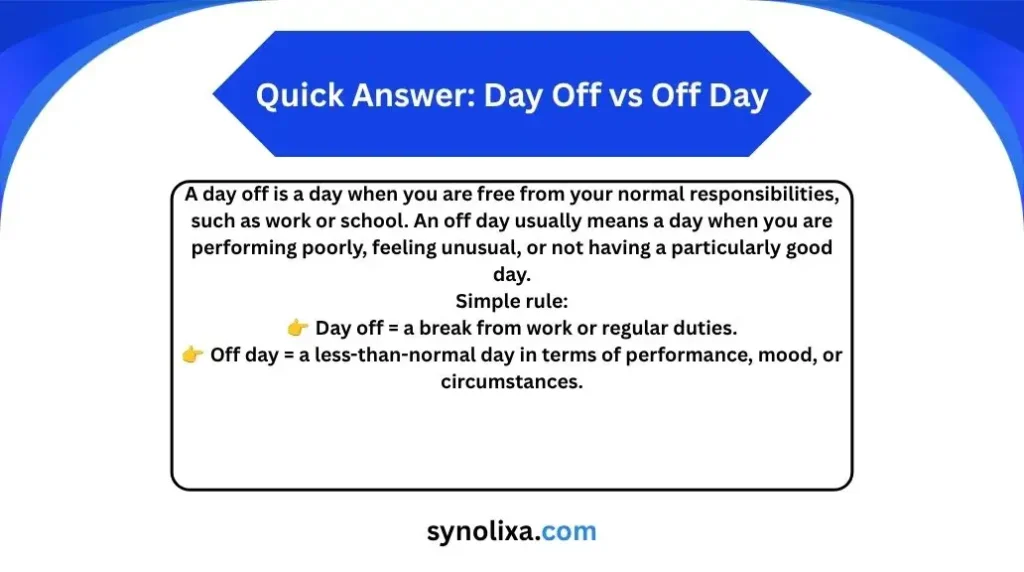
A day off is a day when you are free from your normal responsibilities, such as work or school. An off day usually means a day when you are performing poorly, feeling unusual, or not having a particularly good day.
Simple rule:
👉 Day off = a break from work or regular duties.
👉 Off day = a less-than-normal day in terms of performance, mood, or circumstances.
Examples:
- “Saturday is my day off.” ✅
- “I am having an off day today.” ✅
Understanding the Basics: Day Off vs Off Day
The easiest way to understand these expressions is to focus on what each phrase describes.
A day off describes your schedule. It tells someone that you are not required to work or perform your normal duties.
An off day describes your condition or experience. It suggests that something is not going as well as usual.
Comparison Table
| Form | Type | Meaning | Example | Correct/Incorrect |
|---|---|---|---|---|
| day off | Noun phrase | A scheduled break from work or duties | “Friday is my day off.” | ✅ Correct |
| off day | Noun phrase | A day when performance, mood, or circumstances are below normal | “I am having an off day.” | ✅ Correct |
| off day for a work break | Noun phrase | Intended to mean a scheduled day away from work | “Monday is my off day.” | ⚠️ Less standard/ambiguous |
| day off for poor performance | Noun phrase | Intended to mean a bad or unusual day | “I am having a day off today.” | ❌ Usually incorrect for this meaning |
The important point is that day off and off day are both real expressions. The difference is their meaning and typical use.
What Does “Day Off” Mean?
A day off is a day when you are not required to work or perform your usual duties.
It is commonly used for employees, students, and anyone who has a regular schedule.
Examples of “Day Off”
- “I have a day off tomorrow.”
- “She is taking a day off to relax.”
- “Sunday is my day off.”
- “I usually spend my days off with my family.”
- “Can I take a day off next Friday?”
In each example, the phrase refers to a break from a normal obligation.
Sentence Breakdown
Consider:
“I have a day off tomorrow.”
- I = subject
- have = verb
- a day off = noun phrase
- tomorrow = time expression
The phrase day off functions as a noun phrase. It identifies a day when the speaker is free from their normal responsibilities.
“Day Off” at Work
This expression is especially common in professional English.
For example:
“I will be out of the office because I have a day off.”
Or:
“My day off is Wednesday.”
You can also use the plural:
“I have two days off this week.”
The plural form is days off, not “day offs.”
✅ “I have three days off.”
❌ “I have three day offs.”
Common Expressions With “Day Off”
Some natural expressions include:
- take a day off
- have a day off
- get a day off
- enjoy a day off
- spend a day off
- request a day off
- use a day off
- schedule a day off
- give someone a day off
For example:
“I am going to take a day off tomorrow.”
This means the speaker will not work tomorrow.
What Does “Off Day” Mean?
An off day usually refers to a day when someone is not feeling or performing as well as usual.
It can describe:
- poor performance
- low energy
- unusual mistakes
- a bad mood
- a difficult experience
- a generally unsuccessful day
For example:
“I am having an off day today.”
This does not normally mean that you are not working. Instead, it suggests that something about your performance, mood, or general experience is below normal.
Examples of “Off Day”
- “I made several mistakes today. I am having an off day.”
- “Even professional athletes have an off day.”
- “She seems quiet today. Maybe she is having an off day.”
- “The presentation was not my best work. I was having an off day.”
- “Everyone has an off day sometimes.”
Sentence Breakdown
Consider:
“I am having an off day.”
- I = subject
- am having = verb phrase
- an off day = noun phrase
Here, off modifies day. The phrase describes an unusual or less successful day.
The Core Difference Between Day Off and Off Day
The simplest distinction is this:
A day off is about not working. An off day is about not performing or feeling normally.
Compare these two sentences:
“I have a day off tomorrow.”
This means you do not have to work tomorrow.
“I am having an off day today.”
This means today is not going particularly well for you.
Notice that you could have a day off and still have an off day.
For example:
“Today is my day off, but I am having an off day because I feel tired.”
The first phrase describes your schedule. The second describes how you are feeling.
A Simple Memory Trick 🧠
Think of the expressions this way:
DAY OFF → OFF FROM DUTIES
OFF DAY → OFF FROM YOUR USUAL PERFORMANCE
This simple connection makes the difference much easier to remember.
Correct Meanings and Uses
1. Using “Day Off” for a Work Break
Use day off when someone is free from work.
Example:
“I have a day off on Friday.”
Meaning: The person does not have to work Friday.
Another example:
“My boss approved my day off.”
Meaning: The boss approved the employee’s absence from work.
2. Using “Day Off” for School or Regular Duties
The phrase can also describe a break from school or another regular responsibility.
For example:
“We have a day off from school tomorrow.”
This means students do not have to attend school.
You can also say:
“The students have a day off.”
3. Using “Off Day” for Poor Performance
Use off day when someone is performing below their normal level.
Example:
“The player had an off day.”
This means the player did not perform as well as expected.
4. Using “Off Day” for Mood or Energy
An off day can also describe how someone feels.
For example:
“I am feeling unusually tired today. I think I am having an off day.”
Here, the phrase has nothing to do with being absent from work.
5. Using “Off Day” in Sports
Sports writing often uses off day to describe an unusually weak performance.
For example:
“The team had an off day.”
This means the team did not perform at its normal level.
It does not necessarily mean that the team did not play.
Is “My Off Day” Correct?
This is where things can become confusing.
In some varieties of English, especially outside the United States, people may use off day to mean a scheduled day away from work.
For example:
“Monday is my off day.”
This can be understood as meaning Monday is the day when the person does not work.
However, in standard US English, day off is generally the clearer and more natural choice when you mean a scheduled break from work.
Instead of:
“Monday is my off day.”
A US English speaker would usually say:
“Monday is my day off.”
This distinction is especially useful in professional writing because off day can also mean a day of poor performance.
Test Tip 📝
Ask yourself:
“Am I talking about being free from work, or am I talking about having a bad/unusual day?”
If you mean free from work, use:
day off
If you mean poor performance, mood, or circumstances, use:
off day
This test works in most everyday situations.
Case Study: A Workplace Conversation
Imagine that Alex works at a restaurant.
Alex’s regular schedule is Monday through Friday, but the manager gives Alex Saturday off.
Alex might tell a coworker:
“Saturday is my day off, so I am going hiking.”
Here, day off is correct because Alex is not scheduled to work.
Now imagine Alex works Monday but makes several mistakes because of tiredness.
Alex might say:
“I do not know what happened today. I was having an off day.”
Here, off day is correct because Alex’s performance was below normal.
Workplace Email Example
Suppose an employee wants to tell a manager about a scheduled absence.
A clear message would be:
“I will be taking my scheduled day off on Friday.”
This is better than saying:
“I will be taking my off day on Friday.”
The second version may be understood, but it can sound less natural in US professional English.
Practical Lesson
When communicating at work, choose day off when discussing schedules, shifts, vacations, or approved time away.
Use off day when discussing performance, mood, productivity, or an unusual experience.
Grammar Rules: Why Are They Different?
Both day off and off day are noun phrases, but the position of off changes the meaning.
Day Off
In day off, the word off comes after the noun.
The phrase means a day that is free from normal work or responsibilities.
Examples:
- “I need a day off.”
- “Tomorrow is my day off.”
- “She requested a day off.”
Off Day
In off day, the word off comes before the noun.
Here, off functions as a modifier describing a day that is unusual or below normal.
Examples:
- “I am having an off day.”
- “The pitcher had an off day.”
- “It was an off day for the entire team.”
Standard dictionaries, including Merriam-Webster, recognize day off and off day as established expressions, with context determining their meaning. The important point is not that one phrase is grammatically valid and the other is not. Both are valid; they simply serve different meanings.
That is why saying “off day is always wrong” would be inaccurate.
Is “Off Day” Incorrect?
No. Off day is not incorrect.
It is a standard expression when you mean that someone is having a poor, unusual, or less successful day.
For example:
“I am having an off day.”
This sentence is completely natural.
The confusion happens when people use off day when they actually mean day off.
For example:
“Tomorrow is my day off.” ✅
This clearly communicates that the person is not working.
Using:
“Tomorrow is my off day.”
may be understood in some contexts, but it can create ambiguity in US English because off day commonly has the performance/mood meaning.
Common Mistakes With Day Off vs Off Day
Why do people confuse these expressions? There are several reasons.
1. The Words Are Reversed
The phrases contain exactly the same two words:
- day + off
- off + day
Because the words are identical, it is easy to assume the phrases mean the same thing.
But English often changes meaning when word order changes.
2. Fast Typing
When people type quickly, they may write the first expression that comes to mind.
For example:
“Tomorrow is my off day.”
The writer may actually mean:
“Tomorrow is my day off.”
This is especially common in casual messages.
3. Autocorrect
Autocorrect can sometimes reinforce an incorrect or less suitable phrase.
A person may type quickly and send the message without checking whether the phrase matches the intended meaning.
4. Lack of Knowledge
English learners may naturally assume that day off and off day are interchangeable because they contain the same words.
Learning the meaning of each phrase solves this problem.
Similar Grammar Confusions
The difference between day off and off day is similar to many other English distinctions where small changes affect meaning.
| Confusing Forms | Correct Use |
|---|---|
| it’s / its | “It’s raining.” / “The dog wagged its tail.” |
| your / you’re | “Your book.” / “You’re ready.” |
| there / their / they’re | Location / possession / they are |
| affect / effect | Usually verb / usually noun |
| advice / advise | Noun / verb |
| then / than | Time or sequence / comparison |
| everyday / every day | Adjective / each day |
| day off / off day | Break from duties / unusual or poor day |
The lesson is simple: similar-looking words or phrases can have different grammatical roles and meanings.
Day Off vs Off Day in Everyday Conversation
In casual conversation, both phrases are common.
Examples With “Day Off”
“What are you doing on your day off?”
“I am going to sleep all morning on my day off.”
“I finally have a day off.”
These examples all refer to free time away from work or normal responsibilities.
Examples With “Off Day”
“I am sorry I was quiet today. I am just having an off day.”
“Do not worry about that mistake. Everyone has an off day.”
“He usually plays well, but today was an off day.”
Here, off day refers to an unusual or less successful experience.
Day Off vs Off Day in Professional Writing
Professional writing requires clarity.
If you are writing about schedules, use day off.
Examples:
- “I would like to request a day off.”
- “My scheduled day off is Thursday.”
- “I have a day off next Monday.”
- “She is taking a day off for a personal appointment.”
If you are discussing performance, use off day.
Examples:
- “The employee appeared to be having an off day.”
- “The team had an off day during the second half.”
- “The presentation was affected by an off day for the speaker.”
Professional Tip 💼
When discussing work schedules, day off is usually the safest choice in US English.
It removes ambiguity and makes your meaning immediately clear.
Day Off vs Off Day in Creative Writing
Creative writers can use both phrases effectively.
For example:
“After six exhausting days, Friday finally arrived as her day off.”
This establishes a break from work.
Compare that with:
“Friday was an off day, and nothing seemed to go according to plan.”
Now the phrase describes an unsuccessful or unusual day.
Creative writing often depends on context, so the distinction can even help an author create subtle meaning.
Day Off vs Off Day in Texting and Social Media
Social media and texting are informal, so you may see both expressions.
Examples:
“Finally got a day off! 🎉”
This means the person is free from work.
Another example:
“Not feeling like myself today. Definitely an off day. 😴”
This means the person is having a difficult or unusual day.
Which One Should You Use?
Use:
“day off” → when talking about free time.
Use:
“off day” → when talking about a bad or unusual day.
Even in informal writing, choosing the right phrase makes your message easier to understand.
Why This Difference Matters
It may seem like a tiny grammatical distinction, but word choice matters.
1. Clarity in Communication
Compare:
“I have an off day tomorrow.”
with:
“I have a day off tomorrow.”
The second sentence immediately tells the reader that you are not working tomorrow.
The first sentence may make someone wonder whether you mean you will have a difficult day.
2. Professionalism
In workplace communication, unclear wording can cause unnecessary confusion.
If you are requesting time away from work, say:
“I would like to request a day off.”
This is direct and professional.
3. Accuracy in Digital Communication
Emails, texts, and online messages are often read quickly. Clear wording helps your audience understand your meaning without needing additional context.
4. Confidence in English
Knowing distinctions such as this one helps English learners write and speak more naturally.
A useful principle is:
Clear words create clear communication.
Special Exceptions and Regional Usage
There is an important regional point to remember.
Some English speakers, particularly in varieties of English outside the United States, may use off day to mean a scheduled day away from work.
For example:
“Tuesday is my off day.”
In that context, the speaker may mean that Tuesday is their regular non-working day.
This usage can be understood, but if your goal is standard US English, day off is the clearer choice for a break from work.
There is also another expression worth knowing:
“Take the Day Off”
This is a very common American English expression.
For example:
“You should take the day off and get some rest.”
It means the person should not work that day.
Another related phrase is:
“Have a Day Off”
“I finally have a day off.”
Again, this means the person is free from work or another regular responsibility.
Quick Recap Checklist
Use this checklist whenever you are unsure.
| Question | If Yes → Use |
|---|---|
| Am I talking about not working? | day off |
| Am I talking about scheduled free time? | day off |
| Am I requesting time away from work? | day off |
| Am I talking about poor performance? | off day |
| Am I describing an unusually difficult day? | off day |
| Am I describing low energy or poor mood? | off day |
| Am I talking about an athlete performing poorly? | off day |
Practice Examples
1. “I do not have to work tomorrow.”
Correct:
“Tomorrow is my day off.”
2. “I made several unusual mistakes today.”
Correct:
“I am having an off day.”
3. “I want to request Friday away from work.”
Correct:
“I want to request a day off on Friday.”
One-Line Rule
If you are OFF WORK, you have a DAY OFF. If the DAY feels OFF, you are having an OFF DAY. 🧠
FAQs
1. What is the difference between “day off” and “off day”?
A day off is a day when you are free from work, school, or another regular responsibility. An off day is usually a day when you are performing poorly, feeling unusual, or experiencing a difficult day.
2. Is “day off” correct for a vacation or work break?
Yes. Day off is the natural expression for a scheduled break from work or another regular duty.
Example:
“I am taking a day off next Friday.”
3. Is “off day” grammatically correct?
Yes. Off day is grammatically correct when it describes a day that is unusual, unsuccessful, or below normal.
Example:
“The athlete had an off day.”
4. Can I say “Monday is my off day”?
The sentence may be understood, and this usage exists in some varieties of English. However, in standard US English, “Monday is my day off” is generally clearer when you mean that you do not work Monday.
5. Is “I am having an off day” correct?
Yes. This is a common and natural expression. It means you are not feeling or performing as well as usual.
6. Which is better in American English: “day off” or “off day”?
Neither phrase is universally “better.” They have different meanings. Use day off for a break from work or duties and off day for an unusual or poor day.
Conclusion
The difference between day off vs off day is simple once you focus on the meaning.
A day off is a day when you are free from work, school, or another regular responsibility. You can have a day off, take a day off, request a day off, or enjoy a day off. An off day, however, usually describes a day when your performance, mood, energy, or overall experience is not as good as normal.
Remember the easiest rule:
Day off = a break from your duties.
Off day = a day that is not going well or feels unusual.
So, if Friday is your scheduled break from work, say, “Friday is my day off.” If you make unusual mistakes on Tuesday, say, “I am having an off day.”
Both expressions are correct, but they are not interchangeable. Once you understand this small difference, your English will become clearer, more precise, and more natural.
If the day is OFF from work, it is your DAY OFF. If the DAY feels OFF, it is an OFF DAY. ✨

Hi, I am Noah Harrison. I work at Synolixa as an English language editor, reviewing and creating helpful content to make English learning easier and clearer.


[…] The answer depends on the grammatical role of the pronoun and the level of formality you want. Day Off vs Off Day | Some of Whom or Some of Who | Marquee vs […]