
Have you ever started a sentence with “there has been or there have been” and suddenly stopped because you were unsure which form sounds correct? You are not alone. This is a common English grammar question, especially when the sentence contains a plural noun such as problems, changes, or several mistakes.
The confusion happens because both “there has been” and “there have been” are grammatically correct expressions. The important point is that they are not interchangeable. The choice depends on the noun that comes after been.
Use “there has been” with a singular noun or an uncountable noun. Use “there have been” with a plural noun. For example, we say, “There has been a problem” but “There have been several problems.”
Understanding this small agreement rule can make your writing much clearer. It is especially useful in professional emails, academic writing, reports, conversations, and everyday English. Once you learn to identify the real subject after there, choosing between the two forms becomes much easier. 😊 Where Are You Headed or Where Are You Heading | Worn or Warn | Alright vs Allright
Quick Answer: There Has Been or There Have Been
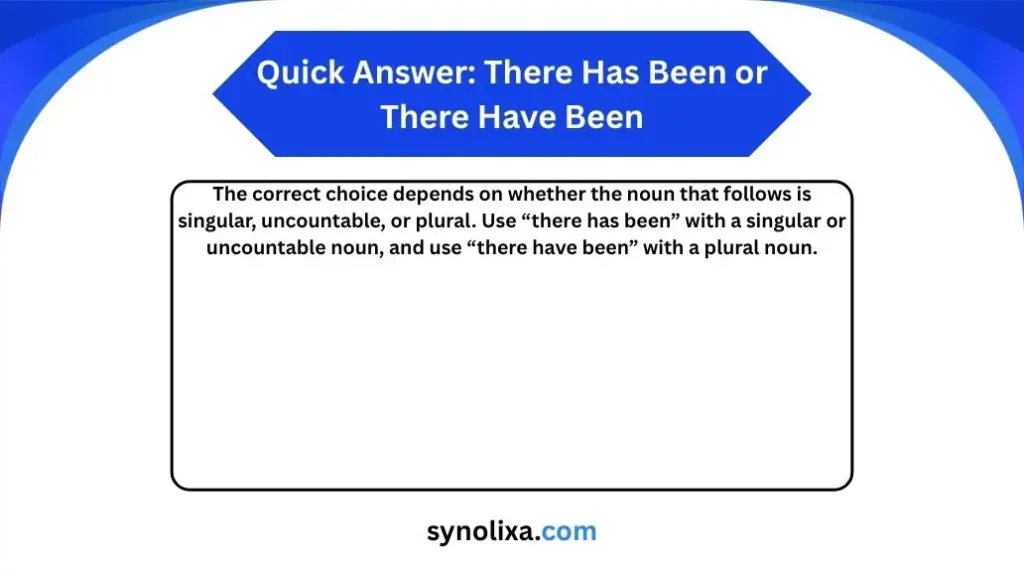
The correct choice depends on whether the noun that follows is singular, uncountable, or plural. Use “there has been” with a singular or uncountable noun, and use “there have been” with a plural noun.
- There has been a delay. ✅
- There has been some confusion. ✅
- There have been several delays. ✅
- There have been many changes. ✅
A simple rule to remember is:
Singular or uncountable noun → has been
Plural noun → have been
Understanding the Basics of There Has Been or There Have Been
The expressions “there has been” and “there have been” are forms of the present perfect construction.
The word there is often used to introduce the existence or occurrence of something. In sentences such as these, there does not determine whether we use has or have.
Instead, the noun that follows the verb determines the agreement.
Compare these sentences:
- There has been a problem.
- There have been problems.
In the first sentence, problem is singular, so we use has.
In the second sentence, problems is plural, so we use have.
Comparison Table
| Form | Type | Meaning | Example | Correct/Incorrect |
|---|---|---|---|---|
| There has been | Singular | One thing has occurred or existed | There has been a mistake. | ✅ Correct |
| There has been | Uncountable | An uncountable thing has occurred or existed | There has been confusion. | ✅ Correct |
| There have been | Plural | Multiple things have occurred or existed | There have been several mistakes. | ✅ Correct |
| There have been | Plural | Multiple events or situations have occurred | There have been many changes. | ✅ Correct |
| There has been | Plural noun | Used with a plural noun | There has been several problems. | ❌ Incorrect |
| There have been | Singular noun | Used with a singular noun | There have been a problem. | ❌ Incorrect |
The key is subject-verb agreement.
What Does “There Has Been” Mean?
There has been means that one thing has existed, happened, occurred, or been present at some point up to now.
Examples:
- There has been a delay.
- There has been an accident.
- There has been a significant improvement.
- There has been some confusion.
- There has been enough discussion.
The noun after been is singular or uncountable.
What Does “There Have Been” Mean?
There have been means that two or more things have existed, happened, occurred, or been present.
Examples:
- There have been several delays.
- There have been many accidents.
- There have been major improvements.
- There have been some problems.
- There have been numerous discussions.
The noun after been is plural.
The Grammar Behind “There Has Been”
Singular Countable Nouns
Use there has been when the noun is singular and countable.
Examples:
- There has been a change.
- There has been an error.
- There has been a misunderstanding.
- There has been a delay.
- There has been a complaint.
Look at the structure:
There + has + been + singular noun
For example:
There has been a mistake.
Here, mistake is singular. Therefore, has is required.
Uncountable Nouns
You can also use there has been with uncountable nouns.
Examples include:
- information
- advice
- confusion
- progress
- traffic
- damage
- improvement
- discussion
- uncertainty
Examples:
- There has been some progress.
- There has been a lot of traffic.
- There has been considerable damage.
- There has been some confusion.
- There has been enough discussion.
Even though an uncountable noun can describe a large amount, it is grammatically treated as singular in this construction.
Sentence Breakdown
Consider:
There has been significant progress.
- There = introductory/existential subject
- has = singular auxiliary verb
- been = past participle of be
- significant progress = noun phrase
Because progress is uncountable, has is appropriate.
The Grammar Behind “There Have Been”
Plural Countable Nouns
Use there have been when the noun is plural.
Examples:
- There have been several changes.
- There have been many complaints.
- There have been three meetings.
- There have been numerous mistakes.
- There have been several improvements.
The structure is:
There + have + been + plural noun
For example:
There have been several changes.
The word changes is plural, so have is required.
Why “Have” Is Used
The auxiliary verb have agrees with plural subjects in the present perfect.
Compare:
- One person has arrived.
- Several people have arrived.
The same basic principle applies to existential constructions:
- There has been one problem.
- There have been several problems.
Why “There” Does Not Decide the Verb
One of the biggest sources of confusion is the word there.
Some writers see there at the beginning and wonder whether they should automatically use has or have. However, there is not the noun that controls the agreement in these constructions.
Compare:
There has been a problem.
The meaningful noun is problem.
Now compare:
There have been several problems.
The meaningful noun is problems.
This is why changing the noun from singular to plural also changes has to have.
A Simple Way to Check
Ignore there has been or there have been temporarily.
Ask yourself:
What comes after “been”?
- a problem → singular → has been
- several problems → plural → have been
- some confusion → uncountable → has been
- many changes → plural → have been
This method works in most ordinary sentences.
Correct Meanings and Uses
1. Talking About One Event or Situation
Use there has been when referring to one event or situation.
Examples:
There has been an accident on the highway.
There has been a problem with the website.
There has been a change in the schedule.
Each sentence refers to one situation.
2. Talking About Multiple Events
Use there have been when several events or situations have occurred.
Examples:
There have been several accidents this week.
There have been many changes to the schedule.
There have been three meetings so far.
The plural nouns accidents, changes, and meetings require have.
3. Talking About Uncountable Things
Use there has been with uncountable nouns.
Examples:
There has been a lot of traffic.
There has been some confusion.
There has been considerable progress.
There has been enough evidence.
The nouns cannot normally be counted as individual units in these meanings, so they take the singular form of the verb.
4. Talking About Something That Started or Happened Recently
The present perfect often connects a past event with the present.
For example:
There has been a power outage.
This tells us that a power outage occurred and is relevant now.
Similarly:
There have been several updates.
This indicates that multiple updates have occurred, with present relevance.
Test Tip: The Singular-or-Plural Test
Here is an easy test you can use when you are unsure.
Step 1: Find the noun
Look immediately after been.
Step 2: Ask whether it is singular or plural
- one issue → singular
- two issues → plural
Step 3: Choose the verb
- Singular → has been
- Plural → have been
Examples
There ___ been a problem.
“Problem” is singular.
Correct:
There has been a problem. ✅
There ___ been several problems.
“Problems” is plural.
Correct:
There have been several problems. ✅
There ___ been some confusion.
“Confusion” is uncountable.
Correct:
There has been some confusion. ✅
This quick test can prevent many agreement errors.
Case Study: Workplace Email
Imagine that a manager needs to inform employees about technical problems.
An employee writes:
There has been several issues with the new software.
This sentence is incorrect because issues is plural.
The corrected version is:
There have been several issues with the new software.
Now imagine the employee is referring to one issue:
There has been an issue with the new software.
This version is correct because issue is singular.
Practical Workplace Example
A professional email might say:
There have been several delays in processing customer requests this week. Our team is reviewing the cause and working to resolve the issue.
Notice that delays is plural, so there have been is correct.
Later, the email might say:
There has been a significant improvement since yesterday.
Here, improvement is singular, so there has been is correct.
This distinction may seem small, but accurate subject-verb agreement makes professional writing look more polished.
Grammar Rules Explained
The central rule is subject-verb agreement.
The present perfect uses:
has/have + past participle
The verb be has the past participle been.
Therefore:
- has + been
- have + been
When an existential there construction introduces a noun, the verb generally agrees with the following noun phrase.
For example:
There has been a problem.
The singular noun problem takes has.
There have been problems.
The plural noun problems takes have.
Standard English grammar references, including Merriam-Webster’s guidance on subject-verb agreement and usage, recognize the importance of matching the verb with the grammatical number of the subject in these constructions.
Present Perfect Structure
The basic present perfect pattern is:
Subject + has/have + past participle
Examples:
- She has finished.
- They have finished.
- He has arrived.
- They have arrived.
With an existential construction:
- There has been a problem.
- There have been problems.
The same agreement principle remains in place.
“There Has Been” vs. “There Have Been” in Questions
The same rule applies when forming questions.
Singular
Has there been a change?
Correct because a change is singular.
Plural
Have there been any changes?
Correct because changes is plural.
More examples:
- Has there been an update?
- Has there been a mistake?
- Has there been any progress?
- Have there been any complaints?
- Have there been several delays?
- Have there been changes to the policy?
A useful shortcut is to look at the noun that follows been.
Negative Forms
You can also make these constructions negative.
Singular or Uncountable
Use:
There has not been
or the contraction:
There hasn’t been
Examples:
- There hasn’t been a problem.
- There hasn’t been any progress.
- There hasn’t been enough time.
- There hasn’t been a response.
Plural
Use:
There have not been
or:
There haven’t been
Examples:
- There haven’t been any problems.
- There haven’t been many complaints.
- There haven’t been any major changes.
- There haven’t been enough opportunities.
Again, singular or uncountable nouns take has, while plural nouns take have.
Common Mistakes
Many people make mistakes with there has been or there have been because the construction feels different from a simple sentence.
Mistake 1: Using “Has” With a Plural Noun
❌ There has been several problems.
Why is it wrong?
Problems is plural.
Correct:
There have been several problems.
Mistake 2: Using “Have” With a Singular Noun
❌ There have been a problem.
Why is it wrong?
A problem is singular.
Correct:
There has been a problem.
Mistake 3: Confusing “There” With “Their”
These words sound similar but have different meanings.
- There = refers to a place or introduces existence.
- Their = shows possession.
- They’re = contraction of they are.
Examples:
There have been several changes.
Their changes were significant.
They’re making changes.
Mistake 4: Choosing Based on the Nearest Word
Sometimes writers choose has or have based on a nearby word instead of the actual noun.
For example:
There have been a number of complaints.
This is correct because a number of complaints is plural in meaning and takes a plural verb.
But:
There has been the number of complaints…
would require a different meaning and structure.
Always examine the complete noun phrase rather than guessing.
Similar Grammar Confusions
| Confusion | Correct Forms | Main Difference |
|---|---|---|
| it’s / its | it’s / its | contraction vs. possession |
| your / you’re | your / you’re | possession vs. “you are” |
| their / there / they’re | their / there / they’re | possession, place/existence, contraction |
| affect / effect | affect / effect | usually verb vs. noun |
| then / than | then / than | time/order vs. comparison |
| has / have | has / have | singular vs. plural agreement |
| was / were | was / were | singular vs. plural/past agreement |
Why These Mistakes Happen
Fast Typing
When people type quickly, they may select has or have without checking the noun.
Autocorrect
Autocorrect can sometimes replace a word with a grammatically inappropriate form.
Lack of Grammar Knowledge
If someone has not learned subject-verb agreement clearly, choosing between has and have can feel like guesswork.
The solution is simple: slow down and identify the noun.
Usage in Different Contexts
Everyday Conversation
Both forms are common in normal conversation.
Examples:
There has been a lot of traffic today.
There have been some strange noises outside.
There has been a change of plans.
There have been a few problems.
In casual speech, contractions are also common:
There hasn’t been much time.
There haven’t been many opportunities.
Professional Writing
In professional communication, accurate agreement is important.
Examples:
There has been a delay in processing your request.
There have been several updates to the system.
There has been an increase in customer inquiries.
There have been concerns about the proposed changes.
These constructions are common in emails, reports, announcements, and business documents.
Academic Writing
Academic writing often discusses trends, findings, and developments.
Examples:
There has been considerable research on this topic.
There have been several studies examining the issue.
There has been growing interest in renewable energy.
There have been significant advances in medical technology.
Academic writers should pay close attention to whether the noun is singular, uncountable, or plural.
Creative Writing
Writers can use these forms naturally in stories.
Examples:
There has been a strange silence in the house.
There have been whispers in the village for weeks.
The choice still follows the same grammar rule, even in creative writing.
Social Media and Texting
Informal communication may contain grammar mistakes, but the standard forms remain:
There has been so much drama today.
There have been too many updates lately.
There has been a change of plans.
There have been a few issues.
Social media style does not change the underlying agreement rule.
Why It Matters
Correct grammar helps readers understand your meaning without unnecessary effort. The difference between there has been and there have been is small, but it can affect the accuracy and professionalism of your writing.
1. Clarity
Correct agreement makes sentences easier to understand.
Compare:
There has been several changes.
with:
There have been several changes.
The second sentence immediately sounds correct because the plural noun changes matches have.
2. Professionalism
In emails, reports, applications, and workplace documents, grammar mistakes can make writing appear less polished.
Correct grammar shows attention to detail.
3. Digital Communication
Online writing moves quickly. People often type without reviewing their sentences. A basic grammar check can prevent simple errors from appearing in public posts, emails, or professional messages.
4. Confidence
Knowing the rule makes writing easier. Instead of guessing, you can quickly identify the noun and select the appropriate verb.
“Good grammar makes your message easier to trust.”
The goal is not to make every sentence complicated. The goal is to make your meaning clear.
Special Exception and Edge Cases
There is no major exception that changes the basic rule for standard US English, but some noun phrases can cause confusion.
“A Number of” vs. “The Number of”
This distinction is especially important.
A number of generally means several or many, so it takes a plural verb:
There have been a number of complaints.
But the number of refers to the total count and is singular:
There has been an increase in the number of complaints.
Notice the difference:
- a number of complaints → plural idea → have
- the number of complaints → singular idea → has
This is a useful advanced point for writers.
Collective Nouns
Words such as team, committee, family, or government can have different agreement patterns depending on dialect and meaning. In standard US English, collective nouns are generally treated as singular when the group acts as one unit.
However, the construction there has been or there have been still depends on the grammatical noun phrase being introduced.
For example:
There has been a committee meeting.
Here, meeting is singular.
There Has Been or There Have Been: Quick Recap Checklist
| Question | If Yes → Use |
|---|---|
| Is the noun singular? | There has been |
| Is the noun uncountable? | There has been |
| Is the noun plural? | There have been |
| Are you talking about one event? | Usually there has been |
| Are you talking about multiple events? | Usually there have been |
| Does the sentence contain “a problem”? | There has been |
| Does the sentence contain “several problems”? | There have been |
Practice Example 1
Choose the correct form:
There ___ been a serious mistake.
Answer:
There has been a serious mistake. ✅
Why? Mistake is singular.
Practice Example 2
There ___ been several mistakes.
Answer:
There have been several mistakes. ✅
Why? Mistakes is plural.
Practice Example 3
There ___ been some confusion.
Answer:
There has been some confusion. ✅
Why? Confusion is uncountable in this context.
More Examples to Build Confidence
Singular Examples
- There has been a delay.
- There has been an error.
- There has been a misunderstanding.
- There has been a major improvement.
- There has been a change in policy.
- There has been a noticeable increase.
- There has been an unexpected problem.
Plural Examples
- There have been several delays.
- There have been many errors.
- There have been multiple misunderstandings.
- There have been major improvements.
- There have been several policy changes.
- There have been noticeable increases.
- There have been unexpected problems.
Uncountable Examples
- There has been progress.
- There has been confusion.
- There has been traffic.
- There has been damage.
- There has been discussion.
- There has been uncertainty.
- There has been enough evidence.
A Simple Memory Trick
If you want to remember the rule quickly, use this formula:
ONE → HAS
One problem → There has been a problem.
MORE THAN ONE → HAVE
Several problems → There have been several problems.
UNCOUNTABLE → HAS
Some confusion → There has been some confusion.
You can remember it as:
“Has for one, have for many.” 🧠
This is not a complete explanation of every English agreement pattern, but it is an excellent practical shortcut for this specific construction.
FAQs
1. Is “there has been” grammatically correct?
Yes. There has been is grammatically correct when the following noun is singular or uncountable.
Example:
There has been a problem.
2. Is “there have been” grammatically correct?
Yes. There have been is correct when the following noun is plural.
Example:
There have been several problems.
3. Should I say “there has been several” or “there have been several”?
Use there have been several when the noun following several is plural.
Correct:
There have been several complaints.
Incorrect:
There has been several complaints.
4. Is “there has been some confusion” correct?
Yes. Confusion is normally an uncountable noun in this meaning, so there has been some confusion is correct.
5. Is “there have been a lot of” correct?
Yes, when the noun after a lot of is plural.
Example:
There have been a lot of changes.
However, if a lot of modifies an uncountable noun, use has:
There has been a lot of traffic.
6. Which is correct: “has there been” or “have there been”?
Both can be correct. The noun determines the choice.
- Has there been a problem? ✅
- Have there been any problems? ✅
Conclusion
Choosing between “there has been or there have been” becomes easy once you identify the noun that follows been. Use there has been with a singular noun or an uncountable noun, such as a problem, an error, progress, or confusion. Use there have been with a plural noun, such as problems, errors, changes, or complaints.
The most useful rule is simple: has goes with singular or uncountable nouns, while have goes with plural nouns. For example, “There has been a delay” is correct, while “There have been several delays” is correct.
Remember that there does not determine the verb. The noun that follows the construction is what matters. When you are unsure, find that noun, decide whether it is singular, uncountable, or plural, and then choose has or have.
Once this pattern becomes familiar, you will recognize the correct form almost automatically.
One thing has been → there has been.
Several things have been → there have been.
That simple distinction can make your English more accurate, natural, and professional. ✨

Hi, I am Noah Harrison. I work at Synolixa as an English language editor, reviewing and creating helpful content to make English learning easier and clearer.


[…] document, choosing the right word helps readers understand exactly what you mean. ✍️ There Has Been or There Have Been | Where Are You Headed or Where Are You Heading | Worn or […]