
Have you ever typed a sentence and stopped because you were unsure whether worn or warn was the correct word? You are not alone. These two words look and sound somewhat similar, but they have completely different meanings and grammatical uses. Choosing the wrong one can change the meaning of your sentence.
The easiest way to remember the difference is this: worn is usually connected to the verb wear, while warn means to tell someone about a possible danger, problem, or consequence. For example, you might say, “These shoes are worn,” when the shoes have been used a lot. However, you would say, “I need to warn you about the slippery floor,” when you want someone to be careful.
Understanding worn or warn becomes much easier once you connect each word with its main idea. In this guide, we will examine their meanings, grammar, pronunciation, common mistakes, real-life uses, and practical examples so you can confidently choose the right word every time. 😊 Alright vs Allright | Indolence vs Insolence | Hastle or Hassle
Quick Answer: Worn or Warn?
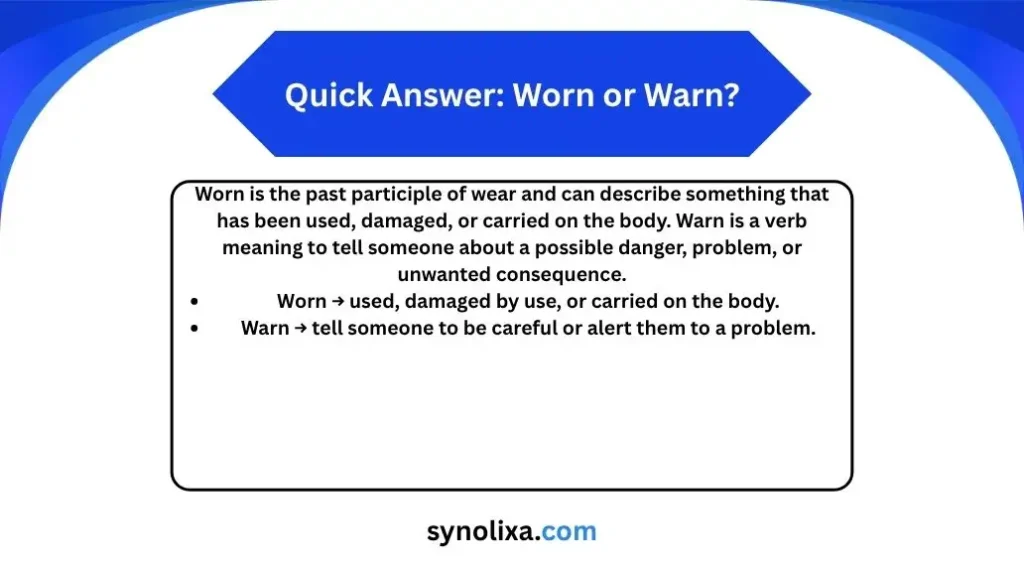
Worn is the past participle of wear and can describe something that has been used, damaged, or carried on the body. Warn is a verb meaning to tell someone about a possible danger, problem, or unwanted consequence.
- Worn → used, damaged by use, or carried on the body.
- Warn → tell someone to be careful or alert them to a problem.
Example: “My shoes are worn from years of use, so my brother warned me that I might need a new pair.”
Understanding the Basics: Worn or Warn
The core difference between worn and warn is meaning and grammatical function.
Worn comes from wear. It can describe clothing or other objects that have been used repeatedly, and it can also appear in verb phrases such as “have worn” or “had worn.” It can describe physical condition or, in some contexts, a person’s tired appearance.
Warn, on the other hand, is a regular verb. It means to give someone information about a possible danger, problem, or negative result. It can be used in sentences such as “The sign warns drivers about the sharp turn.”
Here is a simple comparison:
| Form | Type | Meaning | Example | Correct/Incorrect |
|---|---|---|---|---|
| worn | Past participle/adjective | Used or affected by wear; past participle of wear | My jeans are worn. | Correct |
| warn | Verb | To alert someone to danger or a problem | I need to warn you. | Correct |
| worn | Verb form | Past participle of wear | She has worn that dress before. | Correct |
| warn | Verb | To give notice or caution | They warned us about the storm. | Correct |
| worn | Used for giving a caution | Does not mean “alert” | I will worn you. | Incorrect |
| warn | Used to describe something damaged by use | Does not mean “used up” or “old from use” | My shoes are warn. | Incorrect |
The easiest memory trick
Think of these two words as belonging to different word families:
Wear → wore → worn
Warn → warned → warning
If you are talking about clothing, shoes, equipment, or something that has experienced use, worn may be the word you need.
If you are talking about giving someone a caution or alert, warn is the correct choice.
What Does “Worn” Mean?
Worn is the past participle of wear. It can have several related meanings depending on the sentence.
Worn means used or damaged by use
One common meaning of worn describes something that has become damaged, faded, thin, or less effective because it has been used repeatedly.
Examples:
- These shoes are badly worn.
- The carpet looks worn in the hallway.
- His old backpack is completely worn.
- The book has a worn cover.
In these examples, worn describes the condition of something after repeated use.
Worn can describe clothing that someone has worn
Because worn is the past participle of wear, it can appear with helping verbs.
Examples:
- I have worn this jacket many times.
- She has worn the same boots all winter.
- He had worn his uniform before.
- They have worn protective clothing during the project.
The pattern is:
have/has/had + worn
For example:
She has worn that coat before.
Here, worn is the past participle of wear.
Worn can describe something tired or exhausted
The word worn can also appear as an adjective describing someone who looks tired or affected by stress.
Examples:
- After the long journey, he looked worn.
- She appeared worn after several difficult days.
- The experience left him emotionally worn.
This meaning is related to the idea of being worn down or exhausted.
Worn-out is a common expression
You will often see worn in the compound adjective worn-out.
Worn-out can mean:
- damaged from too much use,
- no longer in good condition,
- extremely tired.
Examples:
- My old shoes are worn-out.
- The machine is worn-out and needs repair.
- After the long trip, everyone felt worn-out.
What Does “Warn” Mean?
Warn is a verb. It means to tell someone about a possible danger, problem, risk, or unpleasant consequence.
Examples:
- I need to warn you about the traffic.
- The teacher warned the students about the deadline.
- The sign warns drivers about the sharp curve.
- She warned me not to touch the hot surface.
The main idea is always connected to giving information that helps someone avoid a problem or prepare for it.
Merriam-Webster uses warn for the act of giving notice about danger or risk, which matches its standard modern English use.
Warn someone about something
One common structure is:
warn + someone + about + something
Examples:
- The guide warned us about the dangerous trail.
- My friend warned me about the traffic.
- The manager warned employees about the policy change.
Warn someone of something
You may also see:
warn + someone + of + something
Examples:
- The report warned residents of possible flooding.
- The doctor warned him of the risks.
- The notice warned visitors of the potential danger.
Warn someone not to do something
Another common structure is:
warn + someone + not to + verb
Examples:
- She warned me not to open the door.
- The teacher warned the students not to run.
- He warned us not to ignore the instructions.
Worn vs. Warn: Sentence Breakdown
Looking at complete sentences makes the distinction much easier.
Example 1: Worn
My favorite sneakers are worn after years of use.
Breakdown:
- My favorite sneakers = subject
- are = linking verb
- worn = adjective describing their condition
- after years of use = explains why they are worn
The sentence is about the condition of the sneakers.
Example 2: Warn
I need to warn you about the slippery floor.
Breakdown:
- I = subject
- need to = verb phrase
- warn = main verb
- you = person receiving the warning
- about the slippery floor = subject of the warning
The sentence is about giving someone caution.
Example 3: Both words
She wore a worn jacket while her brother warned her about the cold weather.
This sentence uses the words correctly because:
- wore relates to wearing clothing.
- worn describes the jacket.
- warned means gave a caution.
Test Tip: How to Choose the Correct Word
When you are unsure about worn or warn, ask yourself one simple question:
Are you talking about wearing or giving a warning?
If the answer is wearing or something affected by use, choose worn.
The tires are worn.
If the answer is giving someone a caution, choose warn.
I should warn you about the icy road.
Another useful test
Try replacing the word with one of these:
For worn:
- used
- damaged
- faded
- carried on the body
- affected by use
For warn:
- alert
- caution
- advise
- notify about danger
If “used” fits the sentence, worn may be correct.
If “alert” fits, warn is probably correct.
Grammar Rules for Worn and Warn
Understanding their grammatical forms makes these words even easier to distinguish.
The forms of “wear”
The verb wear is irregular.
Its main forms are:
| Form | Word | Example |
|---|---|---|
| Base form | wear | I wear glasses. |
| Past tense | wore | I wore glasses yesterday. |
| Past participle | worn | I have worn glasses for years. |
| Present participle | wearing | I am wearing glasses. |
Notice that worn is not the simple past tense of wear.
Incorrect:
Yesterday, I worn my new jacket.
Correct:
Yesterday, I wore my new jacket.
Correct:
I have worn my new jacket several times.
This distinction is important because English irregular verbs do not always follow predictable patterns.
The forms of “warn”
Warn is a regular verb.
Its forms include:
| Form | Word | Example |
|---|---|---|
| Base form | warn | I will warn you. |
| Third-person singular | warns | She warns everyone. |
| Past tense | warned | He warned me. |
| Past participle | warned | They have warned us. |
| Present participle | warning | The sign is warning drivers. |
So, unlike worn, warn does not change into an irregular past form such as wore or worn.
Merriam-Webster and Standard Usage
Standard dictionaries distinguish worn and warn as entirely different words.
Merriam-Webster identifies worn as a form associated with wear and uses it in contexts involving things that have been used or affected by use. Its dictionary examples also show worn in descriptions of clothing and other objects.
Merriam-Webster defines warn in terms of giving notice or caution, particularly about possible danger or risk.
This means the words are not interchangeable.
You cannot replace warn with worn simply because they look similar.
Correct:
The teacher warned us about the deadline.
Incorrect:
The teacher worn us about the deadline.
Likewise:
Correct:
My shoes are worn.
Incorrect:
My shoes are warn.
The spelling difference represents a genuine difference in meaning and grammatical use.
Common Mistakes With Worn or Warn
Mistakes involving these words usually happen because they are short, visually similar words.
Mistake 1: Using “worn” instead of “warn”
Incorrect:
I want to worn you about the problem.
Correct:
I want to warn you about the problem.
Why? The sentence describes giving someone information about a problem. Therefore, the verb warn is required.
Mistake 2: Using “warn” instead of “worn”
Incorrect:
These shoes are warn.
Correct:
These shoes are worn.
The sentence describes shoes that have been used heavily, so worn is correct.
Mistake 3: Confusing “worn” and “wore”
Incorrect:
I have wore this jacket before.
Correct:
I have worn this jacket before.
But:
I wore this jacket yesterday.
The difference is grammatical:
- wore = simple past
- worn = past participle
Why do these mistakes happen?
Several factors can cause spelling confusion.
Fast typing
When people type quickly, they may select the first familiar-looking word.
Autocorrect
Autocorrect can sometimes change a word without the writer noticing, especially when typing on a phone.
Lack of knowledge
If someone has not learned the difference between wear, wore, and worn, they may choose a form based on how it sounds rather than how it functions.
Similar spelling
The letters in worn and warn are close enough to cause occasional typing mistakes.
Similar Grammar Confusions
English has many word pairs that cause confusion because they look or sound similar.
| Confusing Words | Correct Difference |
|---|---|
| its / it’s | its = possession; it’s = it is/it has |
| your / you’re | your = possession; you’re = you are |
| their / there / they’re | possession / place / they are |
| to / too / two | direction/infinitive / also or excessive / number |
| then / than | time or sequence / comparison |
| affect / effect | usually verb / usually noun |
| lose / loose | fail to keep / not tight |
| advice / advise | noun / verb |
| wore / worn | past tense / past participle of wear |
| worn / warn | used or affected by wear / give a warning |
Learning these differences improves both everyday writing and formal communication.
Worn or Warn in Different Contexts
The correct choice depends on what you are trying to communicate.
Everyday Conversation
Both words are common in everyday speech.
Examples with worn:
- My sneakers are really worn.
- I’ve worn this shirt before.
- That couch looks worn.
Examples with warn:
- I should warn you about the traffic.
- She warned me that the store was closed.
- He warned us not to be late.
Professional Writing
Accuracy matters especially in workplace communication.
Example:
Please be aware that the equipment is heavily worn and may require replacement.
Here, worn describes the condition of the equipment.
Another example:
We want to warn employees about the upcoming system maintenance.
Here, warn means to alert employees.
A spelling mistake could make a professional message confusing or distracting.
Creative Writing
Writers can use both words to create vivid descriptions.
Example with worn:
The traveler carried a worn leather bag that had crossed many roads.
Example with warn:
The old fisherman tried to warn the visitors about the changing weather.
In creative writing, the context usually makes the distinction clear.
Social Media and Texting
Short messages often contain spelling errors because people type quickly.
For example:
“Just wanted to warn you that the movie starts at seven.”
Not:
“Just wanted to worn you…”
And:
“These boots are completely worn out.”
Not:
“These boots are completely warn out.”
Even informal writing benefits from using the correct word.
Real-Life Case Study: A Workplace Email
Imagine that an employee needs to email a supervisor about an old piece of equipment.
A confusing sentence might say:
“I wanted to warn you that the machine looks worn.”
This sentence is actually correct because it uses both words for different purposes.
- warn you = alert you
- looks worn = appears damaged or used
A professional email could say:
“I wanted to warn you that the machine appears heavily worn and may need maintenance.”
The sentence works because the two words perform completely different jobs.
Warn tells the reader that there is something important to know.
Worn describes the condition of the machine.
This is a useful example because both words can appear naturally in the same sentence.
Why Worn or Warn Matters
At first, the difference between two short words may seem minor. However, word choice affects how clearly your message is understood.
Clarity in communication
Correct word choice helps readers understand your exact meaning.
Compare:
The tires are worn.
with:
The tires are warn.
The first sentence clearly says the tires have experienced wear. The second contains an incorrect word.
Professionalism
Spelling and grammar mistakes can distract readers in:
- emails,
- reports,
- applications,
- school assignments,
- business documents,
- online articles.
Using the correct word shows attention to detail.
Accuracy in digital communication
Digital writing moves quickly. Messages may be written on phones, tablets, or computers, making typing mistakes easy.
A simple proofreading habit can prevent many errors.
Before sending a message, pause and ask:
“Am I describing wear, or am I giving a warning?”
That one question can help you choose between worn and warn.
A useful reminder
“Clear words create clear meaning.”
The goal of grammar is not simply to follow rules. It is to communicate your meaning accurately.
Special Exceptions and Edge Cases
There is no standard grammatical situation in which worn and warn become interchangeable.
However, there are several related forms worth knowing.
Worn-out
Worn-out is a common adjective.
Examples:
- My shoes are worn-out.
- The old machine is worn-out.
- I felt worn-out after the trip.
Depending on context, it can describe physical condition or exhaustion.
Warning
The noun warning comes from warn.
Examples:
- The sign gave us a warning.
- She ignored the warning.
- The weather service issued a warning.
Warned
Warned is the past tense and past participle of warn.
Example:
The teacher warned the class about the deadline.
Wearing
Wearing is the present participle of wear.
Example:
She is wearing a blue jacket.
These related forms make the word families easier to remember:
wear → wore → worn → wearing
warn → warned → warning
Quick Recap Checklist
Use this checklist whenever you are unsure about worn or warn.
| Question | If Yes → Use |
|---|---|
| Am I talking about something that has been used repeatedly? | worn |
| Am I describing clothing that someone has used? | worn |
| Am I describing something damaged or affected by use? | worn |
| Am I talking about giving someone a caution? | warn |
| Am I alerting someone to danger or a problem? | warn |
| Can I replace the word with “alert”? | warn |
| Can I connect the word to “wear”? | worn |
Practice Example 1
I need to ___ you about the icy road.
Answer: warn
Why? You are giving someone a caution.
Practice Example 2
The tires are badly ___.
Answer: worn
Why? You are describing the condition of the tires.
Practice Example 3
She has ___ the same coat for several winters.
Answer: worn
Why? The sentence uses the past participle of wear after has.
Worn or Warn: Easy Memory Trick
If you want one simple trick, remember:
Worn = Wear
Both are connected to clothing, use, and condition.
wear → wore → worn
Warn = Warning
Both are connected to caution and alerts.
warn → warned → warning
You can even create a mental picture:
👕 Worn → think of an old shirt.
⚠️ Warn → think of a warning sign.
This visual connection can make the distinction easier to remember.
Common Sentences With Worn
Here are several natural examples:
- My favorite shoes are worn from years of use.
- She has worn that dress several times.
- The carpet looks worn near the doorway.
- He was wearing a worn leather jacket.
- The old chair has become badly worn.
- These gloves are too worn to use.
- The book has a worn cover.
- The stairs looked worn after decades of use.
- I have worn these shoes on many trips.
- The fabric is thin and worn.
Notice that all these examples connect worn with wear, use, condition, or something that has been worn on the body.
Common Sentences With Warn
Here are several natural examples:
- I need to warn you about the traffic.
- She warned us about the delay.
- The sign warns visitors about the wet floor.
- He warned me not to touch the equipment.
- The teacher warned the students about the deadline.
- They warned residents about the storm.
- Please warn me if the situation changes.
- The guide warned the group about the steep path.
- The label warns users about possible risks.
- I tried to warn him before it was too late.
Each sentence involves giving information, caution, or an alert.
Worn or Warn in Questions
Questions can also help you see the difference.
Questions with worn
- Have you worn this jacket before?
- Why are these shoes so worn?
- Have they worn out the carpet?
- Is that old backpack completely worn?
Questions with warn
- Did she warn you about the problem?
- Should I warn them?
- Who warned you about the change?
- Did the sign warn drivers about the road?
The grammar of the surrounding sentence usually makes the correct choice obvious.
A Simple Rule for Students and Writers
When you see worn, think about the verb wear.
When you see warn, think about the noun warning.
This gives you a fast decision:
Worn = wear/use
Warn = caution/alert
For example:
I have worn these shoes many times.
The word connects to wear.
I should warn you about these shoes.
The word connects to giving a caution.
Although the words differ by only one vowel, their meanings are completely different.
FAQs
1. Is “worn” the past tense of “wear”?
No. Wore is the simple past tense of wear, while worn is the past participle.
- Past: I wore my jacket yesterday.
- Past participle: I have worn my jacket before.
2. What is the difference between worn and warn?
Worn is related to wear and describes something used, damaged by use, or something that has been worn. Warn means to alert someone about a possible problem, danger, or consequence.
3. Is “warn” a verb?
Yes. Warn is a verb.
Example:
The teacher warned the students about the deadline.
4. Can “worn” be an adjective?
Yes. Worn can function as an adjective.
Example:
He bought a worn leather bag.
It describes the condition or appearance of the bag.
5. Is “I will worn you” correct?
No. The correct sentence is:
I will warn you.
After will, use the base form of the verb, so warn is correct.
6. Is “The shoes are warn” correct?
No. If you mean the shoes have been used and are showing signs of wear, say:
The shoes are worn.
The word warn means to give a caution, so it does not describe the condition of the shoes.
Conclusion
The difference between worn or warn becomes simple once you connect each word with its word family. Worn comes from the verb wear and is used as its past participle. It can describe something that has been used, damaged by repeated use, or carried on the body. Warn, meanwhile, is a verb that means to alert someone about a possible danger, problem, or consequence.
Remember the easiest rule: worn = wear; warn = warning. If you are talking about an old pair of shoes, a used jacket, or something affected by repeated use, choose worn. If you are telling someone to be careful or alerting them to a problem, choose warn.
These words may look similar, but they serve very different purposes. Once you recognize their meanings and grammatical forms, choosing the right one becomes almost automatic.
When in doubt, remember: you wear something until it becomes worn, but you warn someone when there is something they need to know.

Hi, I am Clara Anderson. I work at Synolixa as a vocabulary writer, focusing on synonyms, word meanings, and easy-to-understand English learning content.

[…] professional content, knowing when to use headed and heading can help you communicate clearly. Worn or Warn | Alright vs Allright | Indolence vs […]