Have you ever typed “infront” and then paused to wonder whether it should actually be “in front”? You are not alone. This is a common English spelling and grammar confusion because the two words sound like one unit when spoken quickly. As a result, it can feel natural to write them together.
The correct form in standard English is “in front.” It is written as two separate words. We use in front to describe a position that is farther forward than someone or something else. We also commonly use the longer phrase “in front of” when we identify the person, object, or place that is being referenced.
For example, you can say, “The car is in front,” or “The car is in front of the house.”
The form “infront” is generally considered a spelling error in standard English. It may appear in casual online writing, quick messages, or social media posts, but that does not make it the standard spelling.
In this guide, you will learn exactly when to use in front, why infront is incorrect, and how to avoid this mistake in everyday, academic, and professional writing. ✍️ Greatful or Grateful | Have Fun or Enjoy | Coach vs Couch
Quick Answer: Infront or In Front?
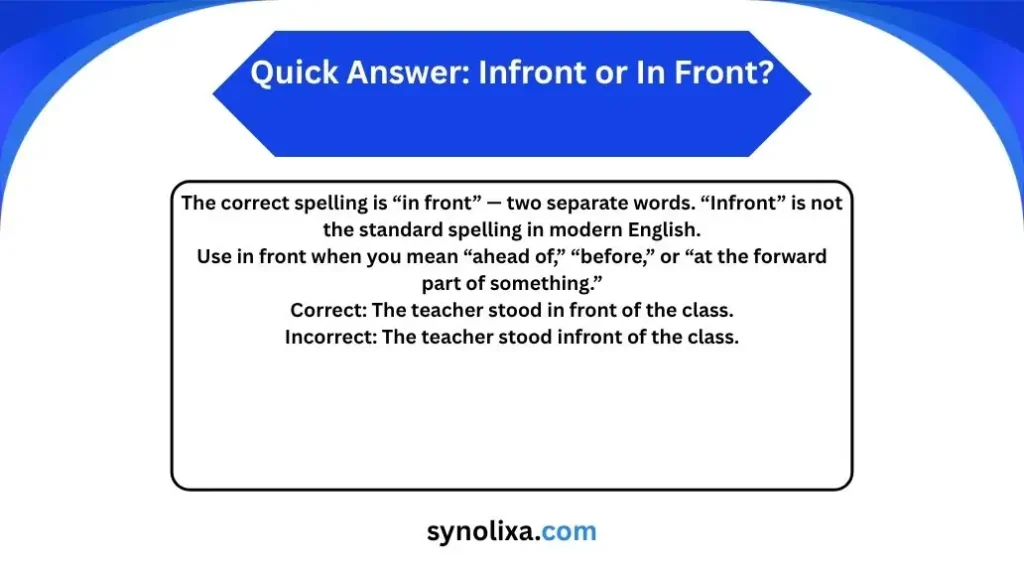
The correct spelling is “in front” — two separate words. “Infront” is not the standard spelling in modern English.
Use in front when you mean “ahead of,” “before,” or “at the forward part of something.”
Correct: The teacher stood in front of the class.
Incorrect: The teacher stood infront of the class.
A simple rule to remember is: If you mean a position ahead of someone or something, write “in front” as two words.
Understanding the Basics: Infront or In Front
The main difference between infront and in front is simple: one is standard English, while the other is not.
Comparison Table
| Form | Type | Meaning | Example | Correct/Incorrect |
|---|---|---|---|---|
| in front | Phrase | Ahead of or at the forward position | She stood in front of me. | ✅ Correct |
| in front of | Prepositional phrase | At or near the forward side of something | The car is in front of the house. | ✅ Correct |
| infront | Nonstandard spelling | Intended to mean “in front” | He stood infront of me. | ❌ Incorrect |
| front | Noun/adjective/verb | Forward part or position | The front door is open. | ✅ Correct |
The key point is that in and front remain separate words when they form the phrase in front.
Why Does “Infront” Look Correct?
English contains many compound words, so it is easy to assume that words that commonly appear together should be combined.
For example:
- inside
- indoors
- beforehand
- upfront
- outside
Because of words like these, writers may naturally assume that in front should also become one word.
However, English does not combine every frequently used word pair. Some expressions remain separate even when they function closely together.
In front is one of those expressions.
The Basic Rule
Remember this:
In front = two words.
Examples:
- The dog is in front.
- She walked in front of us.
- A bus stopped in front of the school.
- He sat in front of me.
- Please stand in front of the camera.
Never write these as infront in standard English.
Correct Meanings and Uses of “In Front”
The phrase in front has several closely related uses. Understanding them makes the spelling easier to remember.
1. “In Front” Means Ahead
The most basic meaning is farther forward than someone or something else.
For example:
The blue car is in front.
Here, in front means that the blue car is ahead of another car or object.
Another example:
I walked in front while my brother followed behind.
In this sentence:
- I = the person ahead
- my brother = the person behind
- in front = the forward position
Cambridge Dictionary defines in front as being farther forward than someone or something else.
2. “In Front of” Shows Position
The phrase becomes especially common when you name what is behind the person or object.
Examples:
- The teacher stood in front of the students.
- The car stopped in front of the house.
- She parked in front of the store.
- He sat in front of me.
- The dog was sleeping in front of the fireplace.
The structure is:
in front of + person/place/object
For example:
The boy is standing in front of the door.
Breakdown:
- in = preposition
- front = noun
- of = preposition
- the door = object of the preposition
Together, the phrase tells us where the boy is positioned.
3. “In Front” Can Refer to an Audience
We also use in front of when someone is visible to other people.
For example:
She gave a speech in front of the class.
This does not simply mean she was physically ahead of the classroom. It means she was speaking while the students were watching her.
More examples include:
- He performed in front of a large audience.
- She felt nervous in front of her classmates.
- Don’t argue in front of the children.
- He answered the question in front of everyone.
Cambridge also recognizes this use of in front of for something done or said while another person is present and able to see or hear it.
4. “In Front” Can Describe a Line or Queue
Imagine that you are waiting at a store.
Someone standing before you is in front of you.
For example:
There were three people in front of me.
This means three people were ahead of you in the line.
You might also say:
The woman in front of me was holding a large bag.
The phrase clearly identifies her position.
5. “In Front” Can Describe Movement
The phrase can also describe movement.
Examples:
- Walk in front of me.
- The dog ran in front of the car.
- She moved in front of the camera.
- He stepped in front of the door.
The phrase tells the reader where someone or something moved.
How to Remember “In Front”
A useful memory trick is to connect front with back.
We normally say:
- in front
- in the back
We do not normally combine in and front into one word.
Think of the phrase as a position:
front ← in front → back
If you are describing something that is ahead, use in front.
Test Tip
Try replacing in front with ahead.
If the sentence still makes sense, in front is probably the phrase you need.
For example:
The car is in front.
Replace it:
The car is ahead.
The meaning still works.
Therefore, in front is correct.
Another example:
She walked in front of me.
You could think:
She walked ahead of me.
Again, the meaning is clear.
Most importantly, remember that the phrase is still spelled in front, not infront.
In Front vs In the Front
There is another small distinction worth learning.
“In Front”
In front usually means ahead of something or someone.
Example:
The teacher is standing in front of the students.
The teacher is positioned ahead of the students.
“In the Front”
In the front can refer to being inside or at the forward part of something.
Example:
We sat in the front of the bus.
Here, the phrase refers to the forward section of the bus.
Another example:
I found the information in the front of the book.
The information appears in the forward section of the book.
So:
- in front of the bus = outside and ahead of the bus
- in the front of the bus = inside the forward section of the bus
This distinction can be important.
In Front vs Ahead
The words in front and ahead can sometimes express similar ideas, but they are not always interchangeable.
Compare:
The car is in front of me.
and:
The car is ahead of me.
Both indicate that the car is farther forward.
However, ahead can also describe progress or future direction.
For example:
We have a difficult exam ahead of us.
You would not normally replace this with “in front of us” when talking about a future challenge.
Learning the difference helps you choose the most natural expression.
In Front vs Opposite
Another common confusion is between in front of and opposite.
They are not always the same.
In front of generally means close to the forward side of someone or something.
Opposite can mean facing someone or something from the other side.
For example:
The restaurant is in front of the hotel.
The restaurant is located toward the hotel’s front side.
But:
The restaurant is opposite the hotel.
This suggests that the restaurant is facing the hotel, often across a street or other space.
Cambridge specifically distinguishes opposite from in front of in this way.
Case Study: A Workplace Email
Imagine that an employee needs to tell a coworker where to meet.
They might write:
“I’ll meet you in front of the main entrance at 9:00 a.m.”
This is clear and professional.
Now imagine the employee writes:
“I’ll meet you infront of the main entrance.”
The reader can probably understand the message, but the spelling is incorrect in standard English.
A polished version should always use:
in front
This small correction matters in workplace communication because correct spelling helps your writing look careful and professional.
Another Workplace Example
Suppose a manager writes:
“Please wait in front of the conference room.”
This means the person should wait near the area outside the conference room.
The phrase in front of clearly communicates location.
Grammar Rules: Why “In Front” Is Correct
The reason in front remains two words is that it functions as a phrase rather than a single standard compound word.
The word front is commonly used as a noun.
For example:
- the front of the building
- the front of the car
- the front of the line
- the front of the classroom
When combined with in, it forms the phrase in front.
Examples:
She stood in front.
He sat in front of me.
The store is in front of the station.
Major English dictionaries recognize in front and in front of as standard expressions. Cambridge Dictionary, for example, lists in front as an established phrase meaning farther forward than someone or something else and lists in front of as a prepositional expression.
What About “Infront”?
Infront is not the standard spelling of this phrase.
It may appear online because people type quickly, combine words accidentally, or rely on informal digital writing. However, its appearance in user-generated text does not make it standard English.
For formal writing, academic work, business communication, websites, and edited content, use:
in front
not:
infront
Common Mistakes With “Infront”
Why do people make this mistake?
There are several common reasons.
1. Fast Typing
When people type quickly, they often combine words that normally appear together.
For example:
in front → infront
This is especially common in casual messages.
2. Autocorrect and Predictive Text
Phones and keyboards can sometimes create unexpected word combinations. If you do not proofread your message, a spelling mistake can remain unnoticed.
3. Pronunciation
When spoken naturally, in front can sound like one connected unit.
Because speech flows smoothly, learners may assume that the written form should also be one word.
4. Confusion With Other Compound Words
English contains many words that are written together, such as:
- inside
- outside
- beforehand
- upfront
This can make infront look believable.
But spelling patterns must be learned individually.
Similar Grammar Confusions
| Common Confusion | Correct Form | Why |
|---|---|---|
| infront / in front | in front | The phrase is written as two words |
| alot / a lot | a lot | “A lot” is two words |
| atleast / at least | at least | The phrase is written separately |
| inbetween / in between | in between | Standard spelling uses two words |
| your / you’re | your / you’re | Different meanings and grammatical functions |
| its / it’s | its / it’s | Possessive vs. contraction |
| their / they’re | their / they’re | Possessive vs. contraction |
| everyday / every day | everyday / every day | Adjective vs. time expression |
The lesson is simple: words that sound connected do not always become one written word.
Usage in Different Contexts
Everyday Conversation
In everyday speech, in front is extremely common.
Examples:
Wait for me in front.
She’s standing in front of the store.
There’s a car in front of us.
Sit in front of me.
These sentences sound natural in everyday American English.
Professional Writing
Professional writing requires standard spelling and clear grammar.
Use:
Please wait in front of the reception desk.
The meeting room is in front of the main entrance.
We will gather in front of the building at noon.
Avoid:
Please wait infront of the reception desk.
Using the correct two-word form makes your writing more polished.
Academic Writing
Students should use in front in essays, assignments, reports, and other formal work.
For example:
The speaker stood in front of the audience.
The experiment was conducted in front of the students.
A spelling error such as infront can distract readers and make otherwise strong writing look less carefully edited.
Creative Writing
Writers also use in front naturally.
For example:
She stopped in front of the old house and looked at the windows.
Or:
A tall tree stood in front of the cabin.
Creative writing does not change the standard spelling rule.
Social Media and Texting
Informal writing often contains spelling mistakes. Someone might type:
Meet me infront of the mall 😂
People may understand the meaning, but infront is still not the standard spelling.
For captions, posts, messages, and public content, in front is the safer choice.
Why “In Front” Matters
It may seem like a tiny spelling issue, but small errors can affect how readers perceive your writing.
1. Clarity
Correct spelling makes your message easier to read.
Compare:
Stand in front of the door.
with:
Stand infront of the door.
The first version follows standard English conventions and is immediately recognizable as correct.
2. Professionalism
Correct grammar and spelling are especially important in:
- job applications
- emails
- school assignments
- business documents
- websites
- reports
- formal messages
A small spelling error can make writing appear rushed.
3. Digital Communication
Online writing moves quickly. People often type without proofreading.
That makes simple spelling rules even more useful.
If you know that in front is always written as two words, you can catch the error instantly.
4. Better Search and Content Quality
For website owners, bloggers, students, and professional writers, standard spelling supports clear and trustworthy content.
Readers expect familiar phrases to appear in their standard forms.
“Clear writing builds trust.”
That simple idea applies even to small grammar choices.
Special Exception: Is “Infront” Ever Correct?
For ordinary English grammar, spelling infront as one word is not correct.
However, you may occasionally encounter Infront as part of a proper name, company name, product name, username, or other brand-specific wording.
A proper name can intentionally use unusual capitalization or spelling.
For example, a company might choose a stylized name containing Infront. That does not change the normal grammar rule.
When you are writing an ordinary sentence, use:
in front
not:
infront
If Infront appears as part of an official name, follow that organization’s established spelling.
Quick Recap Checklist
Use this checklist whenever you are unsure.
| Question | If Yes → Use |
|---|---|
| Do you mean “ahead of” someone or something? | in front |
| Are you describing a forward position? | in front |
| Are you using “of” after the phrase? | in front of |
| Are you describing something located near the forward side of an object? | in front of |
| Are you writing a normal English sentence? | in front |
| Is “infront” simply a spelling choice in your sentence? | ❌ Do not use it |
Practice Example 1
Incorrect: The dog is sitting infront of the door.
Correct: The dog is sitting in front of the door.
Practice Example 2
Incorrect: She walked infront of me.
Correct: She walked in front of me.
Practice Example 3
Incorrect: Please wait infront.
Correct: Please wait in front.
The rule stays the same in all three examples.
A Simple Memory Trick
Here is an easy way to remember the spelling:
In + front = two words.
Imagine a person standing:
[person] → IN FRONT → [another person]
The phrase describes a position, so keep the two words separate.
You can also remember this sentence:
“I stand in front, not infront.”
It is short, easy to remember, and reinforces the correct spelling. 😊
Frequently Asked Questions
Is “infront” one word?
No. Infront is not the standard spelling of the phrase. In standard English, write in front as two words.
Is “in front” correct grammar?
Yes. In front is a standard English phrase used to describe a position that is farther forward than someone or something else. In front of is also a standard prepositional expression.
Should I write “infront of” or “in front of”?
Always write in front of in standard English.
Correct: The car is in front of the house.
Incorrect: The car is infront of the house.
Why do people write “infront”?
The most common reasons are fast typing, pronunciation, autocorrect, and confusion with other English words that are written as one word. Because in front sounds connected in natural speech, it can be easy to mistakenly combine the words when writing.
Is “in front” formal or informal?
In front is neutral and standard English. You can use it in everyday conversation, academic writing, professional communication, and formal writing.
Is “in front of” a prepositional phrase?
Yes. In front of functions as a prepositional expression that indicates position or location. For example, in “The car is in front of the house,” the phrase identifies the car’s position relative to the house. Cambridge Grammar describes in front of as a prepositional expression meaning close to the front of something or someone.
More Examples of “In Front” in Sentences
To make the rule easier to remember, here are more examples:
- The bus stopped in front of the school.
- Please stand in front of the camera.
- She sat in front of me.
- A tree grows in front of our house.
- He walked in front while we followed.
- The children played in front of the building.
- There was a long line in front of the theater.
- I left my bicycle in front of the store.
- The speaker stood in front of the audience.
- Someone parked in front of our driveway.
- The dog ran in front of the car.
- We waited in front of the restaurant.
Notice that in front is always written as two words.
Final Difference: Infront vs. In Front
Let’s make the entire lesson as simple as possible.
Infront ❌
Infront is generally an incorrect spelling when you mean the ordinary English phrase describing a forward position.
Avoid it in:
- essays
- emails
- articles
- professional documents
- schoolwork
- websites
- formal messages
In Front ✅
In front is the correct standard form.
Use it to describe something that is ahead or located toward the forward side of something else.
Examples:
- in front
- in front of me
- in front of the house
- in front of the school
- in front of the camera
The most important rule is easy:
Always write “in front” as two words when you mean the standard English phrase.
Conclusion
The choice between infront and in front is simple once you know the rule. In standard English, the correct form is in front, written as two separate words. The phrase describes something that is ahead, farther forward, or located near the forward side of someone or something. When you identify what it is positioned ahead of, use in front of.
For example, write “She stood in front of the house,” not “She stood infront of the house.”
The incorrect form can appear because people type quickly, hear the phrase as one connected sound, or confuse it with other compound words. However, informal usage does not change the standard spelling.
So, whenever you are unsure, remember the simple formula:
IN + FRONT = TWO WORDS.
Correct spelling may seem like a small detail, but small details create clear, polished, and professional writing. Keep in front separated, and you will never have to wonder about this grammar point again. ✨
Final answer: “In front” is correct; “infront” is incorrect in standard English.

Hi, I am Clara Anderson. I work at Synolixa as a vocabulary writer, focusing on synonyms, word meanings, and easy-to-understand English learning content.
[…] Let’s break down the difference with clear rules, examples, tables, and practical tips. 😊 Infront or In Front | Greatful or Grateful | Have Fun or […]