Have you ever typed a sentence like “She has ran five miles” and then stopped because something felt wrong? You are not alone. The confusion between has ran or has run is common because both ran and run come from the same verb. The tricky part is knowing when each form belongs in a sentence.
The good news is that the rule is simple: “has run” is correct, while “has ran” is incorrect in standard English. The verb run has three important forms: run for the base form, ran for the simple past tense, and run again as the past participle. Cambridge Dictionary lists these forms as “running,” “ran,” and “run.”
Once you understand how helping verbs such as has, have, and had work, this mistake becomes much easier to avoid. In this guide, we will explain has ran or has run, show you real examples, cover common mistakes, and give you easy tests you can use whenever you are unsure. ✅ Affirm vs Confirm | Acception vs Exception | Momma or Mama
Quick Answer: Has Ran or Has Run?
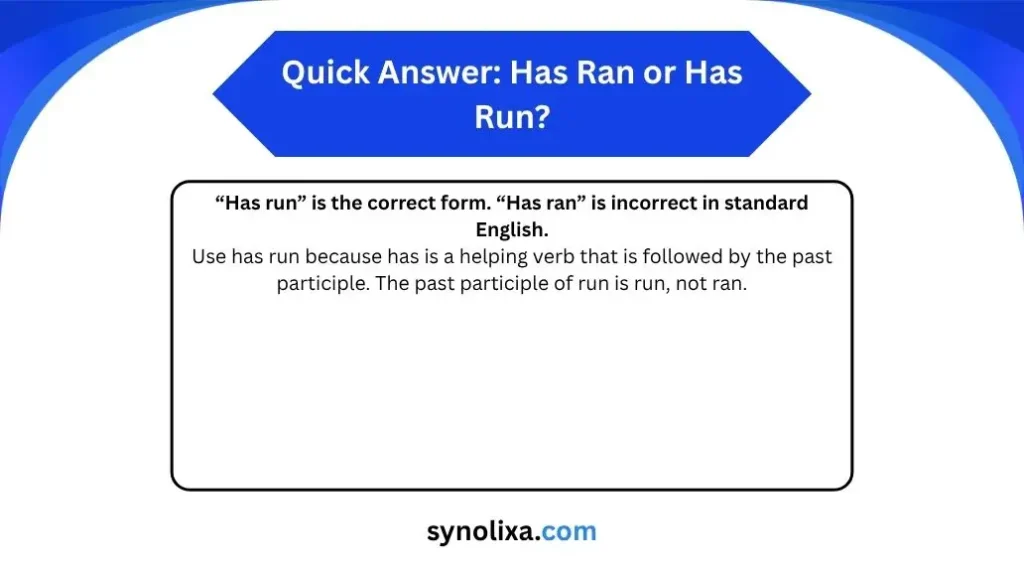
“Has run” is the correct form. “Has ran” is incorrect in standard English.
Use has run because has is a helping verb that is followed by the past participle. The past participle of run is run, not ran.
- ✅ She has run five miles today.
- ❌ She has ran five miles today.
Remember this simple rule:
Has + past participle = has run.
Understanding the Basics: Has Ran or Has Run
The confusion becomes much easier when you look at the three main forms of run.
| Form | Type | Meaning | Example | Correct/Incorrect |
|---|---|---|---|---|
| run | Base form | To move quickly on foot or perform another action associated with run | I run every morning. | ✅ Correct |
| ran | Simple past | An action completed in the past | I ran yesterday. | ✅ Correct |
| run | Past participle | Used with helping verbs such as has, have, and had | I have run three miles. | ✅ Correct |
| has run | Present perfect | An action connected to the present | She has run today. | ✅ Correct |
| has ran | Incorrect verb combination | Uses the simple past after has | She has ran today. | ❌ Incorrect |
Why Does “Ran” Feel Correct?
The word ran is definitely a real English word. That is why the mistake can be confusing.
For example:
- ✅ He ran to school yesterday.
- ✅ They ran across the field.
- ✅ I ran five miles last weekend.
In all of these sentences, ran works because the sentence uses the simple past tense.
The problem begins when you add a helping verb such as has.
- ❌ He has ran to school.
- ✅ He has run to school.
The helping verb changes which form of the main verb you need.
The Three Forms of Run
Think of the verb this way:
Run → Ran → Run
| Verb Form | Example |
|---|---|
| Present/base | I run every morning. |
| Simple past | I ran yesterday. |
| Past participle | I have run today. |
Cambridge Dictionary identifies ran as the past-tense form and run as the past-participle form.
That distinction is the key to understanding has ran or has run.
Correct Meaning and Use of “Has Run”
“Has Run” Means an Action Has Happened
Has run is a present-perfect construction.
It tells us that an action happened in the past but has some connection to the present, or that the exact past time is not the main focus.
For example:
Maya has run five miles today.
This tells us that Maya completed a five-mile run sometime today. The important point is the completed action and its connection to the current day.
The structure is:
Subject + has + past participle
So:
- Maya + has + run
- He + has + run
- She + has + run
- The dog + has + run
Example: “She Has Run Every Morning”
She has run every morning this week.
Breakdown:
- She = subject
- has = helping verb
- run = past participle
- every morning this week = time expression
The sentence describes an activity that has happened repeatedly during a period that is still connected to the present.
Example: “He Has Run the Business for Years”
The verb run has many meanings besides moving quickly.
For example:
He has run the business for ten years.
Here, run means manage or operate a business.
The same grammar rule applies:
has + run
Not:
has + ran
Cambridge’s American Dictionary also uses run for meanings such as managing or operating something.
Example: “The Program Has Run Successfully”
Run can also describe software, machines, programs, events, and processes.
The program has run successfully.
Again, has run is correct.
The verb run can mean “operate,” and Cambridge gives examples of run being used for programs and machines.
When Should You Use “Ran”?
The word ran is correct when you are using the simple past tense without has, have, or had.
Examples:
- I ran yesterday.
- She ran to the bus stop.
- They ran five miles last Saturday.
- He ran across the field.
- We ran out of time.
Notice that none of these examples uses has.
“Ran” With a Specific Past Time
The simple past often works with a finished time in the past.
For example:
She ran five miles yesterday.
Here, yesterday identifies a completed past time.
Compare it with:
She has run five miles today.
The first sentence uses ran because the action is presented as a completed past event. The second uses has run because today is still connected to the present.
Ran vs. Has Run
Compare these pairs:
- She ran yesterday.
- She has run today.
- He ran five miles last week.
- He has run five miles this week.
- They ran the store in 2024.
- They have run the store since 2024.
The exact grammar depends on the time and sentence structure.
The Main Grammar Rule Behind “Has Ran or Has Run”
The most important rule is this:
“Has” Requires the Past Participle
In standard English, has can work as a helping verb in the present perfect.
The pattern is:
Subject + has + past participle
Examples:
- She has eaten.
- He has gone.
- It has broken.
- She has written.
- He has seen.
- She has run.
Notice the different past participles:
- eat → eaten
- go → gone
- break → broken
- write → written
- see → seen
- run → run
The past participle of run happens to look exactly like its base form.
That is one reason learners may find this verb confusing.
Why “Has Ran” Is Incorrect
Ran is the simple past form.
It cannot normally follow has in a standard present-perfect construction.
Therefore:
- ❌ She has ran.
- ❌ He has ran.
- ❌ The dog has ran.
- ❌ They have ran.
Instead:
- ✅ She has run.
- ✅ He has run.
- ✅ The dog has run.
- ✅ They have run.
A Simple Test Tip
Here is an easy way to check your sentence.
Test 1: Look for “Has,” “Have,” or “Had”
If your sentence contains:
- has
- have
- had
ask yourself:
“Do I need a past participle?”
If the answer is yes, use run, not ran.
For example:
She has ___ five miles.
The answer is:
She has run five miles.
Test 2: Remove the Helping Verb
Try removing has.
She has run five miles.
Without has, you could say:
She ran five miles.
This shows that ran is the simple past form, while run is the past participle needed after has.
Memory Trick
Use this three-word pattern:
Run → Ran → Run
And remember:
Has + Run
Never:
Has + Ran
Has Run in Different Types of Sentences
Understanding several examples can make the rule automatic.
Positive Statements
- She has run three miles.
- He has run the company since January.
- The machine has run all day.
- The river has run through the valley for centuries.
- The show has run for six seasons.
Negative Statements
When you add not, the rule does not change.
- She has not run today.
- He hasn’t run since Monday.
- The machine hasn’t run properly.
- The program has not run successfully.
Notice:
hasn’t run
Not:
❌ hasn’t ran
Questions
Questions also use the past participle after has.
- Has she run today?
- Has he run five miles?
- Has the machine run properly?
- Has the program run successfully?
The word order changes, but the verb form stays the same.
Has Run vs Have Run
The same basic rule applies to have.
Use:
- I have run.
- You have run.
- We have run.
- They have run.
Do not use:
- ❌ I have ran.
- ❌ You have ran.
- ❌ We have ran.
- ❌ They have ran.
The structure remains:
have + past participle
Since run is the past participle, use have run.
Has Run vs Had Run
You will also see had run.
This is correct because had also takes the past participle.
For example:
She had run five miles before breakfast.
The structure is:
had + run
Compare:
- She ran five miles.
- She has run five miles.
- She had run five miles.
All three are grammatically possible, but they express different time relationships.
| Sentence | Main Tense |
|---|---|
| She ran. | Simple past |
| She has run. | Present perfect |
| She had run. | Past perfect |
Case Study: A Workplace Email
Imagine a manager sends this email:
“The team has ran several tests on the new system.”
At first glance, the sentence may look acceptable because ran is a real word. But the sentence contains has, so the past participle is required.
The corrected sentence is:
“The team has run several tests on the new system.”
Why Is This Better?
The sentence follows the present-perfect structure:
The team + has + run + several tests
This is especially important in professional writing because grammar mistakes can distract readers from the information being communicated.
Another example:
❌ Our team has ran the report three times.
Correct:
✅ Our team has run the report three times.
The second version is the standard grammatical form.
Grammar in Everyday Conversation
In casual conversation, you may hear people use incorrect forms. That does not make those forms standard grammar.
For example, someone might say:
“She has ran five miles.”
The listener will probably understand the meaning. However, in standard written English, the correct version is:
“She has run five miles.”
Knowing the difference helps you write accurately even when informal speech sounds different.
Professional Writing: Why “Has Run” Matters
Professional communication often requires careful grammar.
Consider these examples:
❌ The software has ran successfully.
✅ The software has run successfully.
Or:
❌ Our department has ran several tests.
✅ Our department has run several tests.
The corrected versions sound more polished and follow standard verb patterns.
This matters in:
- Emails
- Reports
- Resumes
- Business documents
- School assignments
- Formal messages
- Applications
- Presentations
Creative Writing: Can “Ran” Still Be Correct?
Absolutely.
Creative writing does not change the basic grammar rule.
For example:
She ran through the rain and disappeared around the corner.
Here, ran is correct because the sentence uses the simple past.
But:
She has run through these streets many times.
Here, has run is correct because the sentence uses the present perfect.
Creative style can change word choice, sentence length, and tone, but it does not make has ran standard English.
Social Media and Texting
Social media and texting are usually more informal. People often type quickly, shorten words, or ignore grammar rules.
You might see:
“She has ran 10 miles!”
In casual online communication, readers may understand it. However, if you want standard English, write:
“She has run 10 miles!”
This distinction is useful when you are writing something public, professional, educational, or polished.
Common Mistakes With “Has Ran or Has Run”
Why do people make this mistake?
There are several common reasons.
1. Fast Typing
When people type quickly, they may choose the first form that comes to mind.
Because ran is strongly associated with the past tense of run, it can appear automatically.
2. Autocorrect
Autocorrect does not always understand the grammatical structure of a sentence.
A typing system may recognize ran as a correctly spelled word without recognizing that run is required after has.
3. Lack of Knowledge
Some writers simply have not learned the difference between a simple past verb and a past participle.
This is especially common with irregular verbs.
4. Irregular Verb Confusion
Regular verbs are often easier:
- walk → walked → walked
- play → played → played
- work → worked → worked
But run changes differently:
- run → ran → run
That unusual pattern can cause confusion.
Similar Grammar Confusions
The has ran or has run problem belongs to a larger group of common English mistakes.
| Confusion | Correct Form | Why |
|---|---|---|
| has ran / has run | has run | Has takes the past participle |
| has went / has gone | has gone | Gone is the past participle |
| has ate / has eaten | has eaten | Eaten is the past participle |
| has saw / has seen | has seen | Seen is the past participle |
| it’s / its | Depends on meaning | It’s = it is; its = possessive |
| your / you’re | Depends on meaning | Your = possessive; you’re = you are |
| their / they’re | Depends on meaning | Their = possessive; they’re = they are |
| then / than | Depends on meaning | Then relates to time; than is used in comparisons |
Learning the patterns behind these mistakes is more useful than memorizing individual corrections.
Why This Grammar Difference Matters
A two-letter difference can seem small, but grammar helps readers understand your meaning quickly.
Clarity
Correct verb forms make sentences easier to process.
Compare:
She has ran three miles.
with:
She has run three miles.
The second sentence follows the expected grammatical pattern.
Professionalism
Correct grammar can make your writing appear more careful and polished.
This is especially useful in:
- Schoolwork
- Applications
- Business communication
- Formal emails
- Reports
- Public writing
Digital Communication
Online writing moves quickly. Because people often communicate through short messages, small grammar mistakes can become common.
Learning one simple rule can prevent the mistake every time:
Has + past participle.
A Helpful Quote
“Grammar gives language its structure.”
The idea is simple: good grammar helps readers understand how words relate to each other.
Special Exception: Is “Has Ran” Ever Correct?
In standard English, has ran is not the correct present-perfect form of the verb run.
However, you may encounter unusual cases where words appear next to each other in ways that look similar.
For example, a proper name, title, quotation, dialectal usage, or nonstandard speech may contain has ran. Such an occurrence does not change the standard grammar rule.
If you are writing standard US English, use:
has run
There is no normal standard-English exception that makes has ran the correct present-perfect construction.
“Has Run” Can Have Many Meanings
One reason run is such an interesting verb is that it has many meanings.
Run = Move Quickly
She has run five miles today.
Run = Manage
He has run the store for years.
Run = Operate
The machine has run all afternoon.
Run = Continue or Take Place
The program has run for three hours.
Run = Flow
Water has run down the wall.
The meaning changes, but the grammar does not.
After has, use run.
Cambridge Dictionary lists several meanings of run, including moving quickly, operating something, managing something, and flowing.
Has Run in Present Perfect Tense
The present perfect is especially important for understanding this topic.
Basic Structure
Subject + has/have + past participle
Examples:
- She has run.
- He has written.
- They have gone.
- We have eaten.
The tense connects a past action to the present in various ways.
For example:
She has run five miles today.
The action happened earlier, but today is still the current day.
Another example:
He has run the company since 2020.
The action began in the past and continues into the present.
Simple Past vs Present Perfect
One of the best ways to master has ran or has run is to compare simple past and present perfect.
Simple Past
Use ran:
She ran five miles yesterday.
The action is presented as a completed event in the past.
Present Perfect
Use has run:
She has run five miles today.
The action is connected to the present.
Compare These Sentences
| Simple Past | Present Perfect |
|---|---|
| She ran yesterday. | She has run today. |
| He ran last week. | He has run this week. |
| They ran in 2025. | They have run this year. |
| I ran earlier. | I have run several times today. |
The important thing is not simply the time word. The sentence structure also determines the verb form.
A Fast Way to Remember the Rule
Try this three-step method.
Step 1: Find the Helping Verb
Look for:
has / have / had
Step 2: Ask for the Past Participle
If you see one of these helping verbs, you usually need a past participle.
Step 3: Choose “Run”
For the verb run:
Past participle = run
Therefore:
has run
This method is much more reliable than trying to decide based only on what sounds natural.
Quick Recap Checklist
| Question | If Yes → Use |
|---|---|
| Does the sentence contain has before the verb? | run |
| Does the sentence contain have before the verb? | run |
| Does the sentence contain had before the verb? | run |
| Is the sentence simple past with no helping verb? | ran |
| Is the action described as a completed past event? | Often ran |
| Are you using present perfect? | has/have run |
| Are you using past perfect? | had run |
Practice Example 1
She has ___ five miles.
Correct answer:
run
Full sentence:
She has run five miles.
Practice Example 2
She ___ five miles yesterday.
Correct answer:
ran
Full sentence:
She ran five miles yesterday.
Practice Example 3
They have ___ the experiment twice.
Correct answer:
run
Full sentence:
They have run the experiment twice.
Practice: Choose “Ran” or “Run”
Try these before looking at the answers.
- He has ___ three miles today.
- She ___ to the store yesterday.
- They have ___ several tests.
- We ___ out of time last night.
- The machine has ___ all day.
- I ___ five miles last Saturday.
- The company has ___ several successful campaigns.
- The dog ___ across the yard.
Answers
- run
- ran
- run
- ran
- run
- ran
- run
- ran
The pattern should now be clear.
FAQs
Is “has ran” grammatically correct?
No. In standard English, has ran is incorrect. The correct form is has run because has is followed by the past participle, and the past participle of run is run.
Is “has run” correct?
Yes. Has run is the standard present-perfect form.
Example:
She has run five miles today.
What is the past tense of “run”?
The simple past tense is ran.
Example:
She ran five miles yesterday.
What is the past participle of “run”?
The past participle is run.
Examples:
She has run five miles.
She had run five miles before breakfast.
Should I say “I have ran” or “I have run”?
Say I have run.
Correct:
I have run three miles.
Incorrect in standard English:
I have ran three miles.
Should I say “she ran” or “she has run”?
Both can be correct, depending on the sentence.
Use she ran for the simple past:
She ran yesterday.
Use she has run for the present perfect:
She has run today.
Is “had ran” correct?
No. In standard English, use had run.
Example:
She had run five miles before the race ended.
The pattern is:
had + past participle = had run
Conclusion
The answer to has ran or has run is straightforward: “has run” is correct, while “has ran” is incorrect in standard English. The reason is that has is a helping verb used with the past participle, and the past participle of run is run. The simple past form is ran.
Think of the verb pattern as:
run → ran → run
Use ran when you are using the simple past:
She ran yesterday.
Use has run when you are using the present perfect:
She has run today.
Use had run for the past perfect:
She had run before breakfast.
Once you remember that has + past participle requires run, this common grammar problem becomes much easier. When in doubt, check the helping verb first.
Remember: If “has,” “have,” or “had” comes before the verb, run with “run,” not “ran.” 🏃♂️📚

Hi, I am Noah Harrison. I work at Synolixa as an English language editor, reviewing and creating helpful content to make English learning easier and clearer.


[…] examples, covers the rare exception, and shows you how to choose the right form every time. 😊 Has Ran or Has Run | Affirm vs Confirm | Acception vs […]
[…] In this guide, we will explain the meanings, pronunciation, grammar, common mistakes, usage, examples, and simple memory tricks that will help you confidently choose between coach and couch. 📝 Interested In or Interested On | Paid vs Payed | Has Ran or Has Run […]