Have you ever stopped while writing a sentence and wondered whether you should say “in the street” or “on the street”? 🤔 You are not alone. Both expressions are correct English, but they are not always used in the same way. The right choice depends on what you mean and how you are describing a person’s location.
In American English, “on the street” is very common when talking about a person’s general location, a particular street, or something located along a street. For example, you might say, “The restaurant is on the street,” or “I saw my friend on the street.”
However, “in the street” is also correct when someone or something is physically within the roadway or street area. For example, “The children were playing in the street” means they were physically in the roadway.
So, the difference is mainly about position and meaning. “On the street” often describes being along or at a street, while “in the street” usually emphasizes being physically inside the street or roadway.
Let’s explore the difference between in the street or on the street so you can choose the correct expression confidently every time. ✍️ Reevaluation or Re-Evaluation | Propose or Purpose | Passerbyers or Passersby or Passerby
Quick Answer: In the Street or On the Street?
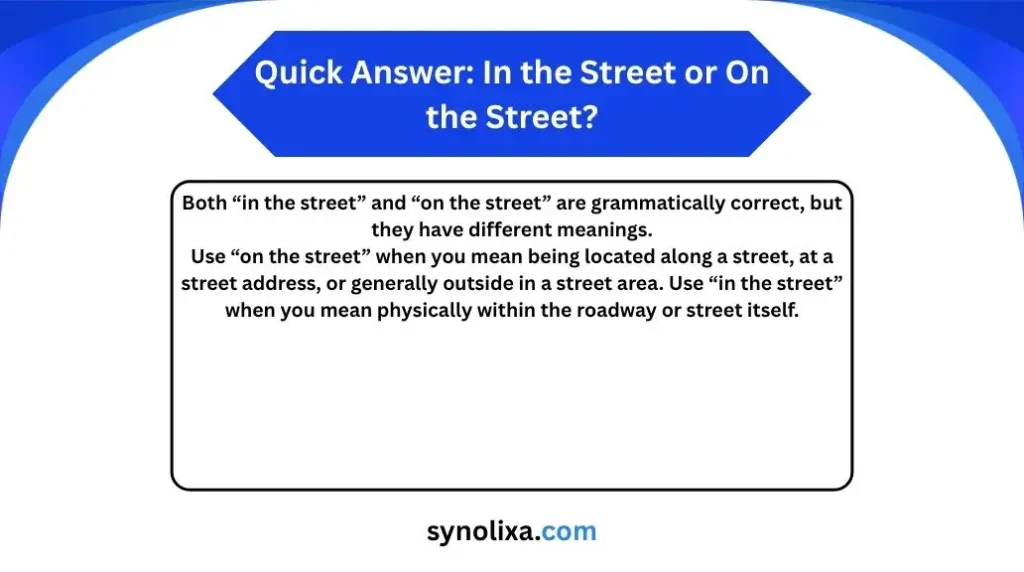
Both “in the street” and “on the street” are grammatically correct, but they have different meanings.
Use “on the street” when you mean being located along a street, at a street address, or generally outside in a street area. Use “in the street” when you mean physically within the roadway or street itself.
Examples:
- “The coffee shop is on the street.” ✅
- “I saw Sarah on the street.” ✅
- “The children were playing in the street.” ✅
- “There was a large object in the street.” ✅
A simple rule is:
On the street = along, beside, or associated with a street.
In the street = physically within the roadway or street area.
Understanding the Basics: In the Street or On the Street
The key difference between in the street and on the street is the preposition.
The prepositions in and on describe location, but they create different mental pictures.
In usually suggests that something is inside an area or surrounded by boundaries.
On often suggests a position on a surface, along a route, or at a particular location.
A street can be viewed in different ways. When you imagine the street as the roadway itself, something can be in the street. When you think of the street as a location, route, or address, something can be on the street.
Comparison Table
| Form | Type | Meaning | Example | Correct/Incorrect |
|---|---|---|---|---|
| in the street | Prepositional phrase | Physically within the street or roadway | “The ball is in the street.” | ✅ Correct |
| on the street | Prepositional phrase | Located along, beside, or associated with a street | “The store is on the street.” | ✅ Correct |
| in a street | Prepositional phrase | Physically within a street area | “A car stopped in a street.” | ✅ Correct, depending on context |
| on a street | Prepositional phrase | Located along a particular street | “She lives on a quiet street.” | ✅ Correct |
There is no universal rule that says one phrase is always correct and the other is always wrong.
Instead, the meaning determines the correct preposition.
Correct Meanings and Uses of “On the Street”
1. Use “On the Street” for a Location
One of the most common uses of on the street is to identify where something or someone is located.
For example:
“The bookstore is on Main Street.”
Here, the bookstore is located along Main Street.
The phrase does not mean that the bookstore is physically sitting in the roadway. Instead, the street acts as a location or address reference.
Other examples include:
- “My school is on Oak Street.”
- “There is a new restaurant on this street.”
- “Her office is on Market Street.”
- “We found a small café on the street.”
- “The hotel is on the main street.”
In these sentences, on connects the subject with the street as a location.
2. Use “On the Street” for Being Outside in a Street Area
On the street can also describe someone who is outside or moving around in a public street area.
For example:
“I met an old friend on the street.”
This usually means you encountered the person while you were outside, somewhere along the street.
Another example:
“I saw several people on the street.”
The phrase gives a general picture of people being outside in the street environment.
3. Use “On the Street” for Street Addresses
American English commonly uses on when describing an address located along a street.
For example:
“They live on Pine Street.”
This means their home is located along Pine Street.
You can also say:
- “The office is on Fifth Avenue.”
- “Our apartment is on Washington Street.”
- “The library is on Main Street.”
- “The restaurant is on Jefferson Avenue.”
This is an important everyday use of on the street.
Sentence Breakdown
Consider:
“The bakery is on Maple Street.”
- The bakery = subject
- is = linking verb
- on Maple Street = prepositional phrase showing location
The bakery is associated with the location called Maple Street. It does not mean the bakery is physically sitting on the pavement.
Correct Meanings and Uses of “In the Street”
1. Use “In the Street” for Physical Position
Use in the street when something is physically located within the street or roadway.
For example:
“A bicycle was left in the street.”
The bicycle is physically within the roadway.
Other examples include:
- “There is a large branch in the street.”
- “The ball rolled into the street.”
- “A dog ran into the street.”
- “The workers were standing in the street.”
- “A truck stopped in the street.”
Here, in emphasizes the physical area of the street.
2. Use “In the Street” for Activities Happening in the Roadway
Sometimes an activity takes place directly in the street.
For example:
“The children were playing in the street.”
This sentence creates a clear image: the children are physically within the roadway.
Similarly:
“People gathered in the street after the event.”
The gathering occurred in the physical street area.
This use is especially common when the writer wants to emphasize the street as a physical space.
Sentence Breakdown
Consider:
“The ball is in the street.”
- The ball = subject
- is = linking verb
- in the street = prepositional phrase
- in = indicates physical location inside the street area
The phrase tells us exactly where the ball is.
“In the Street” vs “On the Street” With People
This is where learners often become confused.
Consider these two sentences:
“I saw John on the street.”
and:
“John was standing in the street.”
Both can be correct.
However, they create different meanings.
“I Saw John on the Street”
This usually means you encountered John while you were out on the street.
The exact physical position may not matter.
He could have been:
- walking on the sidewalk,
- standing near a building,
- crossing the road,
- walking along the street.
The focus is the general street location.
“John Was Standing in the Street”
This is more specific.
It suggests that John was physically standing in the roadway or street area.
The phrase in the street gives a stronger sense of physical position.
Easy Comparison
Think of it this way:
On the street → general location
In the street → physical position within the roadway
This distinction will help you choose the right phrase in most everyday situations.
“In the Street” vs “On the Street” With Objects
Objects can also change the meaning.
Compare:
“There is a restaurant on the street.”
This suggests the restaurant is located along the street.
Now compare:
“There is a table in the street.”
This suggests the table is physically placed in the roadway.
The difference is clear:
- Restaurant on the street → location/address
- Table in the street → physical position
More examples:
| Sentence | Meaning |
|---|---|
| “There is a house on the street.” | The house is located along the street. |
| “There is a chair in the street.” | The chair is physically within the roadway. |
| “She lives on the street.” | The street is her general residential location. |
| “She is standing in the street.” | She is physically in the roadway. |
| “We met on the street.” | We encountered each other while outside. |
| “We found a wallet in the street.” | The wallet was physically in the roadway. |
Test Tip: How to Choose the Right Phrase
Here is a simple test you can use.
Ask yourself:
Am I talking about the street as a location or address?
If yes, on the street is often the better choice.
Ask:
Am I describing something physically inside the roadway?
If yes, in the street is usually the better choice.
Quick Test
“The apartment is ___ Green Street.”
You are giving an address or location.
✅ The apartment is on Green Street.
Now:
“The car is ___ the street.”
If you mean the car is physically within the roadway:
✅ The car is in the street.
This simple mental test works in many situations.
Case Study: A Real-Life Conversation
Imagine two coworkers talking about a morning commute.
Alex: “Did you see what happened on the street this morning?”
Jordan: “No. What happened?”
Alex: “There was a large box in the street.”
Jordan: “Really? Was it blocking traffic?”
Notice how both expressions appear naturally.
“What happened on the street?”
Here, on the street refers to the general street environment or location.
“There was a large box in the street.”
Here, in the street means the box was physically in the roadway.
This conversation shows why both phrases are useful.
They are not competing phrases where one must always replace the other. Instead, they communicate different relationships to the street.
Grammar Rules: Why Do We Use “In” and “On”?
Prepositions can be difficult because English does not always follow one simple formula.
In general, in is often used for enclosed spaces, areas, or locations viewed as spaces.
Examples:
- in the room
- in the city
- in the park
- in the water
- in the street
On is often used for surfaces, routes, lines, or locations associated with a particular path or street.
Examples:
- on the table
- on the wall
- on the road
- on Main Street
- on the street
However, these are patterns rather than rules that work perfectly in every sentence.
English prepositions depend heavily on meaning, context, and established usage.
Major English dictionaries, including Merriam-Webster, document the many meanings and uses of prepositions such as in and on. Their dictionary entries show that prepositions can express different relationships involving location, position, time, and other meanings.
For in the street and on the street, the important issue is not simply memorizing one preposition. It is understanding what the speaker wants to communicate.
Why “On Main Street” Is Standard
When giving a street location, American English normally uses on:
“The bank is on Main Street.”
You would not normally say:
“The bank is in Main Street.”
That sounds incorrect in standard American English.
The reason is that the street name identifies a location along a particular route.
Why “In the Street” Is Natural
When something occupies the physical roadway, in is natural:
“A tree fell in the street.”
The tree is physically within the roadway.
So, the meaning controls the choice.
Common Mistakes With “In the Street” and “On the Street”
Why do people make mistakes with these phrases?
There are several common reasons.
1. Fast Typing
When people type quickly, they may choose the first preposition that comes to mind.
For example:
“The store is in Main Street.”
A person may know the location but accidentally choose in instead of on.
2. Autocorrect
Autocorrect can sometimes change words or phrases without the writer noticing.
Because both in and on are common English words, spelling software may not recognize a context-based preposition error.
3. Lack of Knowledge
English learners may translate a similar expression from their first language.
That can lead to sentences that sound natural in one language but not in English.
4. Confusing General Location With Physical Position
This is perhaps the biggest issue.
People may not distinguish between:
- being on the street as a general location, and
- being in the street as a physical position.
Once this distinction becomes clear, the choice is much easier.
Similar Grammar Confusions
The confusion between in and on is part of a larger group of common English problems.
| Common Confusion | Correct Forms | Main Difference |
|---|---|---|
| it’s / its | “It’s cold.” / “The dog wagged its tail.” | Contraction vs. possessive |
| your / you’re | “Your book.” / “You’re ready.” | Possessive vs. contraction |
| there / their / they’re | “There it is.” / “Their car.” / “They’re here.” | Location, possession, contraction |
| to / too / two | “Go to school.” / “Too much.” / “Two books.” | Preposition, excess, number |
| in / on | “In the street.” / “On the street.” | Physical position vs. general location |
| affect / effect | “It affected me.” / “The effect was clear.” | Verb vs. noun in common uses |
The lesson is simple: small words can make a big difference in meaning.
Usage in Different Contexts
The choice between in the street and on the street can change slightly depending on the context.
Everyday Conversation
In casual conversation, on the street is very common.
Examples:
- “I saw him on the street.”
- “There are a lot of people on the street.”
- “Where is the new store? It is on this street.”
- “We met on the street yesterday.”
Use in the street when emphasizing physical position:
- “The ball is in the street.”
- “A dog ran into the street.”
- “There is something in the street.”
Professional Writing
Professional writing requires clear location descriptions.
For example:
“Our office is located on Jefferson Avenue.”
This is clear and standard.
If a report describes an obstruction, you might write:
“A fallen tree was found in the street.”
The distinction makes the report precise.
Creative Writing
Writers may use either expression to create a specific image.
For example:
“People filled the street as the parade began.”
Here, the phrase emphasizes the street as a public space.
Another sentence might say:
“A broken sign lay in the street.”
Now, the writer emphasizes the object’s physical position.
Creative writing often depends on these subtle differences.
Social Media and Texting
In texts and social media posts, people commonly use on the street for general location.
Examples:
- “Ran into my old friend on the street! 😊”
- “The city is beautiful on the street at night.”
- “Best little café on this street.”
For physical location:
- “Why is there a chair in the street? 😂”
- “Someone left a bike in the street.”
Although casual writing allows flexibility, the same meaning-based distinction still applies.
Why It Matters
Knowing when to use in the street or on the street may seem like a small grammar detail, but accurate preposition use improves communication.
1. Clarity
The correct preposition helps readers understand the exact location.
Compare:
“There is a car on the street.”
This could simply mean the car is traveling along the street.
Now:
“There is a car in the street.”
This can suggest that the car is positioned within the roadway, possibly in a place where it should not be.
The difference can matter.
2. Professionalism
Correct grammar makes workplace communication easier to understand.
A sentence such as:
“The delivery entrance is on Oak Street.”
sounds clear and professional.
3. Digital Communication
Emails, messages, social posts, and online content are often read quickly.
Small grammar choices can affect how easily people understand your message.
4. Better Writing Accuracy
Learning the difference between these phrases also teaches a larger lesson:
Good grammar is not only about rules; it is about communicating meaning clearly.
That is especially important when two expressions are both grammatically possible but have different meanings.
Special Exceptions and Edge Cases
There is no major grammatical exception that makes either phrase universally wrong.
However, context can affect which expression sounds most natural.
“On the Street” as an Idiom
The phrase on the street can have meanings beyond physical location.
For example:
“He learned it on the street.”
Here, the expression can suggest learning through real-world experience rather than formal education.
Another example is:
“The news is already on the street.”
This can refer idiomatically to information circulating publicly.
These uses should not be interpreted literally.
“In the Street” as a Fixed Context
In the street can also appear in expressions describing events or activities occurring within the street area.
For example:
“Music filled the street.”
or:
“People were dancing in the street.”
In these examples, the street is being treated as a physical public space.
The exact meaning still depends on context.
In the Street or On the Street: A Simple Memory Trick
If you struggle to remember the difference, use this image:
🛣️ Think “ON” for a Street Location
If you are talking about a street as an address, route, or general location, think:
ON the street
Examples:
- on Main Street
- on Oak Avenue
- on the street
- live on the street
- a store on the street
🚗 Think “IN” for the Roadway
If something is physically within the roadway, think:
IN the street
Examples:
- a ball in the street
- a car in the street
- a dog in the street
- people in the street
- debris in the street
This is not an absolute formula for every possible sentence, but it is an excellent practical guide.
Quick Recap Checklist
Use this checklist whenever you are unsure.
| Question | If Yes → Use |
|---|---|
| Am I giving a street address? | on the street |
| Am I naming a particular street? | on |
| Am I talking about a general street location? | on the street |
| Is something physically within the roadway? | in the street |
| Am I emphasizing something occupying the street? | in the street |
| Am I describing an obstruction in the roadway? | in the street |
Practice Example 1
The restaurant is ___ Main Street.
Answer:
✅ The restaurant is on Main Street.
Why? You are identifying the restaurant’s location.
Practice Example 2
There is a large pothole ___ the street.
Answer:
✅ There is a large pothole in the street.
Why? The pothole is physically part of or located within the roadway.
Practice Example 3
I saw my teacher ___ the street.
Answer:
✅ I saw my teacher on the street.
Why? The sentence describes a general encounter or location.
Frequently Asked Questions
1. Is “in the street” correct English?
Yes. “In the street” is grammatically correct when you mean that someone or something is physically within the street or roadway.
Example:
“The children were playing in the street.”
2. Is “on the street” correct English?
Yes. “On the street” is also grammatically correct and is extremely common in American English.
It can describe a general location, a street address, or something located along a street.
Example:
“The store is on the street.”
3. Should I say “I live in Main Street” or “I live on Main Street”?
In standard American English, say:
“I live on Main Street.”
When referring to a street as an address or location, on is normally used.
4. What is the difference between “in the street” and “on the street”?
“In the street” usually emphasizes physical position within the roadway. “On the street” commonly describes a general location, street address, or position along a street.
For example:
- “The ball is in the street.”
- “The store is on the street.”
5. Is “on the street” more common in American English?
Yes, on the street is very common in American English, especially when referring to street locations and addresses.
For example:
“Our office is on Washington Street.”
However, in the street is also standard when the intended meaning involves physical position within the roadway.
6. Can “in the street” and “on the street” be interchangeable?
Sometimes they may describe roughly the same general situation, especially in casual conversation, but they can create different meanings.
Compare:
“I saw him on the street.”
with:
“He was standing in the street.”
The first describes a general encounter. The second emphasizes his physical position within the roadway.
Conclusion
So, when deciding between in the street or on the street, remember that both expressions are correct, but they are used for different meanings.
Use “on the street” when you are talking about a street as a general location, route, address, or place where someone is encountered. For example, “The bookstore is on Main Street” and “I saw Anna on the street” are natural American English sentences.
Use “in the street” when you want to emphasize that someone or something is physically within the street or roadway. For example, “The ball is in the street” clearly describes physical position.
The easiest memory trick is:
On the street = location or along the street.
In the street = physically within the roadway.
Once you focus on the meaning rather than trying to memorize a single rule, the choice becomes much easier. 📝
When in doubt, ask yourself: Am I describing a street as a location, or am I describing something physically inside the street? The answer will usually tell you which preposition to use.

Hi, I am Ethan Parker. I work at Synolixa as a grammar and writing specialist, helping readers understand English grammar and improve their writing skills.

[…] both correct. The right choice depends on the meaning you want to express. Imitated vs Intimated | In the Street or On the Street | He Is Risen or He Has […]