Have you ever written a sentence like “I paid the bill” and then wondered whether “payed” might be correct instead? You are not alone. The words paid vs payed cause confusion because both look like possible past-tense forms of the verb pay. In most everyday situations, however, only one of them is the standard choice.
The correct word in ordinary English is paid. It is the past tense and past participle of pay when you mean giving money for something, settling a debt, or giving someone money they are owed. For example, “I paid for dinner” and “She has paid the invoice” are both correct.
Payed is not simply an incorrect spelling of paid. It has a limited use in specialized nautical contexts, especially when referring to letting out or loosening rope, cable, or chain. Because this meaning is uncommon in everyday English, most writers should use paid.
Understanding the difference between paid and payed is easy once you know what each word means. This guide explains the rule, gives practical examples, covers the rare exception, and shows you how to choose the right form every time. 😊 Has Ran or Has Run | Affirm vs Confirm | Acception vs Exception
Quick Answer: Paid vs Payed
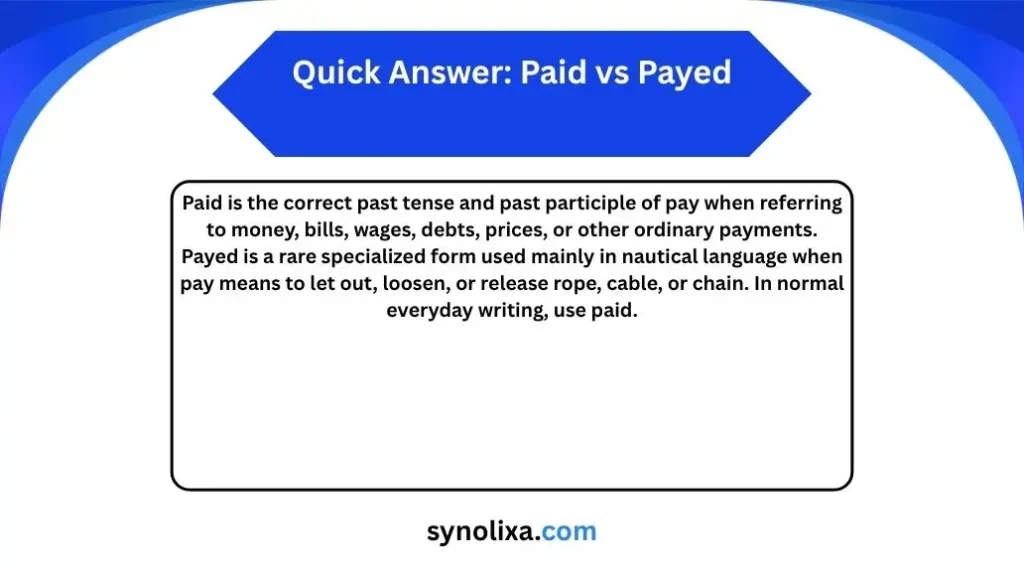
Paid is the correct past tense and past participle of pay when referring to money, bills, wages, debts, prices, or other ordinary payments.
Payed is a rare specialized form used mainly in nautical language when pay means to let out, loosen, or release rope, cable, or chain. In normal everyday writing, use paid.
Quick rule:
💡 If money is involved, use paid.
- I paid the bill. ✅
- She paid $50 for the book. ✅
- We have paid the fee. ✅
- I payed the bill. ❌
Understanding the Basics: Paid vs Payed
The confusion comes from the fact that pay is an irregular verb.
With many regular verbs, we form the past tense by adding -ed:
- walk → walked
- talk → talked
- work → worked
- clean → cleaned
It may seem logical to assume:
pay → payed
But English does not always follow a simple spelling pattern. The ordinary past tense of pay is paid, not payed.
Comparison Table
| Form | Type | Meaning | Example | Correct/Incorrect |
|---|---|---|---|---|
| pay | Base verb | Give money or settle an obligation | I need to pay the bill. | ✅ Correct |
| paid | Past tense | Gave money or settled an obligation | I paid the bill yesterday. | ✅ Correct |
| paid | Past participle | Used with have, has, or had | She has paid the bill. | ✅ Correct |
| paying | Present participle | Giving money or settling an obligation | He is paying the bill. | ✅ Correct |
| payed | Rare specialized form | Let out or loosened rope/cable | The crew payed out the line. | ✅ Specialized use |
| payed | Ordinary past tense for money | Supposed to mean “gave money” | I payed the bill. | ❌ Incorrect |
The key distinction is meaning.
Paid is used for the normal financial meaning of pay.
Payed has a much narrower technical meaning.
The Three Main Forms to Remember
Think of the ordinary verb like this:
Present: pay
Past: paid
Past participle: paid
Examples:
- I pay my bills every month.
- I paid my bill yesterday.
- I have paid my bill already.
Notice that paid works both as the simple past and as the past participle.
Correct Meanings and Uses of Paid
Paid Means Gave Money
The most common meaning of paid is that someone gave money for something.
Examples:
- I paid for my lunch.
- She paid the cashier.
- We paid for the tickets.
- They paid the full price.
- He paid $20 for the book.
In each example, money is being transferred in exchange for something.
Paid Means Settled a Bill
Paid can also describe settling a bill or financial obligation.
Examples:
- I paid the electricity bill.
- She paid her credit card bill.
- We paid the restaurant bill.
- He paid the outstanding balance.
- They paid the invoice on time.
Here, paid shows that an amount owed has been settled.
Paid Means Received Wages or Salary
We also use paid when someone receives money for work.
Examples:
- I was paid yesterday.
- She gets paid every Friday.
- The workers were paid on time.
- He was paid for his work.
- They have not been paid yet.
This is another ordinary use of paid.
Paid Means Gave Money to Someone
The verb can describe giving money directly to another person.
For example:
The company paid the employee.
The basic structure is:
Subject + paid + person
You can also add what the payment was for:
The company paid the employee for the extra hours.
Paid Means Suffered a Cost or Price
English also uses pay figuratively.
Examples include:
- He paid a high price for his mistake.
- She paid the consequences of her decision.
- They paid dearly for the error.
These sentences do not necessarily involve literal money. Even so, the correct form is paid, not payed.
Test Tip
When you are unsure about paid vs payed, ask:
Am I talking about ordinary payment, money, wages, a bill, a price, or a debt?
If the answer is yes, choose paid.
That simple test will solve most cases.
When Is Payed Correct?
This is where the topic becomes slightly more interesting.
Payed does exist as a word, but it is uncommon. It is associated mainly with specialized nautical language.
In this context, pay can mean to let out or loosen something such as a rope, cable, or chain. The past form can therefore be payed.
For example:
The sailors payed out the rope.
The meaning is not “gave money.” It means that the rope was allowed to run out or was released.
Another example might occur in technical descriptions involving a vessel and a line:
The crew payed out more cable.
Here, payed has a specialized meaning connected with handling a line or cable.
Why Does This Exception Exist?
English has many words with specialized forms that are uncommon in everyday speech. The important thing is not to treat payed as an alternative spelling of paid.
It is better to think of them as serving different meanings:
- paid → ordinary financial or figurative uses
- payed → specialized nautical use
That distinction makes the rule much easier to remember.
Paid vs Payed in Everyday Sentences
Let’s compare them directly.
Example 1
❌ I payed the bill yesterday.
✅ I paid the bill yesterday.
Why?
The sentence is about settling a bill. Therefore, paid is correct.
Example 2
❌ She has payed for the tickets.
✅ She has paid for the tickets.
Why?
The sentence uses the present perfect construction:
has + past participle
The past participle of pay in its ordinary sense is paid.
Example 3
❌ We payed the employee on Friday.
✅ We paid the employee on Friday.
Why?
The sentence describes giving an employee wages. Use paid.
Example 4
Specialized use:
The crew payed out the line.
Here, the word refers to releasing or letting out a line. This is a technical use, not an ordinary payment.
Grammar Rules Behind Paid vs Payed
The standard everyday verb pay is irregular.
Its ordinary forms are:
| Tense/Form | Correct Form | Example |
|---|---|---|
| Base form | pay | I pay the bill. |
| Simple past | paid | I paid the bill. |
| Past participle | paid | I have paid the bill. |
| Present participle | paying | I am paying the bill. |
The important point is that paid is not merely a spelling preference. It is the established past-tense and past-participle form of pay for its ordinary meaning.
Merriam-Webster’s dictionary resources distinguish established word forms and usage according to meaning and context. When a specialized word form exists, context matters.
So, if your sentence is about paying money, use paid.
Why “Payed” Looks Logical
The spelling payed seems reasonable because English frequently forms past-tense verbs with -ed.
For example:
- play → played
- stay → stayed
- enjoy → enjoyed
Because pay ends in y, some writers naturally assume:
pay + ed = payed
But pay has an established irregular past form:
pay → paid
This is similar to other common irregular verbs:
- say → said
- make → made
- go → went
- buy → bought
- take → took
English contains many historical forms that must simply be learned.
Case Study: A Workplace Email
Imagine an employee needs to tell a manager that an invoice has been settled.
Incorrect
Hi,
I just wanted to let you know that I have payed the invoice.
Thanks!
The writer probably knows that the past participle is needed after have, but chooses payed because it appears to follow the normal -ed pattern.
Correct
Hi,
I just wanted to let you know that I have paid the invoice.
Thanks!
The difference is only one letter, but paid is the standard form.
In professional writing, using the established form makes the message look polished and accurate.
Another Workplace Example
Suppose a manager writes:
The company has paid all outstanding invoices.
This is correct because the company has settled financial obligations.
You would not normally write:
The company has payed all outstanding invoices.
That spelling is incorrect for this meaning.
Common Mistakes With Paid vs Payed
People make this mistake for several understandable reasons.
Fast Typing
When people type quickly, they may write what looks natural instead of checking the correct irregular form.
For example:
I payed the fee yesterday.
The writer may understand the meaning perfectly but make a spelling error because payed resembles the regular past-tense pattern.
Autocorrect
Autocorrect can sometimes create confusion, especially when a specialized or uncommon word appears in a sentence.
Writers should not rely completely on automatic correction. Always check the meaning and grammar of the sentence.
Lack of Knowledge
Some learners simply have not encountered the irregular form paid enough times.
The good news is that this is easy to fix.
Remember:
Pay today, paid yesterday.
Assuming Every Verb Uses -ed
This is one of the biggest reasons behind the error.
English has many irregular verbs:
- have → had
- eat → ate
- see → saw
- buy → bought
- pay → paid
Learning common irregular verbs helps prevent mistakes like payed.
Similar Grammar Confusions
The paid vs payed problem belongs to a larger group of commonly confused English forms.
| Confusion | Correct Choice | Basic Rule |
|---|---|---|
| paid / payed | paid | Use paid for ordinary payment. |
| its / it’s | its / it’s | Its shows possession; it’s means it is or it has. |
| your / you’re | your / you’re | Your shows possession; you’re means you are. |
| their / there / they’re | Depends on meaning | Possession, place, or they are. |
| to / too / two | Depends on meaning | Direction, excessive/also, or the number 2. |
| then / than | Depends on meaning | Time/order versus comparison. |
| affect / effect | Depends on usage | Usually a verb versus a noun, with exceptions. |
| lose / loose | Depends on meaning | Not win/misplace versus not tight. |
These pairs and groups are confusing because the words look or sound similar, but their functions differ.
The best solution is to focus on meaning, not just spelling.
Paid vs Payed in Different Contexts
Everyday Conversation
In everyday speech, paid is overwhelmingly the form you need.
Examples:
- “I already paid.”
- “Who paid for lunch?”
- “She paid me back.”
- “Have you paid the bill?”
You would not normally use payed in these sentences.
Professional Writing
Professional writing requires the standard form.
Examples:
The customer paid the invoice.
We have paid the deposit.
The employee was paid for the additional hours.
Using payed for ordinary payment can make formal writing look careless.
Creative Writing
Creative writing follows the same grammar rules, but specialized vocabulary can appear when the story requires it.
For example, a historical or nautical story could legitimately use payed when describing the release of a rope or line.
But if a character buys something, the correct word remains paid.
She paid for the supplies.
Not:
She payed for the supplies.
Social Media and Texting
Informal communication often contains spelling mistakes, abbreviations, and typos. Still, paid remains the correct standard form.
Examples:
- “Just paid my bill.”
- “I finally paid for the tickets!”
- “They paid me back today.”
Even in a short social media post, paid is the best choice.
Why Paid vs Payed Matters
You might wonder whether this small spelling difference is really important.
It is.
Clarity in Communication
Correct word choice makes your meaning clear.
If you write:
I paid the bill.
Readers immediately understand that you settled a financial obligation.
The sentence is standard and natural.
Professionalism
Small grammar and spelling choices can affect how polished your writing appears.
In a school assignment, business email, application, report, or formal message, using paid correctly shows attention to detail.
Accuracy in Digital Communication
Digital communication is fast. People send messages in seconds, often without proofreading.
That makes simple grammar rules even more useful.
A quick mental check can prevent common mistakes.
A Short Reminder
“When the meaning is money, paid is the form to choose.”
That is the simplest way to remember the rule.
Special Exception: When Payed Is Correct
There is one important exception worth knowing.
Payed can be correct when pay has a specialized nautical meaning involving the letting out, loosening, or releasing of a rope, cable, or similar line.
For example:
The sailors payed out the rope.
Here, payed does not mean that anyone gave money.
This distinction is important because saying “payed is always wrong” would be too broad.
A better rule is:
Use paid for ordinary financial and figurative meanings. Use payed only when the specialized meaning calls for it.
Is Payed Common?
No. In ordinary American English, paid is the form you will see and use for normal payment-related sentences.
Most people can go through years of everyday writing without ever needing the specialized form payed.
Therefore, if you are writing a normal sentence about money, do not choose payed simply because you remember that it can exist.
Paid vs Payed: A Simple Memory Trick
Here is an easy trick:
💰 Money = PAID
If money changes hands, think:
I PAID.
Examples:
- I paid the bill.
- She paid the fee.
- We paid the driver.
- They paid the rent.
⚓ Rope or Cable = PAYED
If you are dealing with the specialized nautical meaning of letting out a line, payed may be appropriate.
Think:
PAYED = specialized nautical use
This is not a rule you will need often, but it helps explain why the word appears in dictionaries and specialized texts.
Quick Recap Checklist
Use this checklist whenever you are unsure about paid vs payed.
| Question | If Yes → Use |
|---|---|
| Did someone give money for something? | paid |
| Was a bill settled? | paid |
| Was an invoice settled? | paid |
| Did someone receive wages? | paid |
| Was a debt settled? | paid |
| Is the sentence about a price or cost? | paid |
| Is pay being used in a specialized nautical sense involving a line or cable? | payed |
| Are you simply talking about ordinary money? | paid |
Practice Example 1
Yesterday, I ___ for my new shoes.
Answer: paid
Why? The sentence describes an ordinary purchase.
Practice Example 2
She has ___ the registration fee.
Answer: paid
Why? The sentence uses has + past participle, and the ordinary past participle of pay is paid.
Practice Example 3
The crew ___ out the line.
Answer: payed, if the sentence uses the specialized nautical meaning of letting out the line.
Paid vs Payed: Quick Examples
Here are some fast examples to make the distinction stick.
Correct: Paid
- I paid the bill.
- She paid for dinner.
- He paid me yesterday.
- We paid the full amount.
- They have paid the invoice.
- The company paid its workers.
- I paid a high price for the mistake.
- Have you paid the fee?
Incorrect for Ordinary Payment: Payed
- I payed the bill. ❌
- She payed for dinner. ❌
- He payed me yesterday. ❌
- We payed the full amount. ❌
- They have payed the invoice. ❌
Specialized Use: Payed
- The crew payed out the line. ✅
- The sailors payed out additional cable. ✅
The meaning determines the correct word.
FAQs About Paid vs Payed
1. Is “paid” or “payed” correct?
Paid is correct for the ordinary past tense and past participle of pay. Use it when talking about money, bills, wages, prices, fees, debts, or similar payments.
2. Is “I payed the bill” correct?
No. The standard sentence is:
I paid the bill.
Payed is not the ordinary past-tense form of pay when referring to paying money.
3. Does the word “payed” exist?
Yes. Payed has a specialized use, especially in nautical language, where pay can mean to let out or release a rope, cable, or line. It is not the normal form for financial payment.
4. Should I say “I have paid” or “I have payed”?
Say:
I have paid.
After have, has, or had, the ordinary past participle of pay is paid.
Examples:
- I have paid.
- She has paid.
- They had paid.
5. Why do people write “payed”?
People may write payed because they apply the common -ed pattern used with regular verbs. Fast typing, autocorrect, and unfamiliarity with irregular verbs can also contribute to the mistake.
6. How can I remember paid vs payed?
Use this simple rule:
Money = paid.
If the sentence is about paying a bill, buying something, receiving wages, settling a debt, or giving money, choose paid.
If the sentence describes the specialized nautical action of letting out a rope, cable, or line, payed may be correct.
Conclusion
The difference between paid vs payed is simple once you focus on meaning. For almost every ordinary situation involving money, the correct word is paid. It is the standard past tense and past participle of pay when you mean giving money, settling a bill, receiving wages, paying a price, or meeting a financial obligation.
For example, write “I paid the bill,” “She paid for the tickets,” and “They have paid the invoice.” Do not use payed in these sentences.
Payed does have a legitimate but rare specialized use, particularly in nautical language involving the letting out or releasing of a rope, cable, or line. This is why you may occasionally encounter the word in technical writing.
The easiest memory trick is:
💰 Money = PAID.
When you remember that one rule, you will get the correct form right in almost every everyday sentence. Pay today, paid yesterday, and choose “paid” whenever money is involved.

Hi, I am Ava Mitchell. I work at Synolixa as an English content writer, creating simple and useful resources about synonyms, vocabulary, and English usage.
[…] everyday and professional writing, and gives you practical examples that are easy to remember. 😊 Paid vs Payed | Has Ran or Has Run | Affirm vs […]